Choose a bathroom remodeling contractor who can explain the hidden work, coordinate the trades, and put the complete scope in writing. Finished photographs help you judge style, but they do not show how a shower was waterproofed, how a plumbing issue was handled, or whether the contractor returned to correct a problem.
Your goal is to establish who will be responsible for the whole result. A persuasive salesperson and an attractive tile sample are only the beginning of that evaluation.
Give candidates the same bathroom brief
Describe the problems you want solved, what you intend to retain, whether fixture positions will move, and the funds available. Include photographs and a rough measured sketch. Explain whether this is your only bathroom and what daily access the household needs.
Ask whether the company provides design, construction, or both, and who verifies dimensions before materials are ordered. If one candidate prices a complete reconstruction and another assumes the existing shower stays, their totals cannot tell you who offers better value.
Ask them to explain the shower before discussing tile colors
A useful question is: “What water-management assembly are you proposing, and who is responsible for checking it before it is covered?” The answer should address the base and drain, walls, corners, penetrations, and transitions as a compatible system.
You do not need to become an installer. You do need a clear explanation of the intended products, who follows their instructions, and which inspections or tests apply. A vague promise to use waterproof materials does not describe the complete assembly.
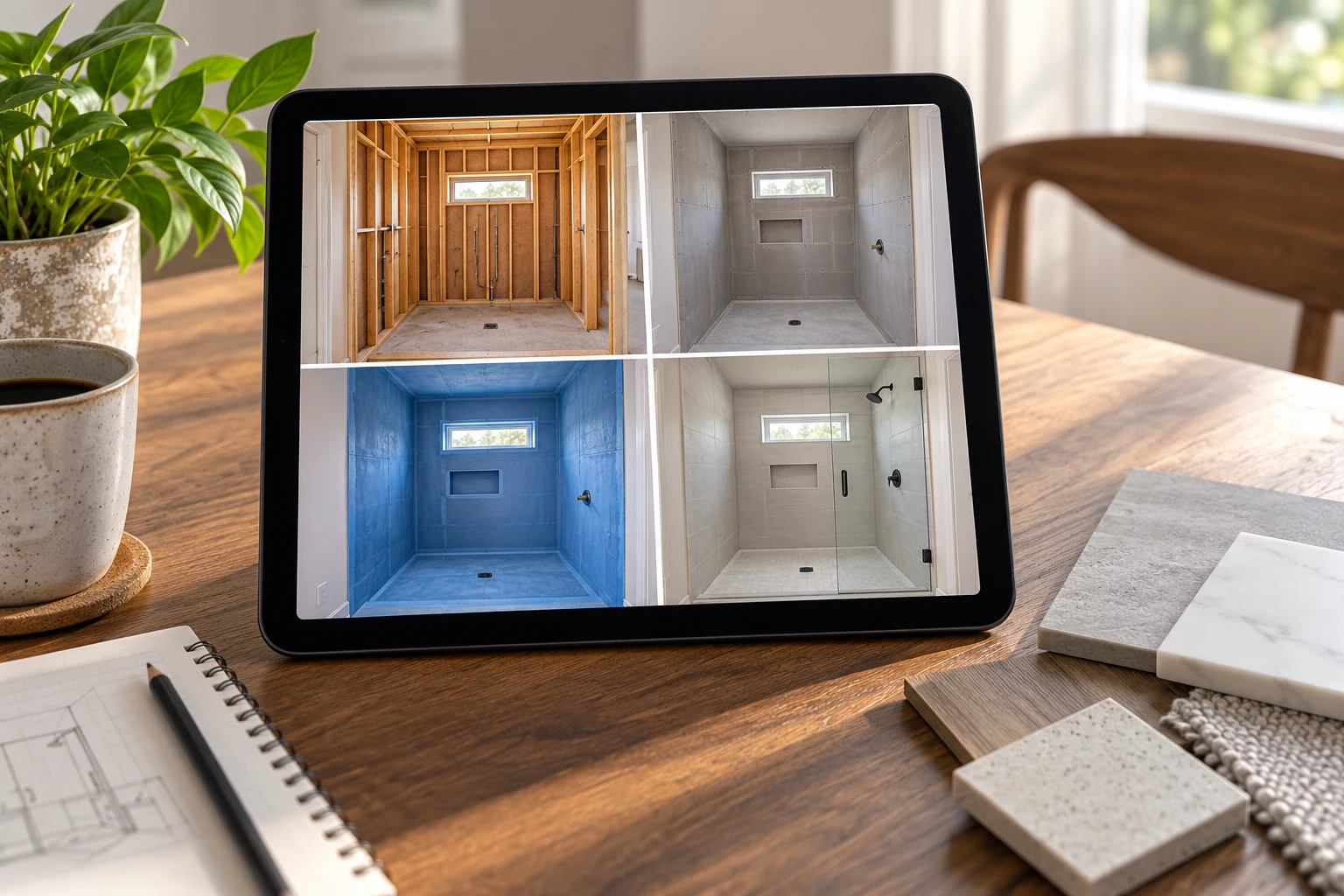
Our tile shower installation cost guide distinguishes a tile-setting price from retiling and building a new shower. Use those scope differences when a quote mentions tile but leaves preparation or waterproofing unclear.
Also ask what happens if demolition exposes damaged framing or unsuitable plumbing. A responsible answer names the decision process: document the condition, identify the correction, price it, and obtain approval before proceeding beyond the agreed scope.
Verify the business, then test its relevant experience
Confirm the legal business name and the licensing or registration applicable in your location. Verify records through the relevant official authority and ask for current proof of insurance. Requirements vary, so do not treat an association badge or a website claim as the same thing as a verified license.
The FTC recommends checking licensing and insurance and obtaining multiple written estimates. Its advice also cautions against automatically choosing the lowest bidder. Use an unexplained price difference as a reason to investigate scope and assumptions.
Request references for projects resembling yours. A beautiful new-build suite says less about renovating a compact occupied bathroom with an existing drain and limited access. Ask recent clients who supervised the work, how often the bathroom was unavailable, how changes were priced, and whether incomplete items were resolved.
Look at consistency across the answers. One delayed delivery is different from a repeated pattern of unanswered calls or unfinished work. Read reviews critically and ask the contractor to explain material concerns without treating every online complaint as proven fact.
Compare what each proposal commits to deliver
| Proposal detail | Useful clarification |
|---|---|
| Demolition and preparation | What is removed, protected, repaired, and disposed of? |
| Trade work | Who handles plumbing, electrical, ventilation, permits, and inspections? |
| Materials and allowances | Which products are selected, and what is still provisional? |
| Site management | Who is your contact, and who supervises subcontractors? |
| Completion and corrections | How are testing, unfinished items, documentation, and warranty requests handled? |

A fixed price can be perfectly useful without exposing every internal labor rate. What matters is whether the promised result, allowances, exclusions, and change procedure are clear. Request written clarification rather than relying on a conversation the contract does not reflect.
Set the working relationship before the room is dismantled
Agree on communication, working hours, access, dust protection, delivery storage, and notice before water or power interruptions. Ask for a realistic sequence that accounts for product availability and inspections, along with a plan for an unexpected delay.
Review the payment schedule against the written scope and applicable local rules. Do not assume that one nationwide deposit percentage applies. Identify what counts as completion, how remaining items are recorded, and what product and workmanship warranties actually cover.
Choose the candidate whose answers remain clear when the discussion moves from finishes to responsibilities. The best proposal is one you can understand well enough to recognize both progress and an unresolved issue.

Ethan Miller
Ethan Miller writes about home improvement, interior design, cleaning, and everyday living at Home & Living Daily. He shares practical tips and simple ideas to help readers create more comfortable and functional homes.