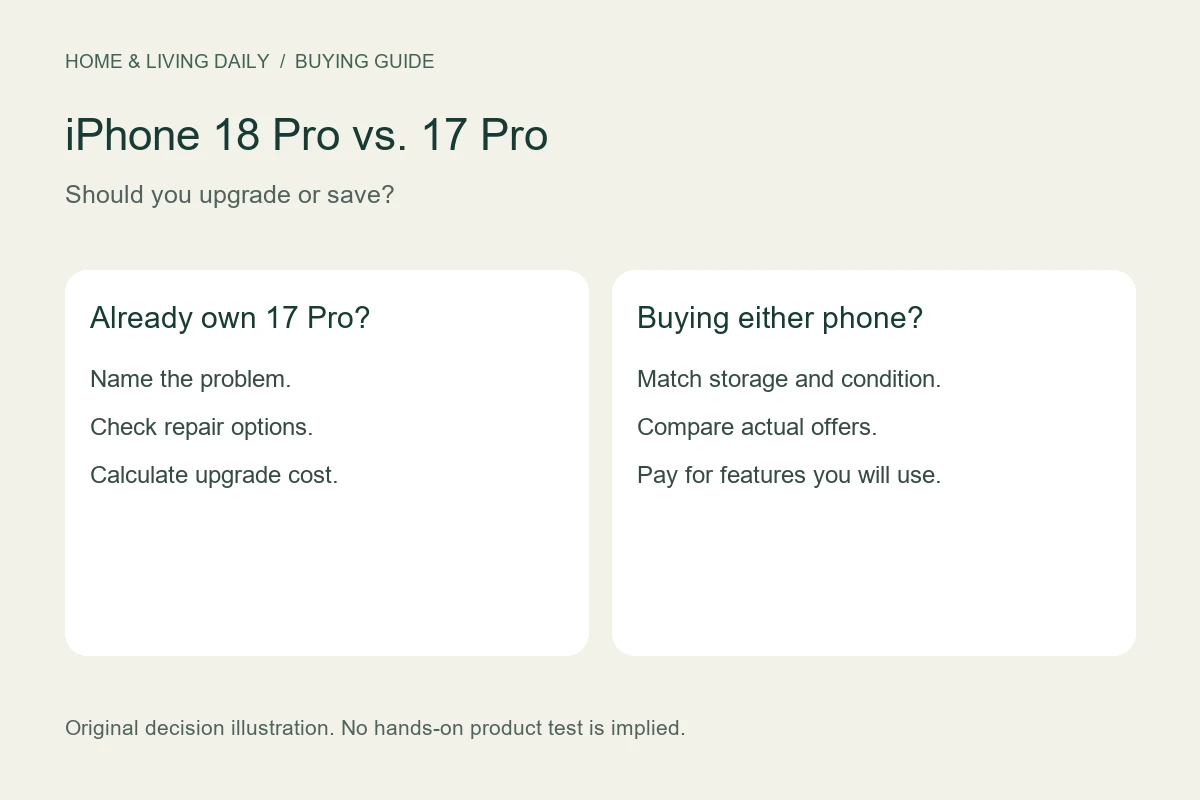
If your iPhone 17 Pro still meets your needs, keep it unless an iPhone 18 Pro feature solves a specific problem. If you are buying either phone today, compare the 18 Pro’s added capability with the actual saving on a comparable 17 Pro—not with the older phone’s original launch price.
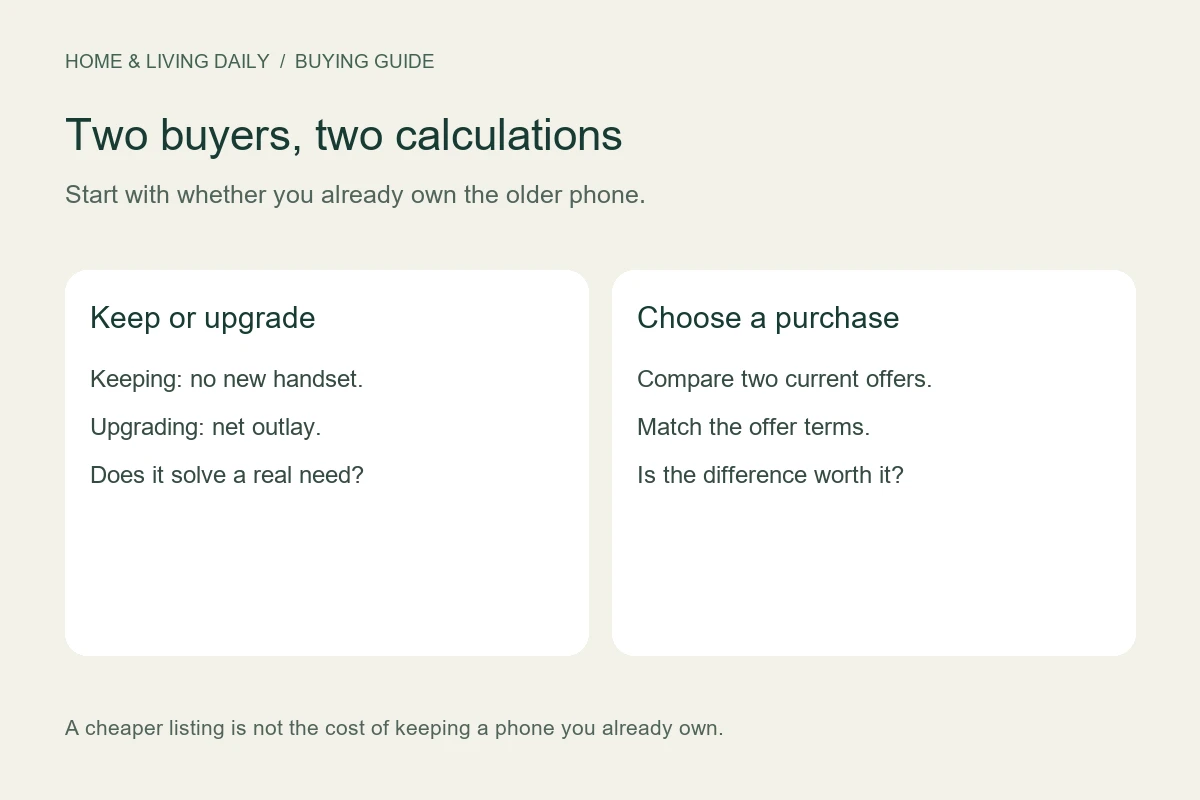
The important split is between replacing a phone you already own and choosing between two purchases. A better specification can justify a premium for one buyer without making an annual upgrade worthwhile for another.
Checked October 28, 2026. This is a source-based buying guide, not a hands-on camera, performance or battery test. It compares the compact Pro models; Pro Max figures are excluded.
The quick decision: keep, upgrade, or buy the discounted model?
| Your situation | Start here | Check before deciding |
|---|---|---|
| You own a working 17 Pro | Keep it | Name a limitation the 18 Pro would actually remove. |
| You want more deliberate camera control | Investigate the 18 Pro | Will you use the added controls in your normal photography? |
| You need a replacement and both are affordable | Compare matched offers | Same storage, condition, seller protection and service terms. |
| A used 17 Pro is much cheaper | Inspect the individual phone | Battery, repairs, activation status, return rights and total cost. |
iPhone 18 Pro vs. 17 Pro: the differences that matter
Apple’s official model comparison and 18 Pro specifications provide the reference points below. Use the model names carefully when reading a comparison page that also offers Max variants.
| Feature | iPhone 17 Pro | iPhone 18 Pro |
|---|---|---|
| Display size | 6.3 inches | 6.3 inches |
| Chip | A19 Pro | A20 Pro |
| Main camera aperture | Fixed | Variable |
| Weight | 206 grams | 211 grams |
| Apple-rated video playback | Up to 33 hours | Up to 36 hours |
The screen-size match means moving from one to the other is not a way to get a substantially larger display. A chip upgrade alone also does not establish how much faster your particular app will feel. For routine messaging, browsing and calls, identify a current limitation before paying to remove it.
Camera: choose for the photographs you want to make
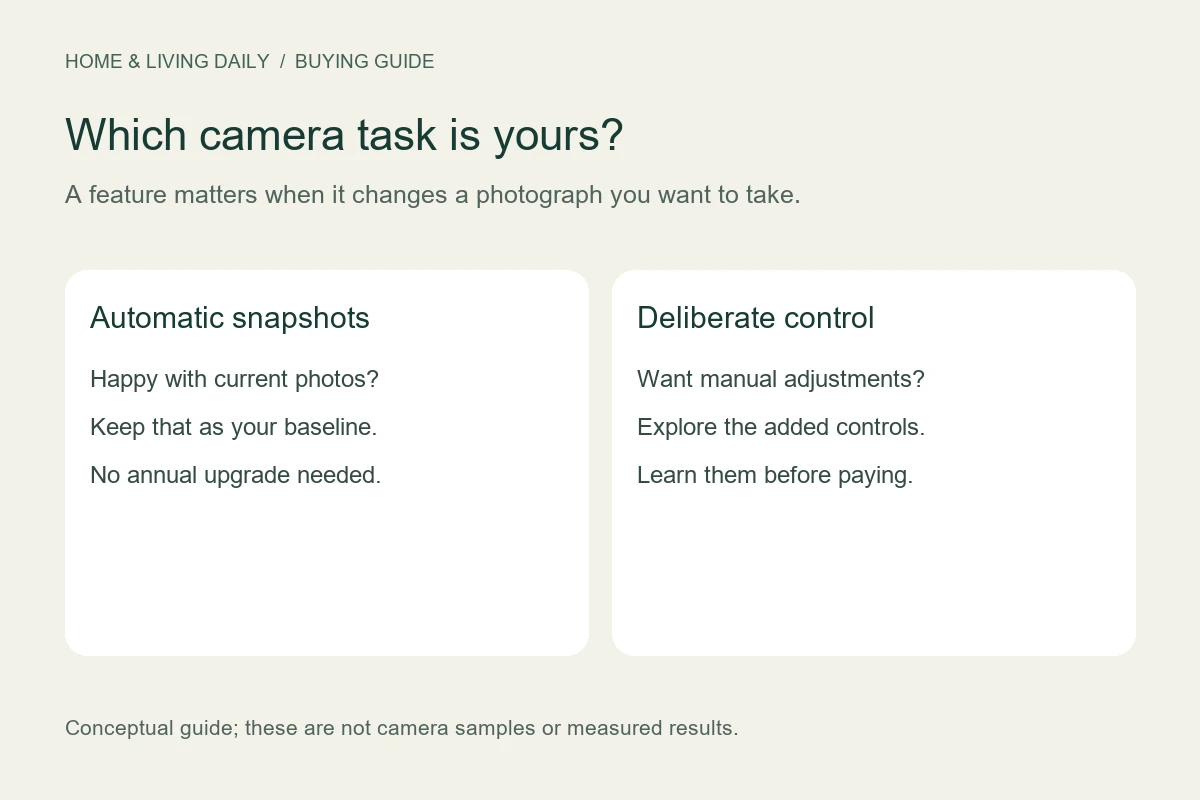
The 18 Pro’s variable main-camera aperture and manual Pro controls are a reason to investigate it if you deliberately adjust exposure and depth of field. They are less compelling if you mostly want uncomplicated snapshots and are already satisfied with your 17 Pro.
Consider an indoor family photograph. The useful question is whether you want more control over the shot and are willing to learn it, rather than whether the newer model has a longer feature list. Subjects moving, available light and your settings still affect the result. This guide does not provide matched sample photographs or prove a measured low-light improvement.
If you are choosing across the wider range, our guide to which iPhone has the best camera covers that broader decision. Here, the question is whether the added capability matters enough to choose between these two Pro models.
Battery and charging: separate a rating from your own routine
The playback figures in the table are Apple’s controlled-test ratings. They are useful reference points, not a promise of those hours while navigating, taking pictures, gaming or using mobile data. They also do not describe the condition of a particular used 17 Pro.
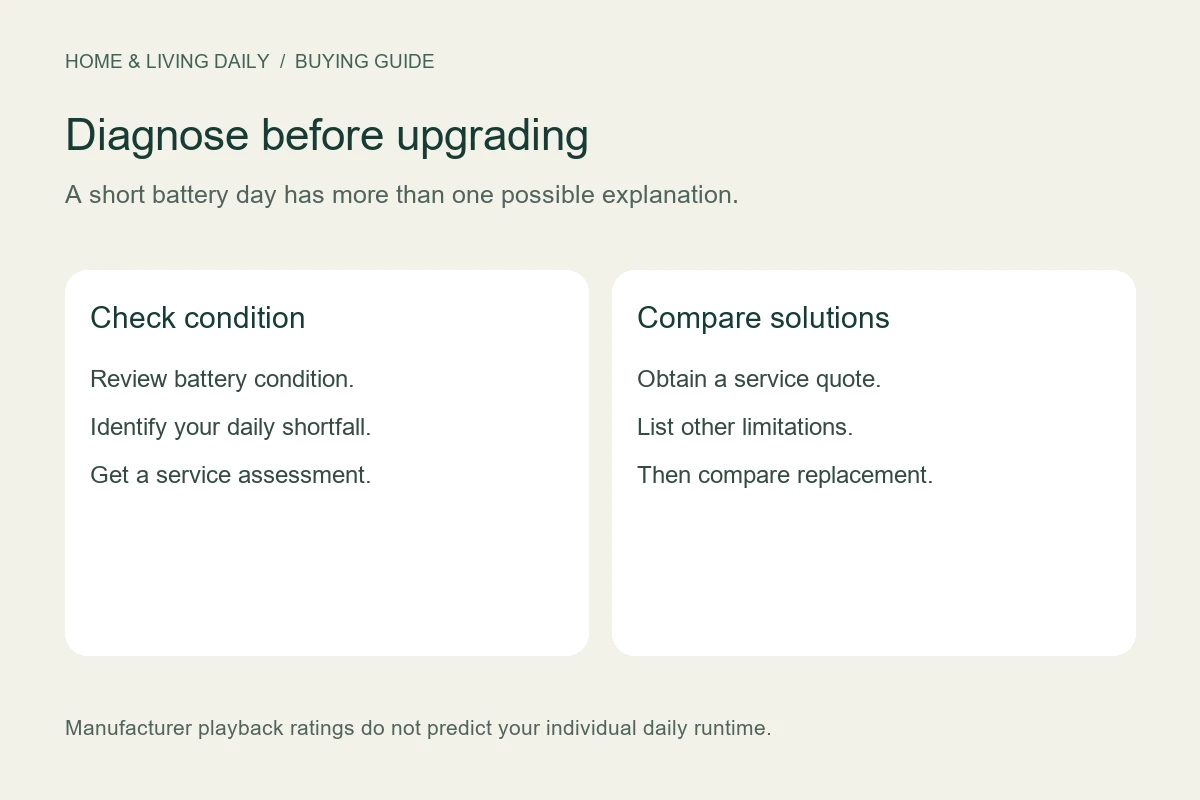
If your existing phone no longer lasts through the day, check its battery condition and obtain a service quote before deciding that a newer generation is necessary. Replacing a worn battery may address the complaint while leaving money for other priorities. It will not fix unrelated limitations such as insufficient storage.
Check charging requirements separately against the manufacturer’s documentation for the exact model and charger. Do not assume an old adapter supports a newly advertised maximum, and do not treat a peak charging claim as a full-charge time.
Price: compare what you will pay today
A launch-price gap does not tell you the difference between two current offers. The older phone may be discounted, refurbished or used; a newer-phone offer may require a trade-in or a more expensive service plan. Our iPhone 18 price guide separates model and storage pricing. For this decision, obtain current quotes for the same capacity and comparable condition.
Use this worksheet: comparable cost = handset payment + required fees + any extra service cost over your comparison period − credits you qualify for. Record when credits arrive and what happens if you leave the plan. Treat uncertain resale proceeds as uncertain, rather than deducting a hoped-for amount.
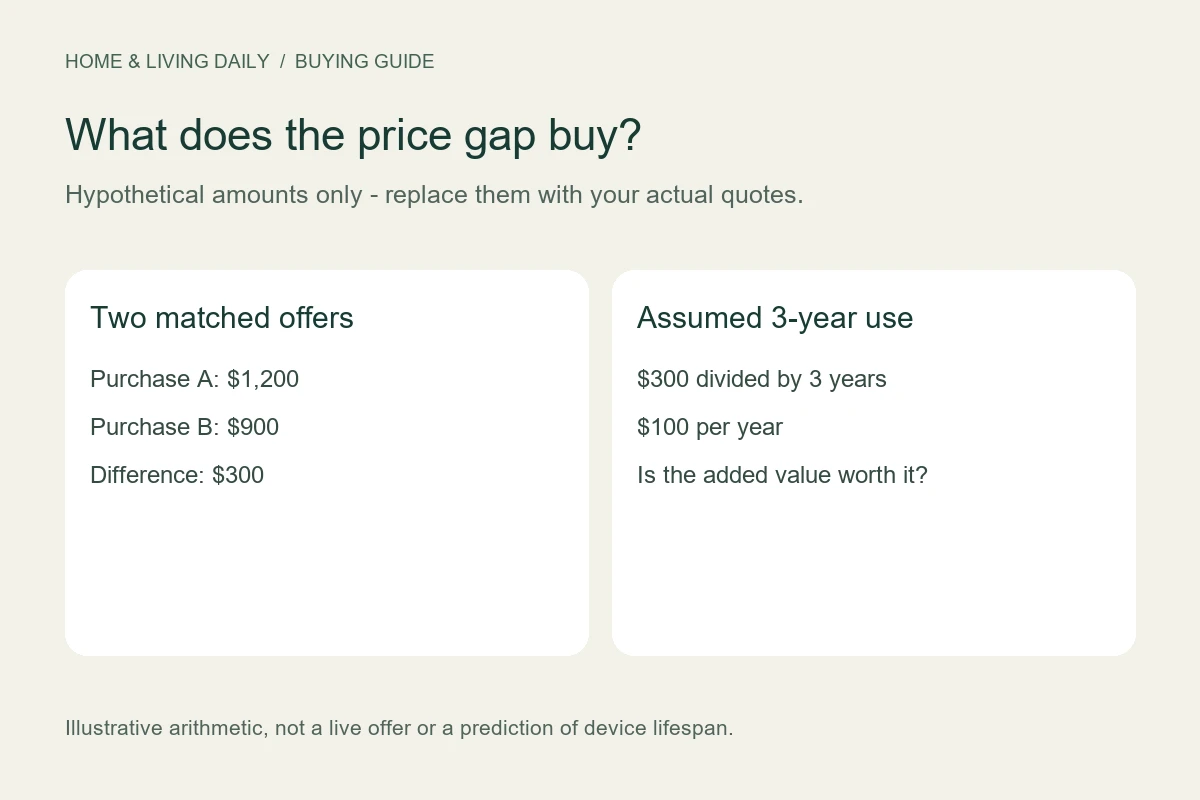
Hypothetical example, not a live offer: suppose two otherwise comparable purchases cost $1,200 and $900 after applicable handset credits. The gap is $300. Spread over an assumed three years of ownership, that is $100 a year. This arithmetic does not predict either phone’s remaining life; it helps you decide whether the feature difference is worth that amount to you.
For an existing 17 Pro owner, use a different calculation: the new purchase plus associated costs, minus a confirmed trade-in or sale value. Compare that outlay with keeping or servicing your current phone. The cheaper 17 Pro listing in the new-buyer example is irrelevant if you already own one.
Before buying a discounted iPhone 17 Pro
Confirm storage, unlocked or carrier status, condition, seller identity and return terms. For a used phone, check battery condition and repair history, verify that activation can be completed, and test the functions you depend on. A low price is less attractive when the device cannot be returned or immediately needs service.
Match capacity before declaring either offer better value. Our guide to whether 256GB is enough for an iPhone can help you estimate local storage needs. Paying less for a capacity you will quickly outgrow is not necessarily a saving.
Which should you choose?
Keep the 17 Pro when it is dependable and you cannot name a meaningful unmet need. Consider the 18 Pro when its specific camera controls or other verified capabilities solve a recurring limitation and the net cost fits your budget. Buy the discounted 17 Pro when its capabilities suit you and the matched offer leaves a worthwhile saving after condition and service costs.
There is no universal discount threshold and no need to replace a satisfactory phone every year. Write down the feature you need, the comparable cost and the terms attached to it. Those three entries make this choice more useful than counting upgrades.

Ethan Miller
Ethan Miller writes about home improvement, interior design, cleaning, and everyday living at Home & Living Daily. He shares practical tips and simple ideas to help readers create more comfortable and functional homes.