A home security camera system can cost a few hundred dollars for a modest DIY arrangement or substantially more for several professionally installed views and a recorder. As a U.S. planning benchmark, HomeAdvisor publishes a typical installed-project range of $590 to $2,040, with an average of $1,289. That is a project-level reference, not a quote for your home or a labor charge to add automatically to a complete system price.
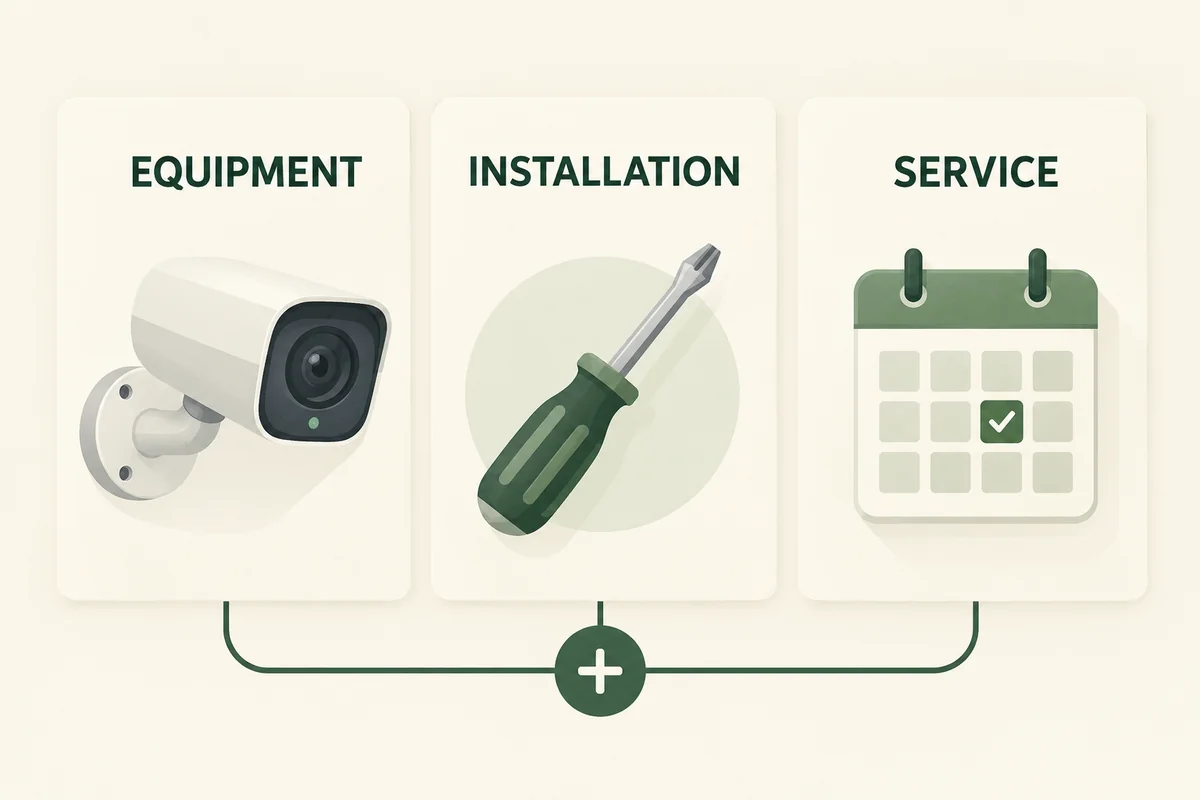
Build your own budget from equipment, physical installation, storage, and recurring services. Those four lines explain the total more usefully than a universal price per camera.
Use the installation type to frame the budget
HomeAdvisor's camera-installation cost guide identifies camera count, system type, equipment, and other scope differences as cost drivers. Use its range to start a conversation, then replace it with a defined local proposal.
| Installation type | Costs to identify | Common omission |
|---|---|---|
| One or two accessible plug-in cameras | Cameras, suitable power, mounts, and the chosen recording arrangement | Memory cards, outdoor power accessories, or paid playback features |
| Several battery cameras | Cameras, any required hub, mounts, battery or charging arrangements, storage, and installation if hired | Service access and ongoing charging or replacement needs |
| A wired system with local recording | Cameras, recorder, drives, network and power equipment, cable routes, termination, and testing | Labor through finished surfaces and making good afterward |
| Cameras integrated with a monitored security system | Equipment, installation, applicable service agreement, and camera-related charges | Confusing alarm monitoring with the camera's recording service |
These are budgeting categories, not packages with guaranteed prices. Two houses with four cameras can require very different work: an accessible single-story cable route is a different purchase from crossing finished floors or reaching an outbuilding.
Itemize the complete equipment
Start with the views you need. An entrance-identification view and a broad yard overview may require different positions or equipment. Buying a large camera bundle before checking those tasks can leave unused hardware and an unresolved important view.
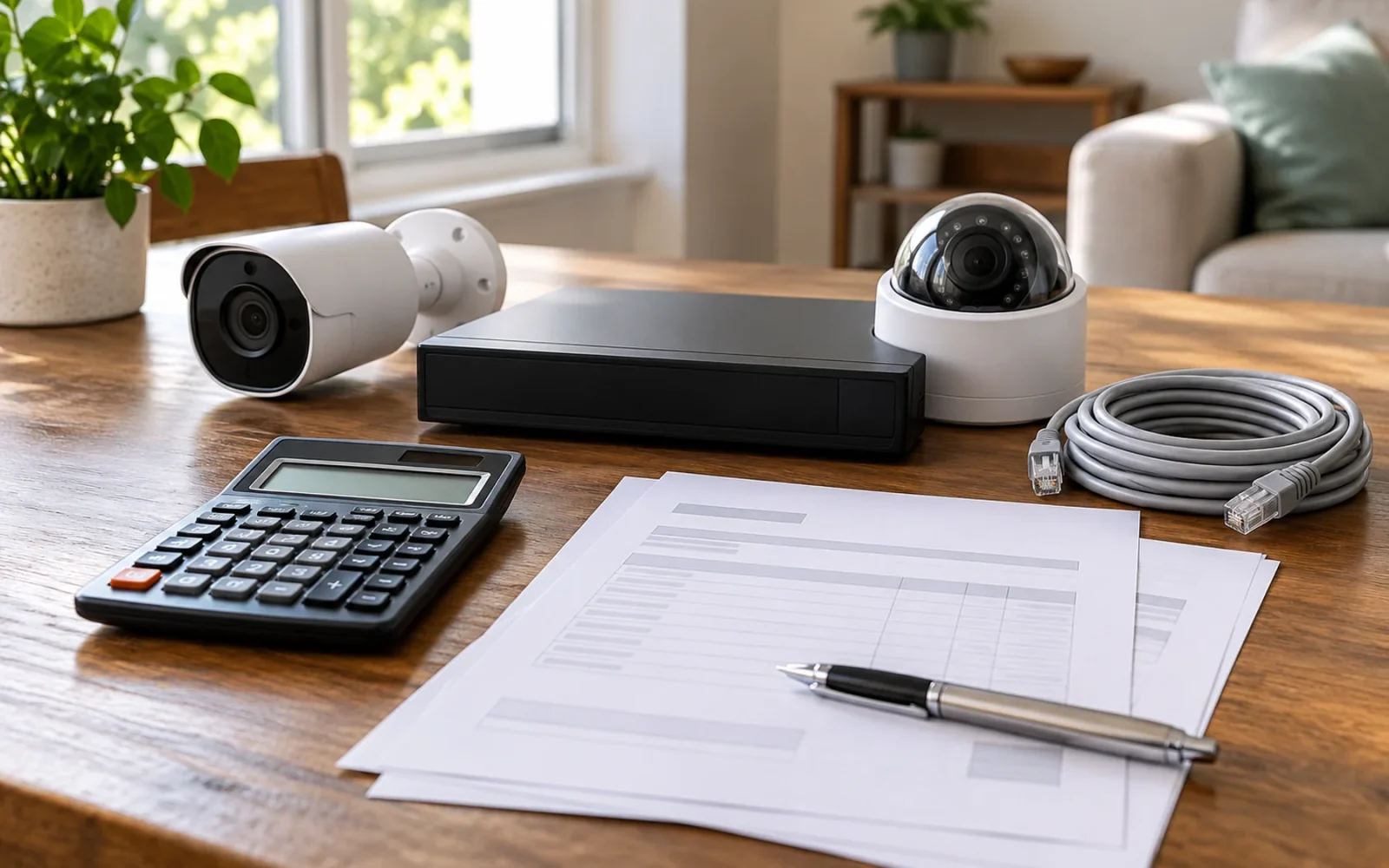
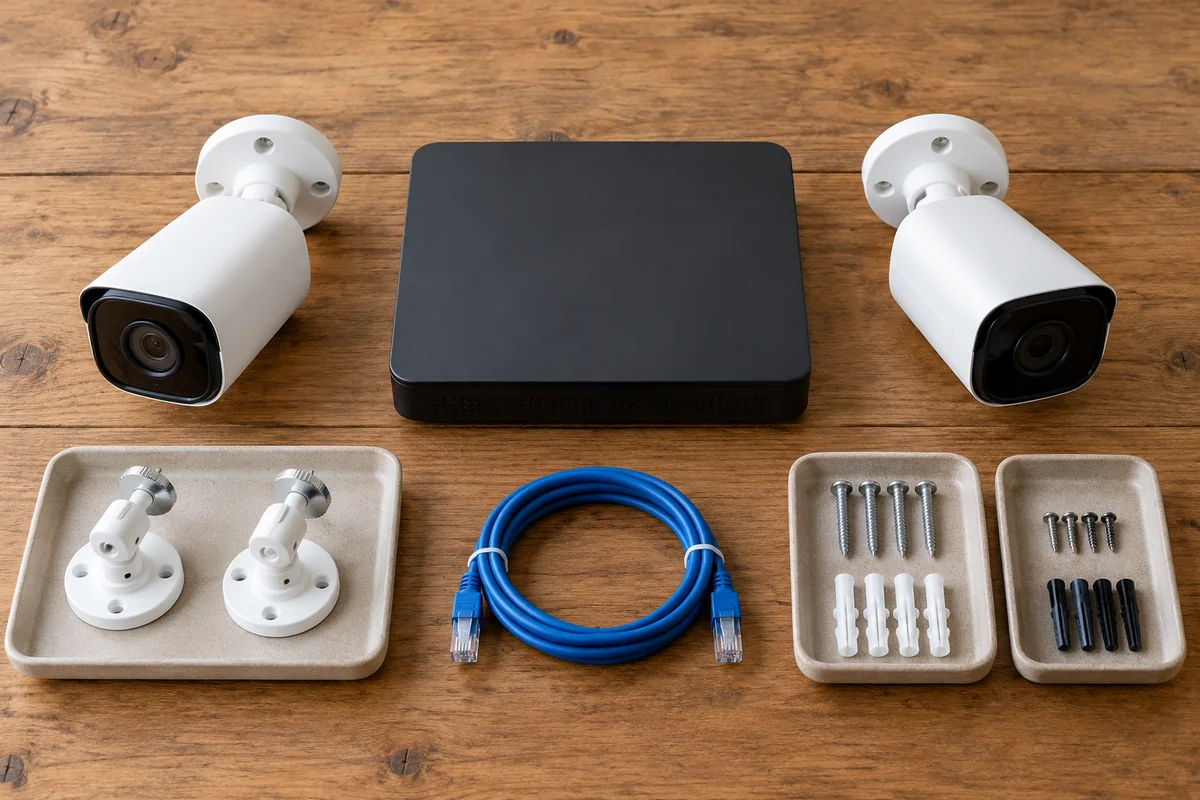
Record exact cameras and quantities. Add the hub or base station if required, recording hardware, specified storage media, mounts, and approved power accessories. For a Power over Ethernet system, identify whether the recorder or a separate switch supplies the needed power and whether its total capacity suits the cameras.
Check bundle contents closely. “Eight-channel” can describe recorder capacity rather than eight included cameras. A recorder price may exclude a hard drive, while a discounted kit may include a drive with less retention than you need. Do not count capacity as equipment already supplied.
Keep optional features separate from the base requirement. A higher-resolution model, spotlight, different lens, or dual view may serve a particular task, but the more expensive version in the same unsuitable position does not automatically solve it.
Price the physical work rather than an unexplained installation fee
Give installers the same proposed views and ask what each price includes. Separate mounting and app setup from new cable runs, cable protection, electrical supply, network changes, and decorative repairs.
Describe the property conditions that affect access: height, wall construction, finished ceilings, route length, distance to a detached building, and available power. Ask who handles penetrations and weather sealing and who returns if the view or connection does not meet the agreed requirement.
For wired work, include labeling and appropriate testing in the scope. Commissioning should show usable recordings, remote access where required, and exports—not simply that every camera produces a live picture.
A published installation starting price is not a whole-house wiring allowance. Likewise, if a proposal already includes cameras, recorder, mounting, cabling, and configuration, adding a second generic installation average would double-count part of the purchase.
Compare recurring costs over the same period
List the features that remain after any free trial: event history, retention, person detection, notification previews, continuous recording, shared access, and downloads. Check them for the exact camera and plan instead of assigning one subscription price to every brand.
Determine whether charges apply per camera, per account, or per location. Annual billing can change the total and the amount due upfront. Promotional first-year service should be separated from the expected renewal price.
Local storage can avoid a cloud-recording fee on suitable systems, but it still requires hardware, maintenance, and a workable retrieval route. Our no-subscription camera guide explains the differences between a free live feed, local clips, and useful remote playback.
Also separate self-monitoring from professional monitoring. Paying for storage does not necessarily mean someone will review an alert or request assistance for you. If a response service is included, compare its scope and conditions independently.
Calculate a three-year ownership example
The following numbers are deliberately hypothetical, not market quotes or a recommended package. Suppose an installation includes $300 of cameras, $60 of storage hardware, and $240 of labor, plus a service you choose at $120 per year.
| Cost component | Illustrative amount |
|---|---|
| Cameras | $300 |
| Storage hardware | $60 |
| Installation labor | $240 |
| Upfront subtotal | $600 |
| Three years of service at $120/year | $360 |
| Three-year total before tax and other costs | $960 |
The example assumes the equipment and labor figures do not overlap, the yearly service remains unchanged, and there are no additional repair or accessory costs. Electricity, replacement batteries, internet or cellular service changes, financing, and taxes are outside that calculation.
Use the same period and required functions for a second proposal. A $950 local-recording package is not automatically cheaper or more expensive than the example; first determine what service, access, retention, maintenance, and installation each actually includes.
Where can you reduce spending without losing the purpose?
Phase the installation around the most important views. Prove one camera's saved daylight and nighttime footage before buying more of the same. Reuse compatible, sound infrastructure when its tested performance meets the new requirements.
Ask for a base proposal and separately priced alternatives. That makes the cost of extra resolution, another view, a different power route, or longer retention visible. Avoid reducing the budget by deleting unidentified installation work that may be necessary for the complete system to function.
Keep the acceptance task clear: can you retrieve the event you bought the system to capture? A cheaper arrangement that cannot supply that footage is a poor comparison, even if every camera in the bundle works.
Conclusion
Budget the full recording arrangement, not just the camera bodies. A useful proposal identifies what is supplied, how it will be installed, what remains payable, and how the household will retrieve footage. Once those boundaries match, comparing totals becomes much more meaningful.

Ethan Miller
Ethan Miller writes about home improvement, interior design, cleaning, and everyday living at Home & Living Daily. He shares practical tips and simple ideas to help readers create more comfortable and functional homes.