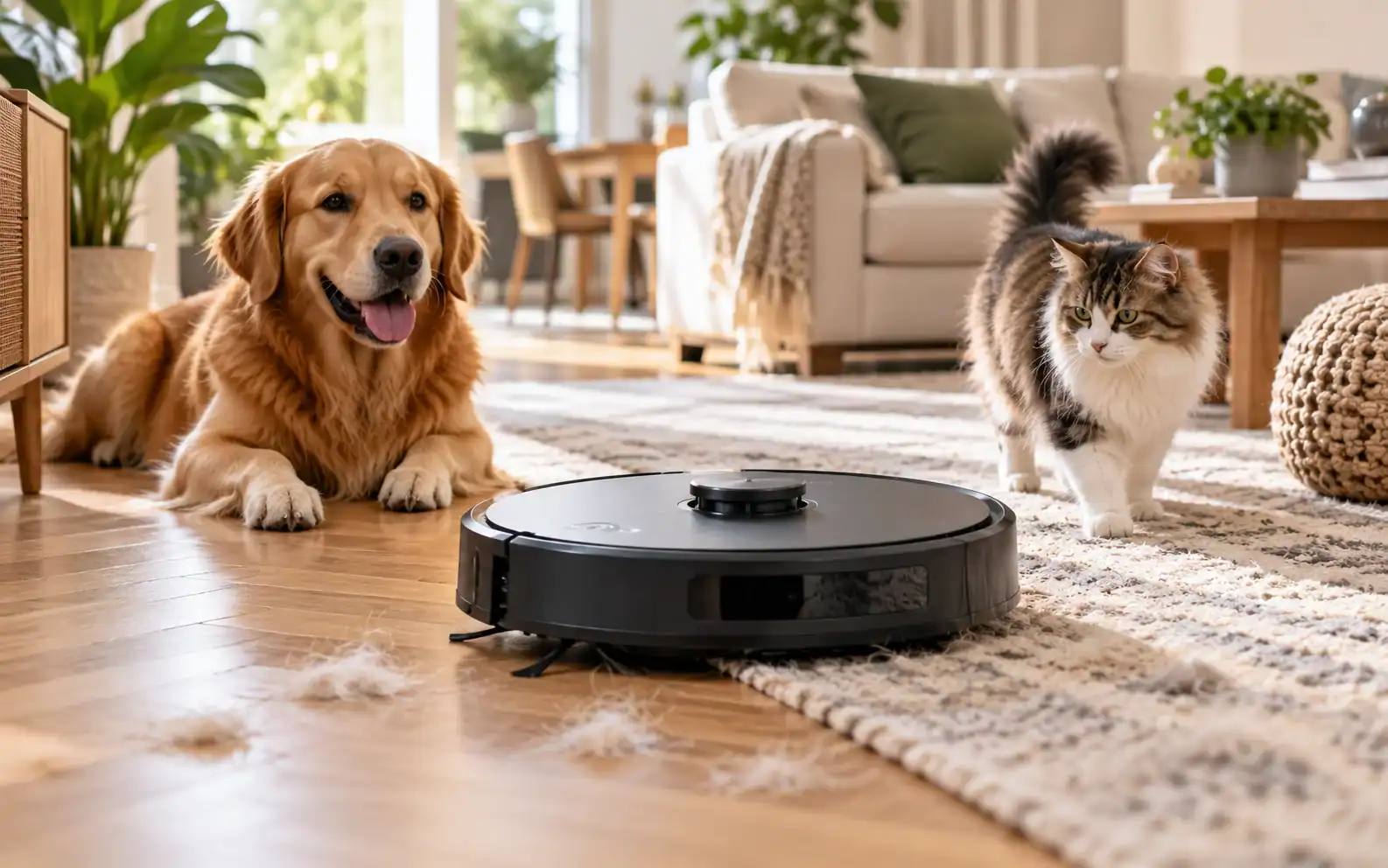
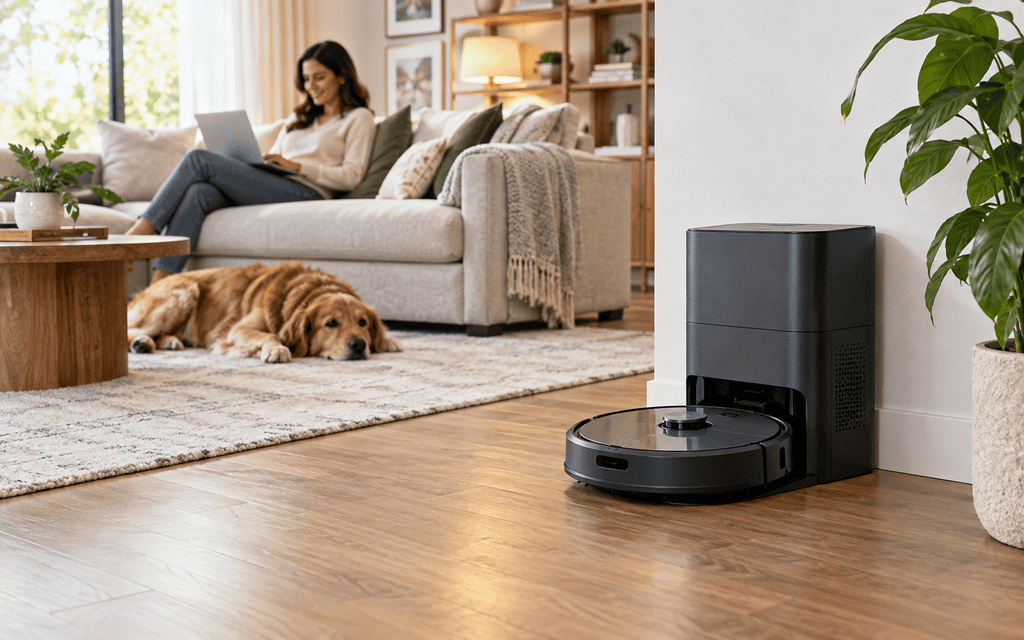
For many pet owners, a robot vacuum can be especially worthwhile.
The reason is simple: pet hair is not a once-a-week problem.
Dogs and cats shed continuously, so floors can start looking dirty again only a day or two after vacuuming. A robot vacuum helps by removing that hair more frequently, often before it has time to collect along walls, under furniture, or in visible clumps.
This is where automation matters more than one-time cleaning power.
A traditional vacuum may still do a better job on deeply embedded hair, especially in carpet. But a robot that runs every day can help prevent that hair from building up in the first place.
For pet owners, the most useful features are usually:
- strong performance on pet hair
- an anti-tangle brush or roller
- good edge cleaning
- a self-emptying dock
- obstacle avoidance
- reliable mapping
- strong carpet performance if your home has rugs or carpet
Self-emptying is particularly useful in homes with heavy shedding because robot dustbins are small. Without a self-emptying dock, you may need to empty the bin very frequently.
You should also pay attention to brush design.
Long pet hair can wrap around rollers, so a vacuum that handles tangles well may save more maintenance time than one with a slightly higher advertised suction number.
When a robot vacuum is especially useful for pets
It is a strong fit if:
- your dog or cat sheds daily
- you have mostly hard floors
- you already vacuum several times a week
- pet hair collects under furniture
- you want floors to stay consistently cleaner between deep cleans
When it may be less impressive
You may still need a traditional vacuum if:
- most of your home has thick carpet
- pet hair becomes deeply embedded
- your pet sheds extremely heavily
- your pet frequently leaves toys, food, or other objects on the floor
So for pet owners, a robot vacuum is often less about replacing deep cleaning and more about keeping shedding under control every day.
Are Robot Vacuums Worth It on Carpet?
Yes, robot vacuums can be worth it on carpet, but the answer depends heavily on the type of carpet and the specific robot.
Hard floors are easier for robot vacuums because dirt stays close to the surface.
Carpet is more difficult because dust, hair, and debris can become trapped between fibers.
Low-pile carpet
Low-pile carpet is usually the easiest type for a robot vacuum.
Many current models can move across it without much trouble and pick up surface debris effectively.
If your home has mostly hard flooring with a few low-pile rugs, a robot vacuum is generally a practical option.
Medium-pile carpet
Performance becomes more model-dependent.
A capable robot with good brush agitation and automatic suction adjustment may perform well, while a weaker model may leave more debris behind.
High-pile and shag carpet
This is where limitations become more noticeable.
Very thick carpet can create extra resistance, interfere with navigation, or reduce pickup performance.
Long fibers may also cause issues with brushes.
If most of your home is covered in thick carpet, a robot vacuum may still help with surface cleaning, but it is less likely to replace regular deep vacuuming.
Mixed flooring
Modern robot vacuums are often well suited to homes with a mix of hard floors and carpet.
Many can detect carpet automatically and adjust their behavior.
Depending on the model, they may:
- increase suction
- lift mop pads
- avoid mopping carpet
- clean carpet first
- perform additional passes
That makes current robot vacuums much more practical for mixed-floor homes than older models.
Still, if carpet performance is a priority, it is better to look at independent carpet-cleaning tests rather than relying on suction specifications alone.
How Hands-Off Are Robot Vacuums, Really?
This is one of the most important questions to ask before buying.
Robot vacuums are often marketed as fully automatic cleaning machines.
In reality, the experience ranges from:
“I still interact with it every day”
to:
“I barely think about it for a week or more.”
The difference usually comes down to the dock, navigation, obstacle avoidance, and how tidy your floors are.
With a basic charging dock
A basic robot returns to its dock and recharges automatically, but you may still need to:
- empty the dustbin
- remove tangled hair
- refill water
- wash mop pads
- move objects out of the way
For some households, that is still useful.
But it is not truly hands-off.
With a self-emptying dock
A self-emptying dock removes one of the most frequent chores by transferring debris from the robot into a larger bag or bin.
This can make a major difference if you run the robot every day.
Instead of emptying the robot after every cleaning session, you may only need to deal with the dock periodically.
With an all-in-one dock
More advanced systems can also automate parts of mopping.
Depending on the model, the dock may:
- empty the dustbin
- wash the mop pads
- dry the mop pads
- refill clean water
- collect dirty water
This significantly reduces daily interaction.
But even then, maintenance does not disappear.
You still eventually need to:
- replace filters
- replace bags
- clean brushes
- refill water
- empty dirty water
- clean the dock
- inspect sensors and wheels
A more accurate way to describe a premium robot vacuum is:
low-maintenance automation, not zero-maintenance automation.
How Much Time Can a Robot Vacuum Save?
The answer depends on how much time you currently spend vacuuming.
Instead of using a generic claim, calculate your own number.
For example:
If you vacuum for 20 minutes, three times per week:
20 minutes × 3 = 60 minutes per week
Over a year:
60 minutes × 52 = 52 hours
Now imagine a robot handles most of those routine cleaning sessions.
You may still do a deeper manual clean occasionally, but much of the weekly work becomes unattended.
Even if the robot only replaces two of your three weekly sessions, that could still free up a meaningful amount of time over the course of a year.
The benefit becomes larger if:
- your home is bigger
- you vacuum often
- you have pets
- you have children
- you have a lot of hard flooring
- you currently spend a lot of time cleaning under furniture
It becomes smaller if:
- you live in a small apartment
- your floors do not get very dirty
- you only vacuum occasionally
This is why a robot vacuum can feel extremely valuable to one person and unnecessary to another.
Who Gets the Most Value From a Robot Vacuum?
A robot vacuum tends to provide the most value in households where floor cleaning is frequent and repetitive.
| Household or situation | Likely value |
| Pet owners | High |
| Busy families | High |
| Large single-level homes | High |
| Mostly hard floors | High |
| Low-pile carpet | Moderate to high |
| Mixed hard floor and carpet | Moderate to high |
| Small studio apartment | Lower |
| Thick or shag carpet | Lower |
| Very cluttered floors | Lower |
The people who benefit most are usually not those who hate cleaning in general.
They are people who repeatedly perform the same floor-cleaning task and want to automate part of it.
A robot vacuum is particularly useful when it can run while you are:
- working
- sleeping
- cooking
- exercising
- taking care of children
- away from home
That is the real value proposition.
You are not necessarily buying a better vacuum.
You are buying cleaning that happens without requiring your time at that moment.
Who May Not Need a Robot Vacuum?
A robot vacuum is not automatically a good purchase for every home.
You live in a very small space
If your entire home takes only 10 minutes to vacuum, automation may not save enough time to justify the cost.
Your home is mostly thick carpet
A robot may still help, but deep carpet cleaning is not its strongest use case.
Your floors are constantly cluttered
If you need to pick up toys, cables, socks, blankets, and other objects before every run, the robot may not feel very automatic.
You rarely need to vacuum
If your floors stay relatively clean and you only vacuum occasionally, there is less routine work to automate.
You expect zero maintenance
Even the most advanced robots need some attention.
If you want a machine that requires absolutely no cleaning, refilling, replacement parts, or occasional troubleshooting, current robot vacuums are unlikely to meet that expectation.
You need one machine to clean everything
Robot vacuums cannot clean:
- stairs
- sofas
- mattresses
- car interiors
- curtains
- shelves
Most households will still need another cleaning tool.
Which Robot Vacuum Features Are Actually Worth Paying For?
Not every extra feature matters equally.
Some can significantly improve everyday use, while others may be less important depending on your home.
Smart Mapping and LiDAR
For many people, reliable mapping is one of the most useful upgrades.
It allows the robot to understand the layout of your home and clean more systematically.
Useful features may include:
- room selection
- no-go zones
- zone cleaning
- room-specific schedules
- multi-floor maps
This makes the robot easier to control and reduces unnecessary cleaning.
Self-Emptying
If you plan to run the robot frequently, this is one of the most practical upgrades.
It is especially useful for:
- pet owners
- larger homes
- daily cleaning
- people who want less interaction with the robot
Without self-emptying, frequent cleaning can mean frequent bin emptying.
Obstacle Avoidance
Obstacle avoidance becomes more valuable if your floors often contain:
- cables
- shoes
- toys
- pet items
- small household objects
A home that is already very tidy may benefit less.
A busy family home may benefit much more.
No system is perfect, but stronger obstacle avoidance can reduce rescues and interrupted cleaning sessions.
Anti-Tangle Brushes
This feature is particularly useful for:
- long hair
- dog hair
- cat hair
A robot that collects hair well but constantly requires you to cut hair off the roller may become frustrating.
Ease of maintenance matters almost as much as pickup performance.
Carpet Detection
This is useful in homes with both hard flooring and carpet.
The robot may automatically:
- increase suction
- avoid mopping
- lift its mop pads
- change cleaning behavior
That can make mixed-floor cleaning much more convenient.
Mop Lifting
If your home has hard floors and rugs, mop lifting is a useful feature.
Without it, a vacuum-mop robot may need to avoid carpet entirely while mopping.
With mop lifting, some models can move between hard floors and carpet without requiring as much intervention.
Full Mop-Washing Dock
This is most valuable if you actually plan to use the mopping feature regularly.
It can reduce the need to manually:
- remove mop pads
- wash them
- refill water
- dry the pads
But if you mainly want vacuuming and rarely mop, paying extra for a highly advanced mopping dock may not be necessary.
Do Not Choose Based on Suction Numbers Alone
Suction specifications are easy to market, but they do not tell the whole story.
Cleaning performance also depends on:
- brush design
- airflow
- floor contact
- carpet agitation
- navigation
- cleaning pattern
- hair handling
A robot with a larger suction number is not automatically better in real-world cleaning.
Independent testing is much more useful than comparing Pa numbers alone.
Can a Robot Vacuum Replace a Regular Vacuum?
Usually, no.
But it can reduce how often you need to use one.
A robot vacuum is excellent for:
- daily maintenance
- dust
- crumbs
- pet hair
- under-furniture cleaning
- light carpet cleaning
A regular vacuum is still better for:
- stairs
- upholstery
- deep carpet cleaning
- concentrated messes
- corners and detailed cleaning
For many households, the best setup is not:
robot vacuum or regular vacuum
It is:
robot vacuum for routine cleaning + regular vacuum for occasional deep cleaning
That combination reduces manual work without sacrificing cleaning performance where a robot is weaker.
So, Are Robot Vacuums Worth It?
For many households, yes—especially if you already spend a significant amount of time vacuuming.
The biggest advantage is not that a robot vacuum cleans better than a good traditional vacuum.
It is that the robot can clean more frequently with far less active effort from you.
A robot vacuum is most likely to be worth it if:
- you have pets
- you vacuum several times a week
- you have mostly hard floors or low-to-medium pile carpet
- your floors are usually reasonably clear
- you value automation
- you want to reduce routine cleaning time
It may be less worthwhile if:
- you live in a very small space
- your home is mostly thick carpet
- your floors are constantly cluttered
- you rarely vacuum
- you expect the robot to replace every other cleaning tool
The best way to judge the purchase is to ask one question:
How much repetitive floor cleaning will this machine realistically remove from my week?
If the answer is “a lot,” a robot vacuum can be one of the more useful home automation purchases.
If the answer is “very little,” the money may be better spent elsewhere.
Frequently Asked Questions
Do robot vacuums really work?
Yes. Modern robot vacuums can handle routine dust, crumbs, hair, and debris effectively, especially on hard floors and low-pile carpet.
They are best used for frequent maintenance cleaning rather than occasional heavy-duty cleaning.
Can a robot vacuum replace a normal vacuum?
Usually not completely.
A robot vacuum can reduce how often you need to use a traditional vacuum, but you may still need manual cleaning for stairs, upholstery, thick carpet, edges, and deep cleaning.
Are robot vacuums good for pet hair?
They can be very useful for pet hair because they can clean frequently.
Performance on hard floors is generally easier than deeply embedded pet hair in carpet, so pet owners should look closely at independent hair-pickup and anti-tangle testing.
Are robot vacuums good on carpet?
Many work well on low- and medium-pile carpet.
High-pile and shag carpet are more difficult, and deeply embedded debris may still require a traditional vacuum.
How often should you run a robot vacuum?
That depends on your household.
Homes with pets, children, or high foot traffic may benefit from daily cleaning.
Lower-traffic homes may only need a few runs per week.
Are self-emptying robot vacuums worth it?
They can be, especially if you run the robot frequently.
A self-emptying dock reduces one of the most repetitive maintenance tasks: emptying the robot’s small dustbin.
The benefit is particularly noticeable in homes with pets or a lot of daily debris.
How long do robot vacuums last?
Lifespan varies significantly by brand, battery quality, usage, maintenance, and availability of replacement parts.
Battery wear, brushes, filters, wheels, and docking components can all affect long-term ownership.
For that reason, lifespan is better evaluated by specific model or brand rather than assuming every robot vacuum lasts the same amount of time.

Ethan Miller
Ethan Miller writes about home improvement, interior design, cleaning, and everyday living at Home & Living Daily. He shares practical tips and simple ideas to help readers create more comfortable and functional homes.