You can create backyard privacy without a fence by screening the place where you sit rather than the entire property boundary. A well-positioned panel, a cluster of suitable plants, or overhead cover can interrupt a particular view while leaving the rest of the garden open.
Start by identifying where the view comes from. A screen that works against a neighboring patio may do very little against a second-floor window. Once you know the direction and height of that sightline, the useful options become much easier to compare.
Test the view from the chair, not just from the lawn
Put a chair where you want to spend time and sit down. Note which windows, paths, or neighboring seating areas face you. Then stand up and repeat. You may need privacy while seated at dinner, while moving around the yard, or both.
Use a freestanding object or a temporarily held sheet of cardboard to test a possible screen position in calm conditions. Move it closer to the chair and then toward the boundary. You are checking the view, not establishing a safe permanent support.
A nearby screen can block a seated view with less material than a distant boundary screen. It also covers a smaller area as you move sideways, so test the whole seating group. Keep the pleasant view open if the unwanted sightline only comes from one direction.
Garden designers at Rock Water Farm explain the importance of vantage points and plant placement in screening. Plant height alone does not determine what a person can see.
Match the solution to the direction of exposure
| Where the view comes from | Useful starting point | What to test |
|---|---|---|
| Ground-level patio next door | A targeted panel or dense planting near your seating | Seated eye level, side gaps, and space to walk around it |
| A path at an angle | Two offset screens or staggered plants | The view as someone approaches from either end |
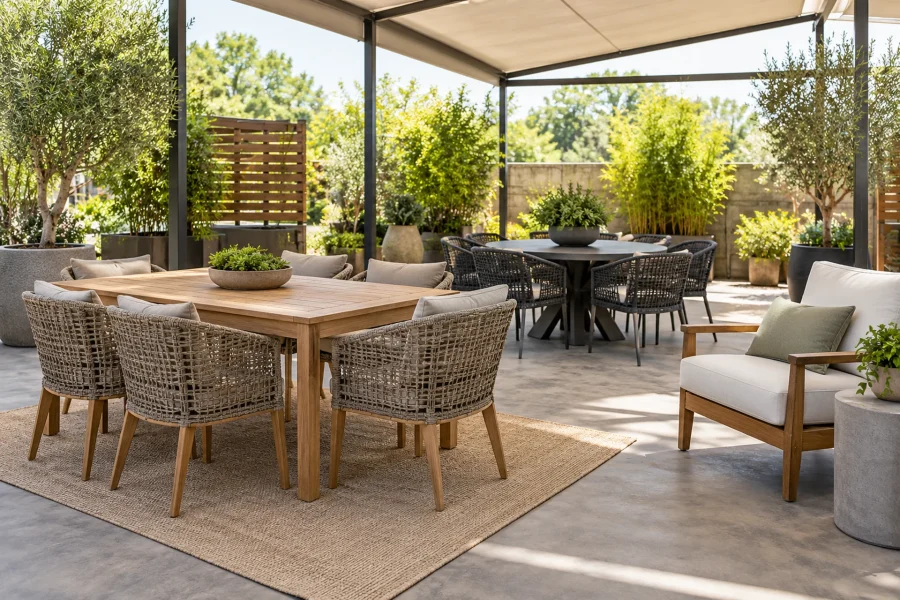
| An upstairs window | Properly supported overhead cover or suitable tree canopy | The actual downward angle and whether the cover reaches the occupied area |
| Several neighboring directions | A smaller private zone with layered screening | Whether you can preserve daylight and access without enclosing everything |
“Without a fence” does not necessarily mean “without rules.” A panel, tall planter, pergola, or hedge can still fall under property, association, lease, or local restrictions. Check the requirements for the specific item before buying or fixing it in place.
For immediate privacy, use a screen that fits its support
Outdoor freestanding panels are useful when you need an effect now, especially around a small seating area. Look at the panel and its support as one product. A broad fabric surface catches wind, and a tall planter is not automatically heavy or stable enough to anchor it.
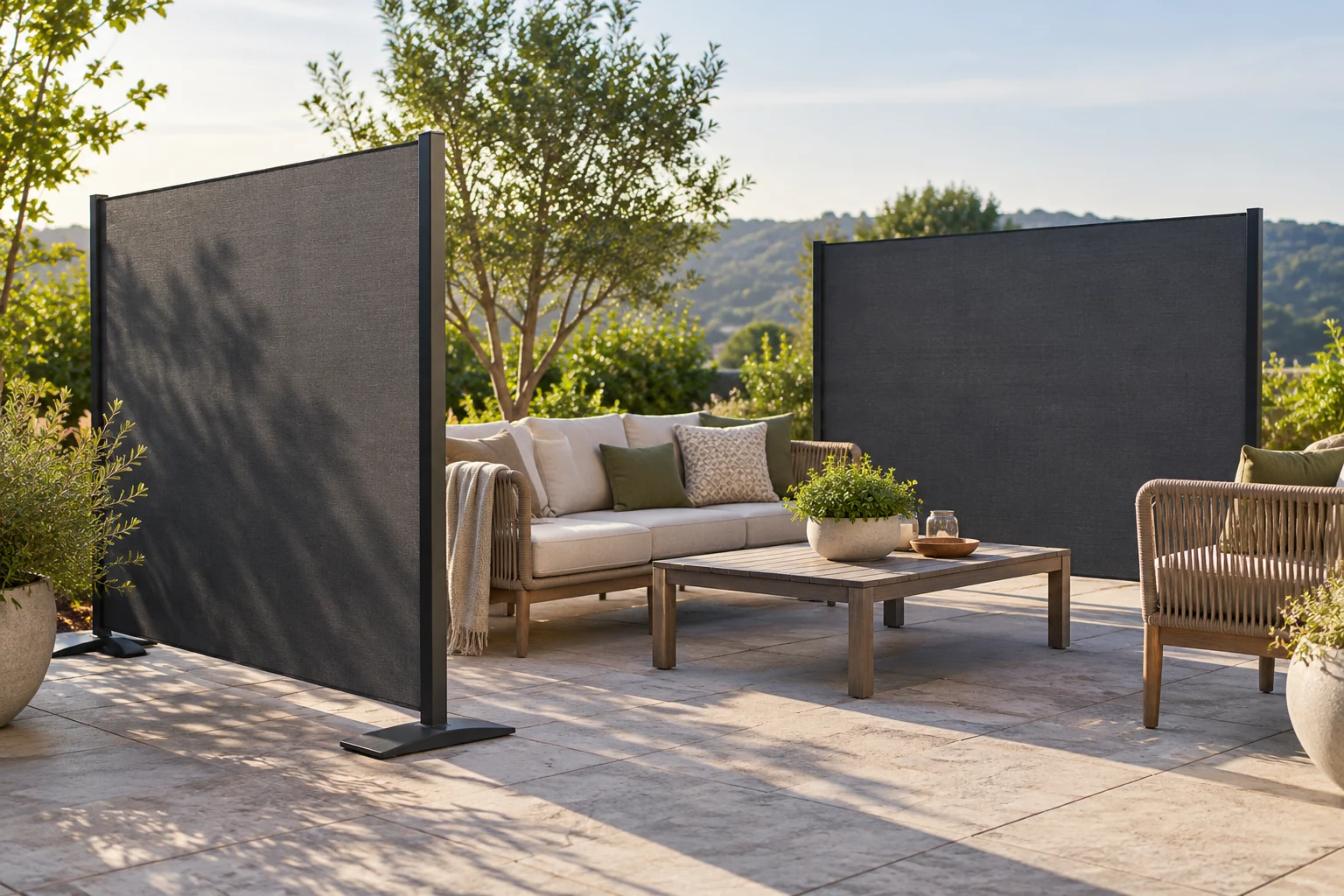
Follow the maker’s anchoring, base, and storage instructions. Keep feet and stabilizers out of walking routes. If a model must be taken indoors in windy weather, include that task in your choice rather than assuming it will remain outside year-round.
A trellis offers a more open look, but bare lattice rarely gives complete privacy. Check the size of its openings from the angle that matters. Climbers can increase coverage over time, although they add weight and may lose foliage seasonally.
Outdoor curtains work when you already have a structure designed to carry the track and fabric. They provide adjustable side coverage, but need restraint and a plan for wind. Do not attach them to a gutter or a decorative member simply because it is in the right place.
Use planting for the space you can maintain
A living screen has three dimensions. You need its eventual width as well as its height, and enough access for watering and pruning. A narrow bed beside a chair cannot accommodate an indefinitely expanding shrub just because it looks compact in the nursery pot.
Choose plants for your light, soil, climate, and required season of coverage. An attractive deciduous shrub may provide excellent summer screening and very little in winter. Ornamental grasses also change through the year and may need cutting back, so do not count on them as permanent opaque walls.
For a planting strip near the property edge, our guide to choosing privacy plants covers mature size, seasonal foliage, and site fit. The same selection questions apply when there is no fence behind them.
Containers let you position foliage near a patio, but their contents need ongoing care. Allow for the plant’s roots, irrigation, drainage, and the weight of the watered container. A row of pots that looks good on installation day still needs a workable route for maintenance.
Combine a small permanent screen with softer planting
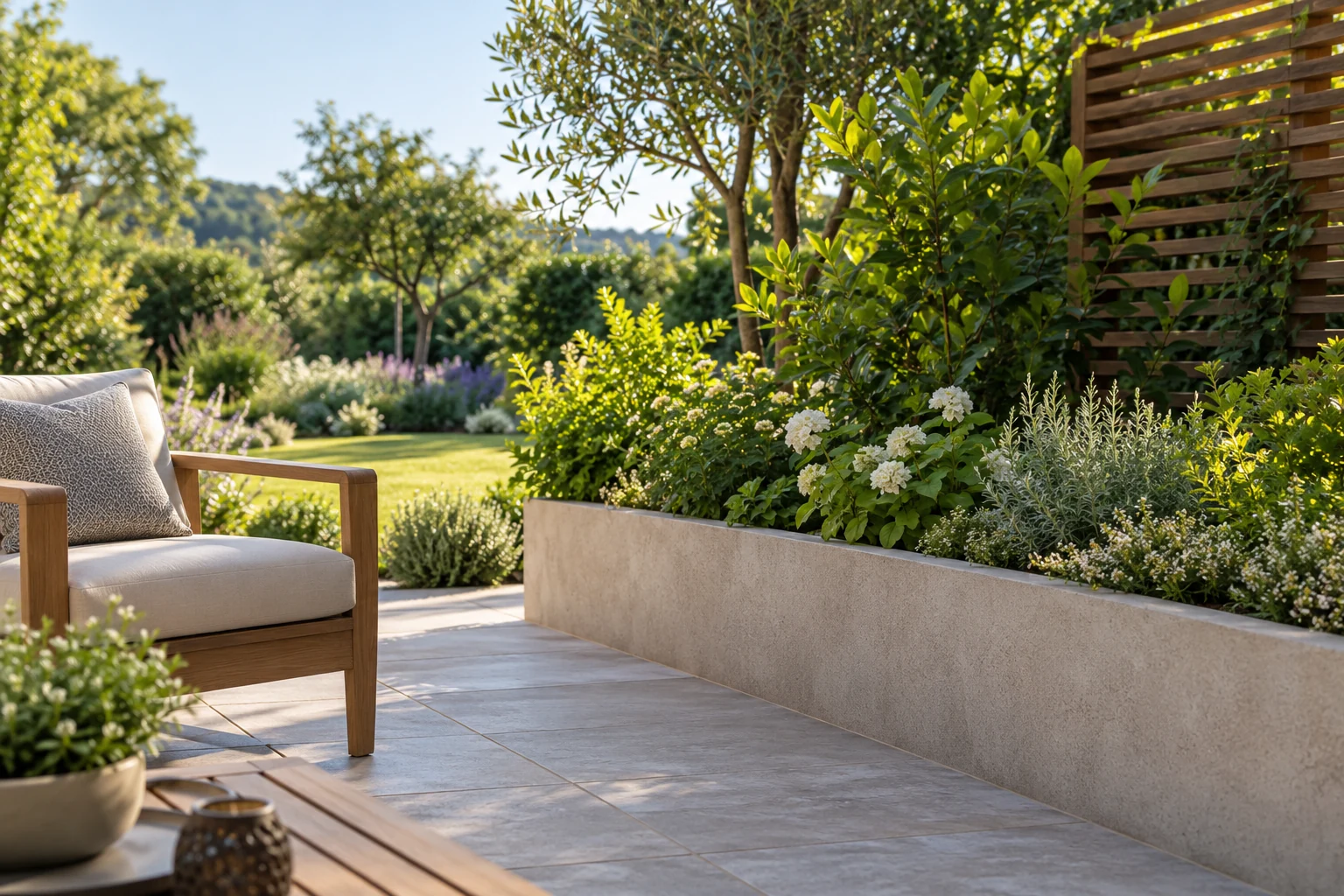
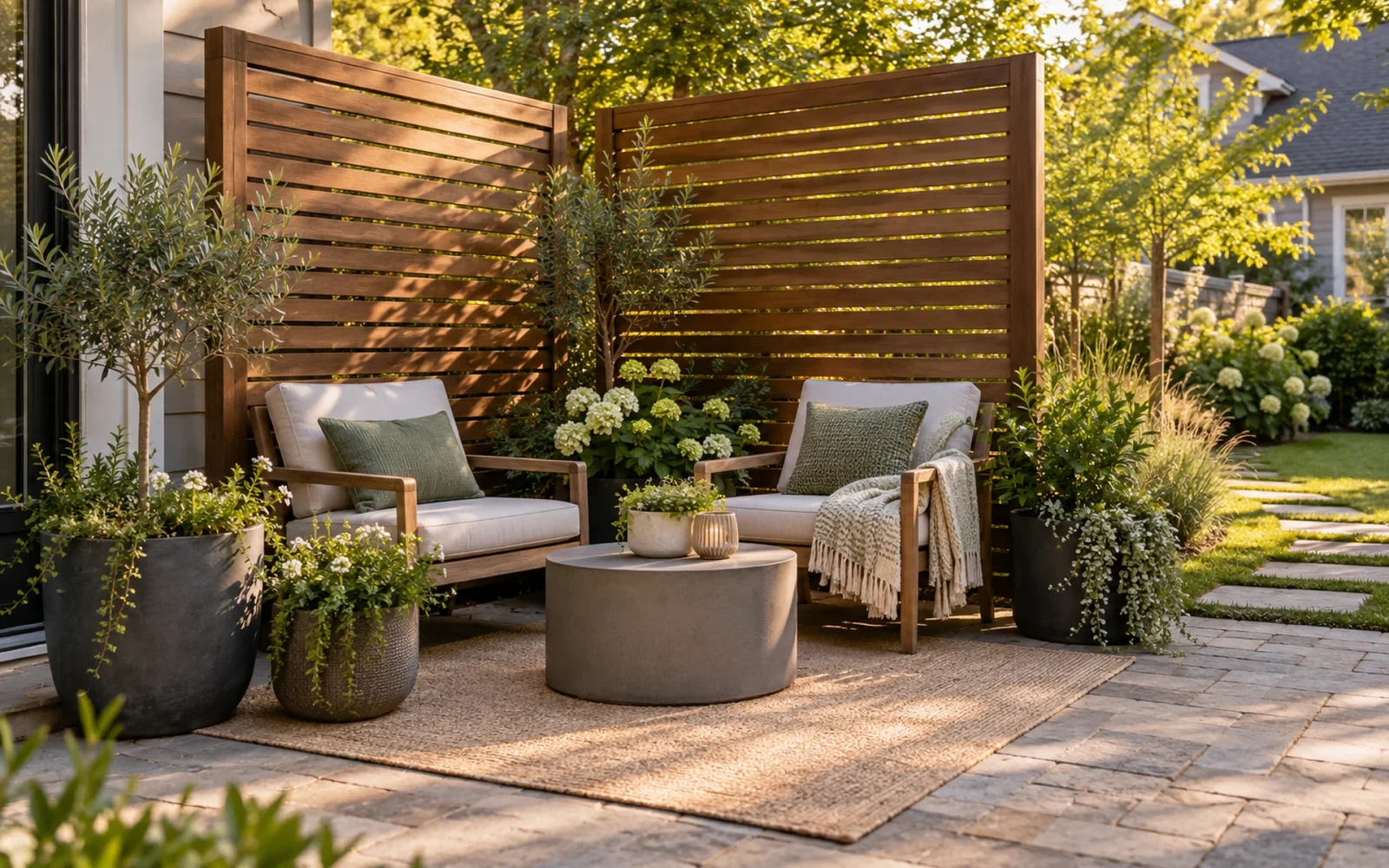
Consider a patio exposed to a neighbor on one side, with an open garden view straight ahead. A possible layout is a panel behind the two most exposed seats, a group of plants beside its end, and an open route on the garden side. That targets one problem without turning every edge into a wall.
Start with the panel position you tested from the chairs. Add plants where they soften its edges or close a real gap. Do not push the planting so close that it rubs against the furniture or hides a path. If future plant growth will provide the main screen, decide whether the panel stays, moves, or becomes redundant.
This is a layout example, not a promise that one standard panel size will work in every yard. The same arrangement may fail if the neighboring view is higher, farther to one side, or through a gap between the seats.
Recheck after dark and before spending more
Privacy can change when your patio is lit and the surroundings are dark. A loosely woven screen may reveal more than expected, and a bright light behind a person can make their outline visible. Test the setup with the lighting you normally use.
Also distinguish visual screening from sound control. Leaves and lightweight panels may hide a neighboring activity without significantly reducing the sound reaching your chair. They do not provide the containment or security functions of a boundary enclosure.
Before adding a second screen, use the first one for a few ordinary evenings. Check whether it blocks the intended view, makes the seat more comfortable, and leaves enough daylight and access. A small zone that works at the times you use it is a useful result even when the rest of the backyard remains open.

Ethan Miller
Ethan Miller writes about home improvement, interior design, cleaning, and everyday living at Home & Living Daily. He shares practical tips and simple ideas to help readers create more comfortable and functional homes.