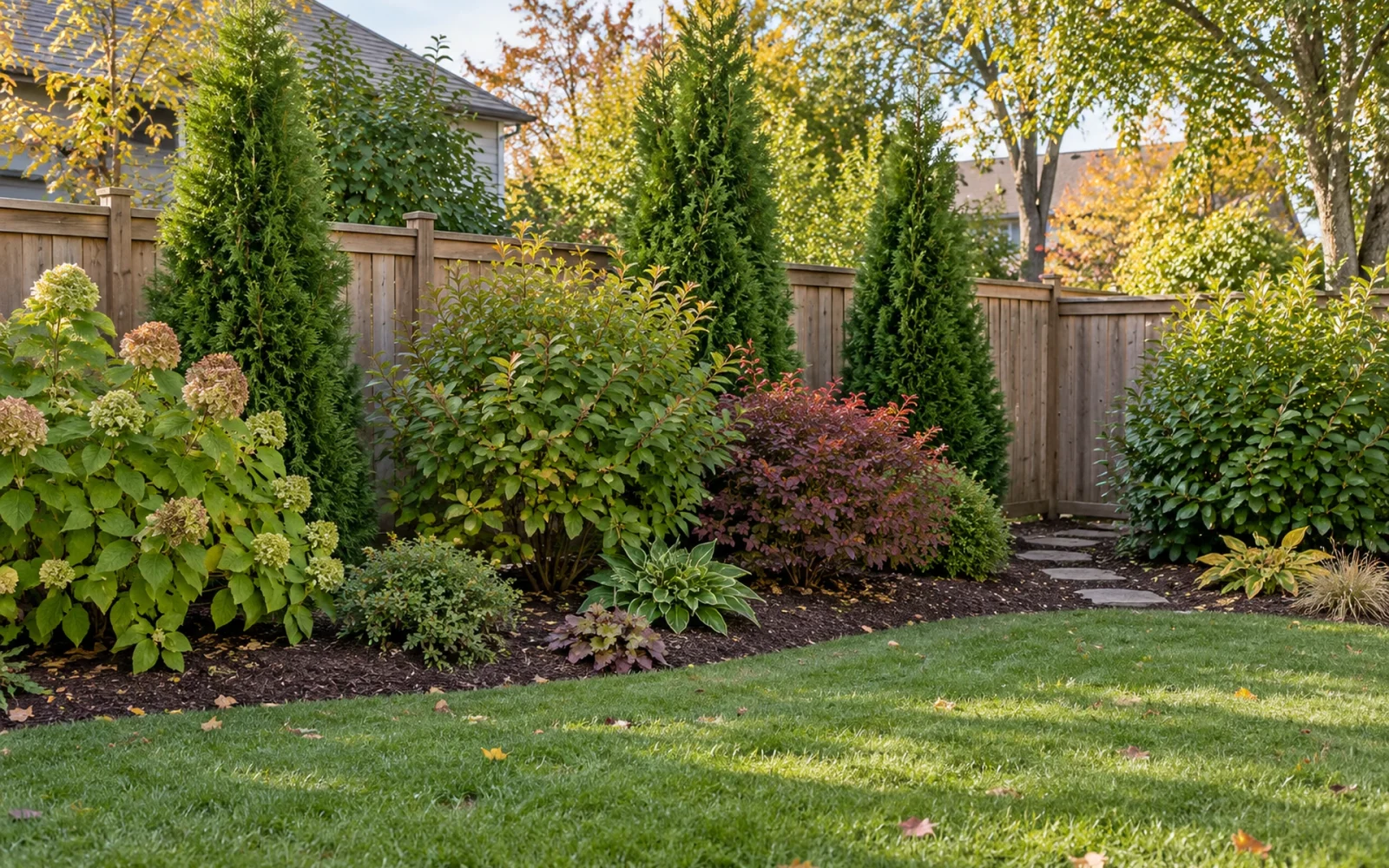
For privacy along a fence, choose shrubs or small trees that will keep foliage at the height where you need screening and fit the available width when mature. A narrow arborvitae cultivar can suit some sunny, cool-climate sites; inkberry can suit an acidic, moist planting strip; yaupon holly is an option for suitable warmer regions. Deciduous shrubs can add useful summer cover, but they will not hide the same view in winter.
The best choice is a plant that fits your site without constant corrective pruning. Start with the view you want to block, then select the plants. Starting with a fast-growing tree and hoping to control its size later often creates a different problem beside the fence.
Decide which view needs screening
Look from the chair, kitchen window, or path where you want more privacy. Is the problem a gap beneath the fence, a neighbor’s ground-floor window, or a view from an upper story? Each calls for a different screen height and position.
You may not need to plant the entire boundary. A shorter planting near the seating area can interrupt a particular sightline while leaving room elsewhere. Very tall screening can also shade your own garden, so consider the effect from both sides of the yard.
For winter privacy, prioritize suitable evergreens or a mix that retains enough foliage after leaf fall. If you mainly sit outside in summer, deciduous flowering shrubs may do the job without creating a dense winter wall.
Measure the planting strip before choosing names
Measure the usable soil width, excluding the space needed to reach fence panels, gates, drains, and utility equipment. Check sunlight along the fence at different times of day. A boundary can have a sunny end, a shaded middle, and a wet low point; the same plant need not occupy all three.
Check soil drainage and, where relevant, pH. Then compare the exact plant or cultivar with your location. The USDA Plant Hardiness Zone Map is based on average annual extreme minimum winter temperatures. It helps assess cold exposure, but does not tell you whether the soil, summer heat, light, or drainage will suit a plant.
Before digging, confirm the boundary and arrange appropriate utility locating. Check any applicable fence-access or planting requirements with the owner or local authority rather than assuming a shrub can be placed anywhere on your side.
Four useful plant options, with their limits
A narrow arborvitae cultivar for a sunny, upright screen
Arborvitae is a group of choices, not one size. ‘Smaragd’, also sold as Emerald Green, is much narrower than large screening cultivars. University of Maryland Extension lists it at approximately 10–15 feet tall and 3–4 feet wide. Confirm the cultivar’s local suitability rather than transferring those dimensions to every plant sold as arborvitae.
It can be useful where an upright evergreen form fits, but allow space for its mature outline and fence access. Consider browsing pressure and establishment watering. A tall plant that loses its lower foliage will not provide the same seat-level screening as the full specimen pictured on its nursery label.
Inkberry holly where acidic soil and a broader shrub fit
Inkberry, Ilex glabra, is a broadleaf evergreen worth considering in suitable eastern and southeastern settings. NC State’s plant profile describes a preference for acidic soil, sun to partial shade, and moist conditions with drainage. The species can reach 5–10 feet tall and 5–8 feet wide, and can spread by suckering.
That makes it a different proposition from a narrow conifer. Check the named cultivar and its mature form if you have limited width or need foliage close to ground level. A compact selection may fit a small bed but never reach the height needed to obscure the view above a tall fence.
Arrowwood viburnum for seasonal cover and a mixed border
Arrowwood viburnum, Viburnum dentatum, is deciduous. It offers a leafy growing-season screen and room for a less formal boundary planting. NC State gives a species range of about 5–10 feet tall and 6–10 feet wide, with cultivar and growing conditions affecting the result.
Allow for its broadening, arching shape rather than forcing it into a narrow slot. In regions with viburnum leaf beetle, ask a local extension service about pressure on the proposed planting. Choose it for seasonal screening, not as a promise of year-round opacity.
Yaupon holly for suitable mild-winter regions
Yaupon, Ilex vomitoria, is a broadleaf evergreen shrub or small tree. NC State lists it for USDA Zones 7a–9b and gives the species a width of about 8–12 feet. It is not a compact hedge simply because a young nursery plant is small.
Upright and dwarf forms serve different purposes. Check the named selection’s eventual height, width, and habit before using it beside a fence. A small mounded cultivar will not substitute for a tall screen, while a large form may consume more of the garden than expected.
Leave space for the grown plant and the fence
Think in terms of mature spread rather than the size of the container you buy. For a simple illustration, a shrub expected to grow 6 feet wide has an approximate 3-foot radius. If you want another foot of working space behind its outer branches, its center would be about 4 feet from the fence. That is layout arithmetic, not a universal planting setback.
Spacing between plants is a separate decision. A formally managed hedge may be planted differently from shrubs intended to keep their natural shape. Follow species- and cultivar-specific guidance, and decide how much pruning you are willing to do before deliberately overlapping their mature outlines.
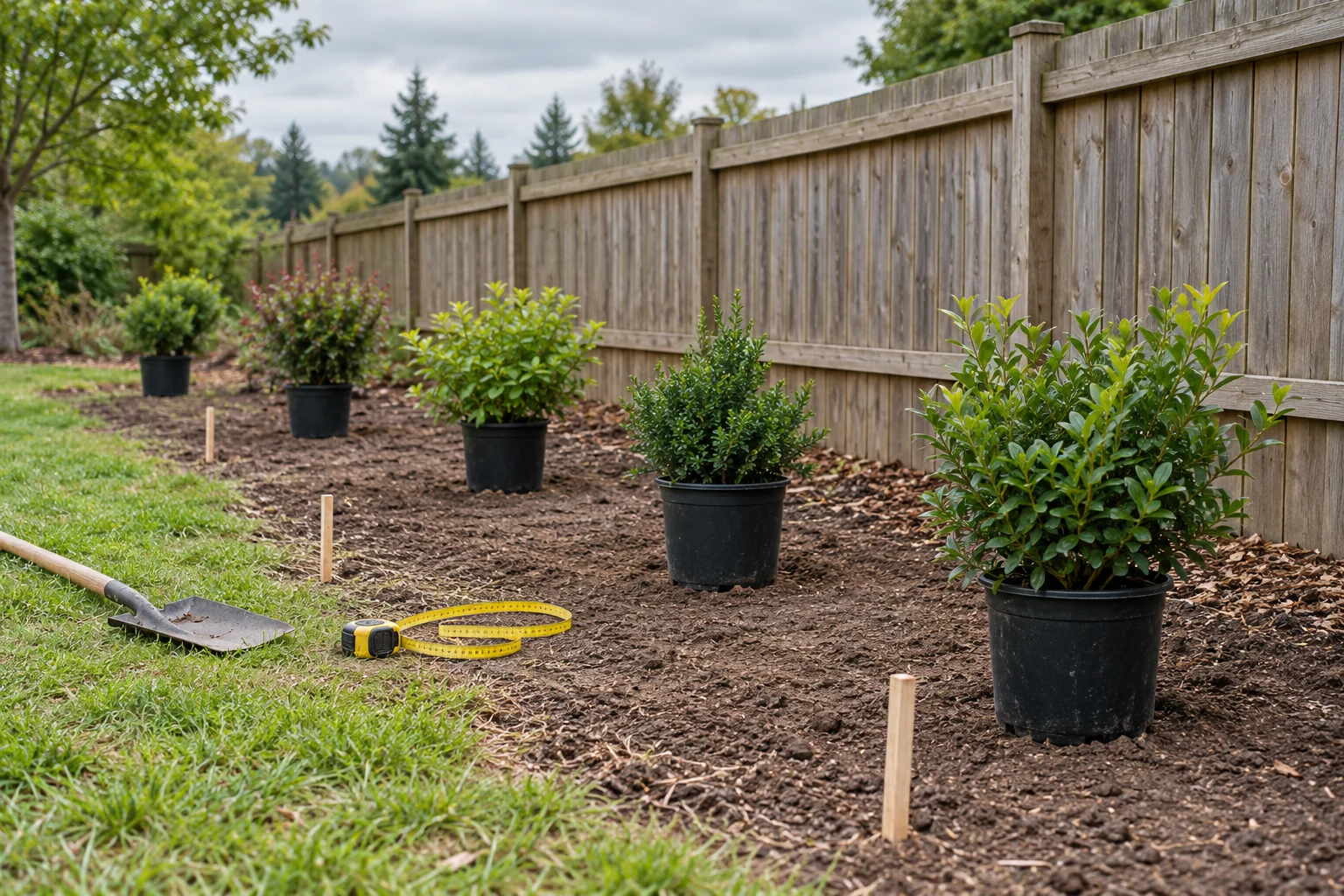
Set nursery pots or temporary markers along the proposed line and walk behind them. Check that a gate can open and a fence panel could still be repaired. If the strip is too narrow, select a smaller appropriate plant or reconsider the screening location. Repeatedly shearing a large shrub is not always a practical substitute for space.
Mix plants where the space permits
A mixed screen can combine evergreen structure with seasonal foliage and flowers. It also avoids making the entire boundary depend on one plant type. Maryland Extension recommends diversity for greater resilience when pests, diseases, or weather stress affect a particular species.
Mixing does not mean filling every gap immediately. Match each plant to the light and soil where it will grow, and check the eventual relationship between taller and shorter plants. In a narrow strip, a simple, well-chosen arrangement may work better than multiple crowded rows.
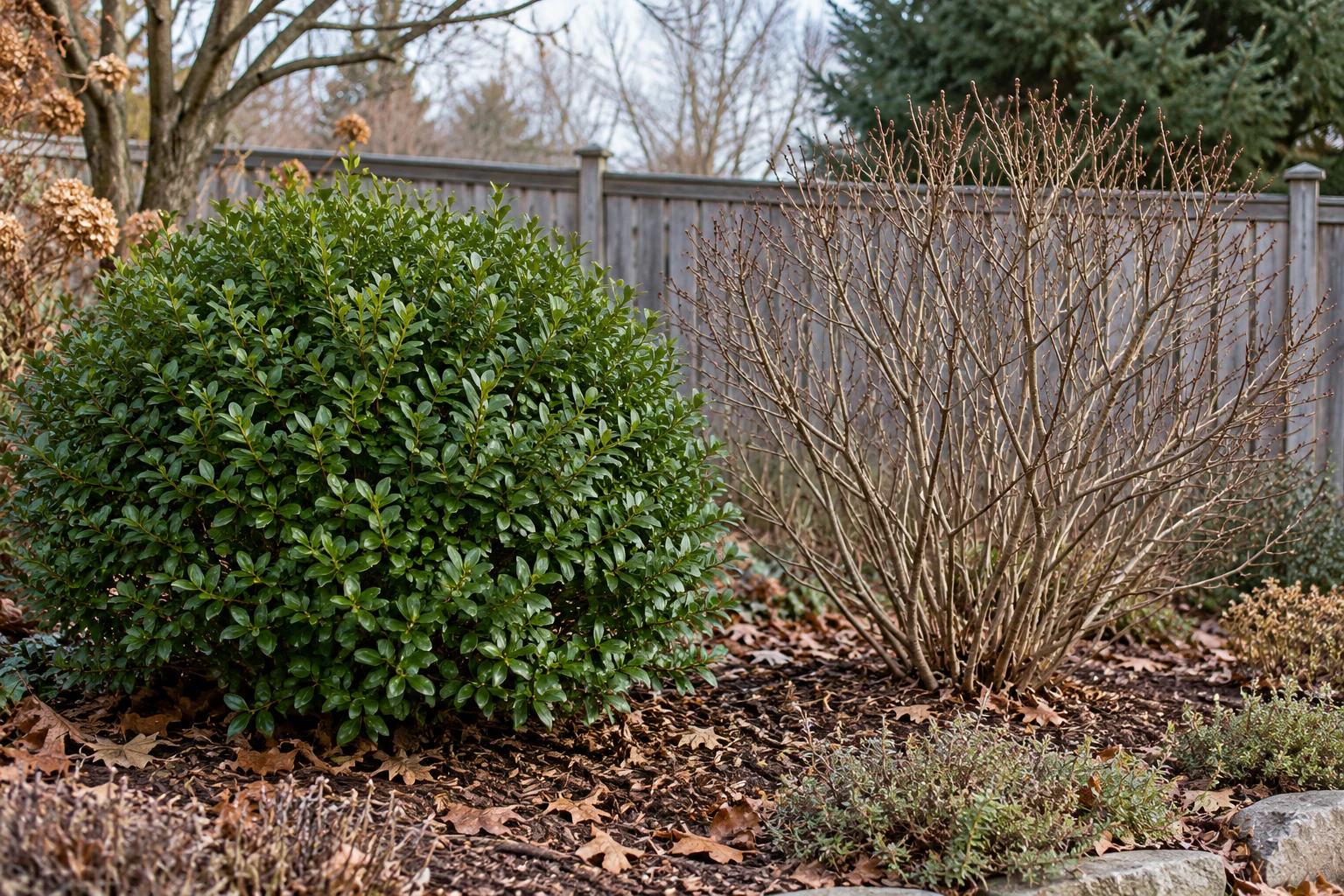
Do not choose bamboo, privet, or another vigorous plant solely because it fills a boundary quickly. Check the exact species against local invasive-plant guidance and any restrictions. A plant suitable in one region can be a poor choice in another.
Plan for establishment rather than instant privacy
Provide access for watering, inspect root balls before planting, and follow appropriate planting-depth and mulch guidance. Monitor the actual root zone during establishment rather than assuming rain wets everything beside a solid fence. Keep mulch away from stems and avoid piling soil against fence boards.
If immediate screening is essential, separate that short-term need from the mature planting plan. A permitted temporary screen can bridge the gap without forcing shrubs too close together. Before buying a full row, have a local nursery or extension service confirm your shortlist against the site conditions and cultivar labels. The goal is a boundary that stays useful as the plants grow, not merely one that looks full on planting day.

Ethan Miller
Ethan Miller writes about home improvement, interior design, cleaning, and everyday living at Home & Living Daily. He shares practical tips and simple ideas to help readers create more comfortable and functional homes.