The Apple Store does not publish a general US guarantee to match competitors’ prices. You can ask Apple about a specific lower offer before buying, and some customers report receiving discounts, but you should not budget around an automatic match or a guaranteed 10% reduction. Apple’s written policy separately offers price protection when Apple itself makes a qualifying price cut soon after you receive a product.
This guide concerns the US Apple Store’s published terms, checked October 20, 2026. Other countries and retailers have their own conditions. A Best Buy, Costco, or Amazon sale does not by itself trigger Apple’s written price-protection policy.
What to ask when another retailer has a lower price
Ask before paying, while the competing offer is still available. Show the live listing and identify the actual seller, model, configuration, condition, stock status, and final price. Then ask Apple whether it can offer an adjustment for that purchase.
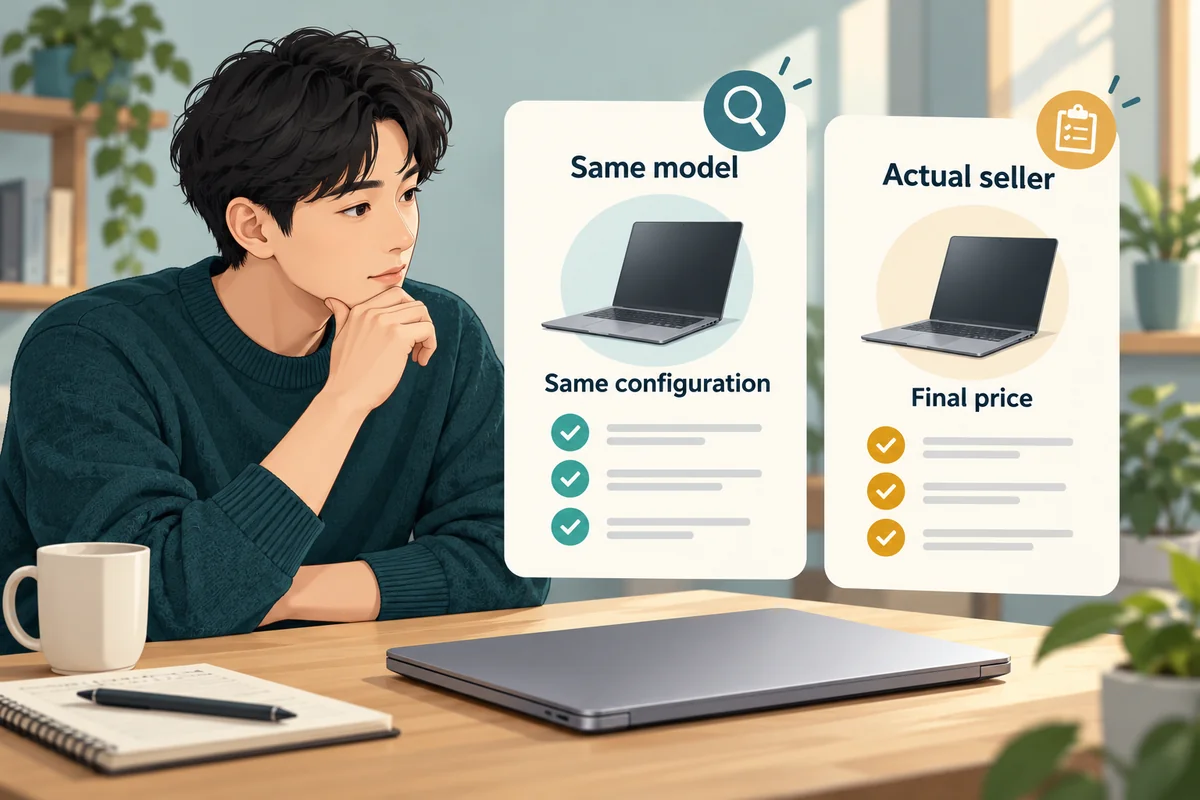
Keep the request specific: “This retailer has this exact new configuration in stock at this price. Can you offer that price here?” That is more useful than asking whether Apple always matches a particular store.
If Apple offers a discount, confirm the total at checkout and whether it changes any financing or promotion you planned to use. If the answer is no, compare buying from the retailer with paying Apple’s price. An earlier shopper’s receipt does not guarantee the same treatment for your product or purchase channel.
In a Reddit discussion about Apple Store price matching, the original poster reported getting 10% off a MacBook Pro. Replies describe different experiences and amounts. These are individual customer reports, not a published entitlement or a reliable universal percentage.
Make sure the offers really match
A lower headline price may cover a different product or require something you do not want. For a Mac, compare chip, memory, storage, screen size, and keyboard configuration. For an iPhone, check storage, carrier conditions, activation requirements, and whether the advertised saving depends on a trade-in.
On a marketplace, the seller matters as well as the website name. A third-party listing, open-box product, membership price, or installment offer can have conditions hidden by a quick price comparison. Verify those details even if you decide to buy from the cheaper seller rather than ask Apple for anything.
For example, a hypothetical $100 saving on a new device is easy to compare if both offers are unconditional and for the same configuration. It is less straightforward if the cheaper listing requires an unwanted service contract. Calculate what you must actually pay, not just the size of the advertised discount.
How Apple’s own price-protection policy works
Apple’s US retail sales policy describes a different situation: Apple reduces its own price on an Apple-branded product shortly after you receive yours. That written provision is the one to use for a qualifying Apple price reduction.
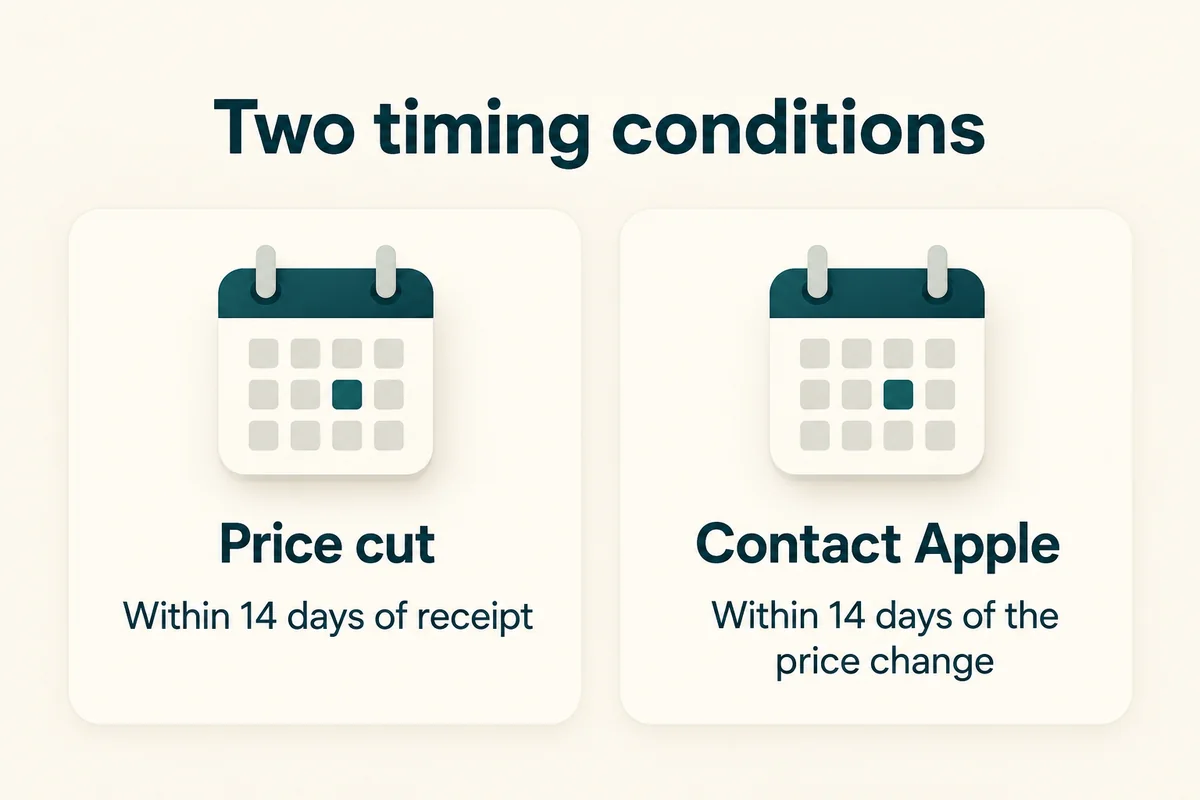
The policy has two separate timing conditions. The price reduction must occur within 14 calendar days of the date you receive the product. You must then contact Apple within 14 calendar days of that price change to request the difference as a refund or credit. Do not replace the receipt date with the order date when checking the first condition.
Here is a hypothetical example, not a current promotion: you receive an Apple-branded product on October 1 for $999, and Apple makes a qualifying reduction to $899 on October 8. The reduction happens seven days after receipt; you would contact Apple within 14 calendar days of the October 8 change. The difference in this example is $100 before any applicable tax adjustment.
Apple excludes limited-time price reductions and special sales events such as Black Friday or Cyber Monday. Price protection is limited to up to ten units of a particular product, and Apple may ask for the product or proof of possession. Keep the receipt and order details available and ask Apple to confirm eligibility rather than assuming a refund is automatic.
A competitor’s sale is a separate question
If you paid Apple $999 and a different retailer advertises $899 while Apple keeps its own price unchanged, that is not the Apple price cut described above. You can ask Apple what it can offer, but the published provision does not promise the $100 difference in that situation.
This distinction also applies to Costco or Amazon. The retailer’s name does not turn its deal into an Apple price reduction. Check the actual offer and seek a clear answer before the purchase or return deadlines pass.
If you already bought the product
First identify who sold it. A purchase from another retailer follows that seller’s adjustment and returns policies. Apple’s store cannot be assumed to reimburse a discount on a transaction it did not make.
For a direct Apple purchase, gather the receipt, date received, exact configuration, and lower-price evidence. Explain whether Apple’s own listed price fell or another seller has a deal. These are different requests, and saying which occurred avoids unnecessary back-and-forth.
If an adjustment is unavailable, check whether returning and buying elsewhere is still practical. Apple’s US returns guidance generally allows 14 calendar days from receipt for eligible direct purchases, with conditions and exclusions. That return period runs independently of the price-protection request window; do not assume one extends the other.
Count delivery delays, stock availability, return conditions, and any financing or carrier consequences before deciding. A return can make sense for a worthwhile saving on an identical available item, but confirm the replacement before giving up a device you need immediately.
Compare available savings without assuming they stack
If a competitor match is unavailable, compare the actual prices you qualify for. Education pricing, refurbished products, trade-ins, and retailer promotions can represent different transactions. Do not combine their advertised savings unless the checkout terms allow it.
A trade-in reduces the cash you pay by giving up something with value. A refurbished item has a different condition from a new one. Neither should be treated as an unexplained discount on the exact same purchase. Keep the product and conditions visible while comparing totals.
Conclusion
Ask Apple about a concrete competing offer before buying, but make your decision using the price it actually confirms. After purchase, establish whose price changed and which deadline applies. That gives you a workable route to a saving without relying on an unwritten percentage as though it were guaranteed.

Ethan Miller
Ethan Miller writes about home improvement, interior design, cleaning, and everyday living at Home & Living Daily. He shares practical tips and simple ideas to help readers create more comfortable and functional homes.