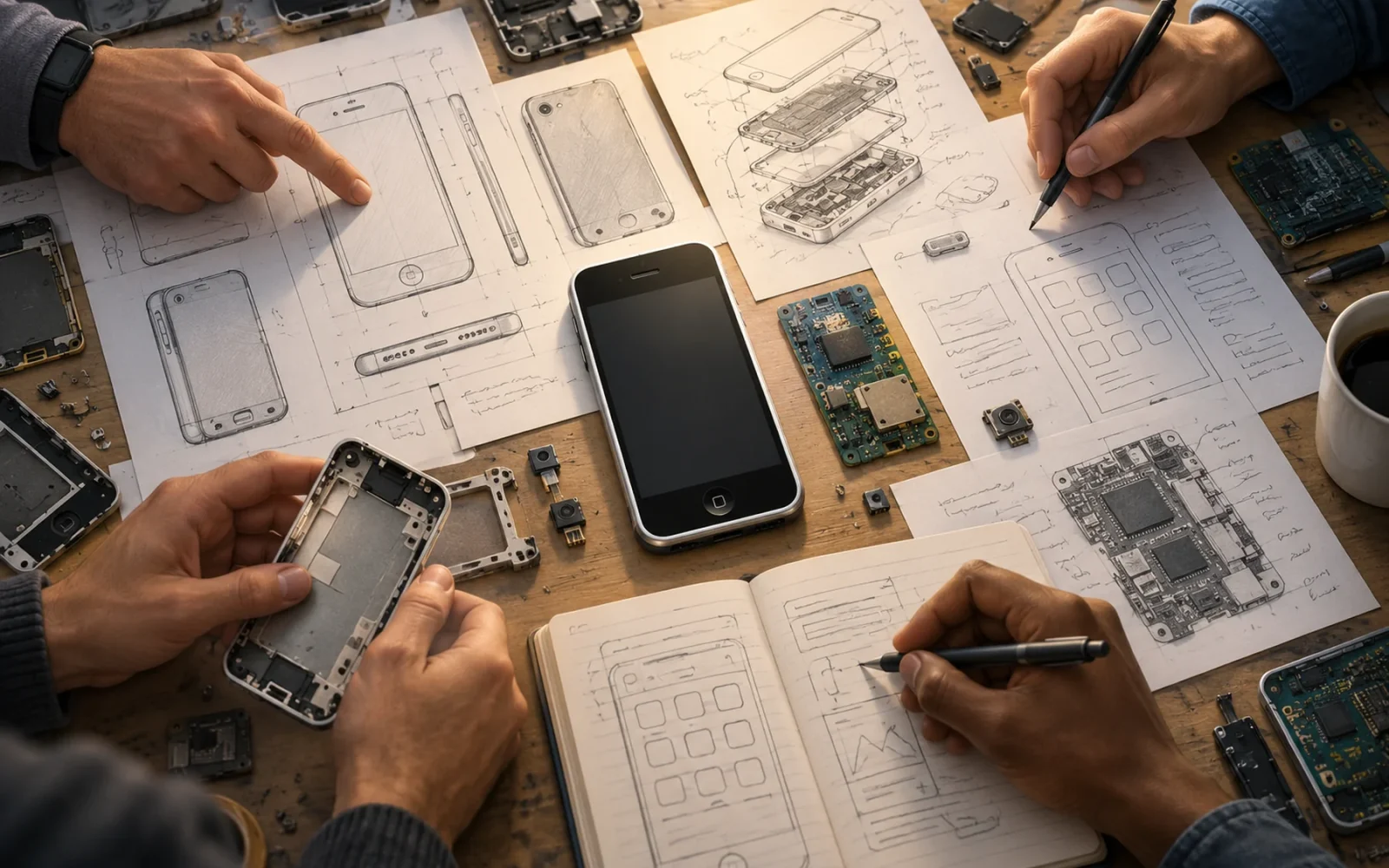
The iPhone was created by a team at Apple under Steve Jobs’ leadership. Jobs drove the product vision and introduced it publicly, while engineers and designers developed the hardware, software, and interface. Calling Jobs the inventor is familiar shorthand, but it leaves out the people who turned that vision into a working phone.
The first iPhone was announced on January 9, 2007, and went on sale in the United States on June 29, 2007. Those are its public introduction and release dates, not the dates on which all of its underlying technologies were invented.
The people and teams behind the first iPhone
Several leaders are central to the story, but their responsibilities were different. Product leadership, industrial design, software development, and hardware engineering are related contributions rather than interchangeable labels.

| Person or team | Main contribution | Why the distinction matters |
|---|---|---|
| Steve Jobs | Product direction, key decisions, and public introduction | Leading the project was different from personally building every component |
| Jony Ive and the industrial design team | The physical product’s design | The phone’s form had to work with its controls and internal hardware |
| Scott Forstall and the software team | Software and interaction development | A large touch display needed usable software, not just new hardware |
| Tony Fadell and the hardware team | Hardware development | The product had to become a practical handheld device |
| Other Apple engineers and collaborators | Specific systems, interfaces, integration, and implementation | The best-known names are not an exhaustive list of contributors |
Apple’s account of Jony Ive’s design career places the iPhone among his major contributions. The Computer History Museum’s interviews with original iPhone developers and Scott Forstall identify Forstall as the original phone’s software leader and include engineers Hugo Fiennes, Nitin Ganatra, and Scott Herz.
The museum’s separate conversation with Tony Fadell describes his leadership of the iPhone’s hardware design. These first-person accounts help explain why there is no satisfactory one-person answer to every version of “who invented it?”
Jobs’ contribution was substantial. Choosing a direction, demanding that an unfamiliar interface become usable, and deciding what a product should be are real parts of creating it. Recognizing that role does not require treating the rest of the development work as incidental.
What was new about the original iPhone
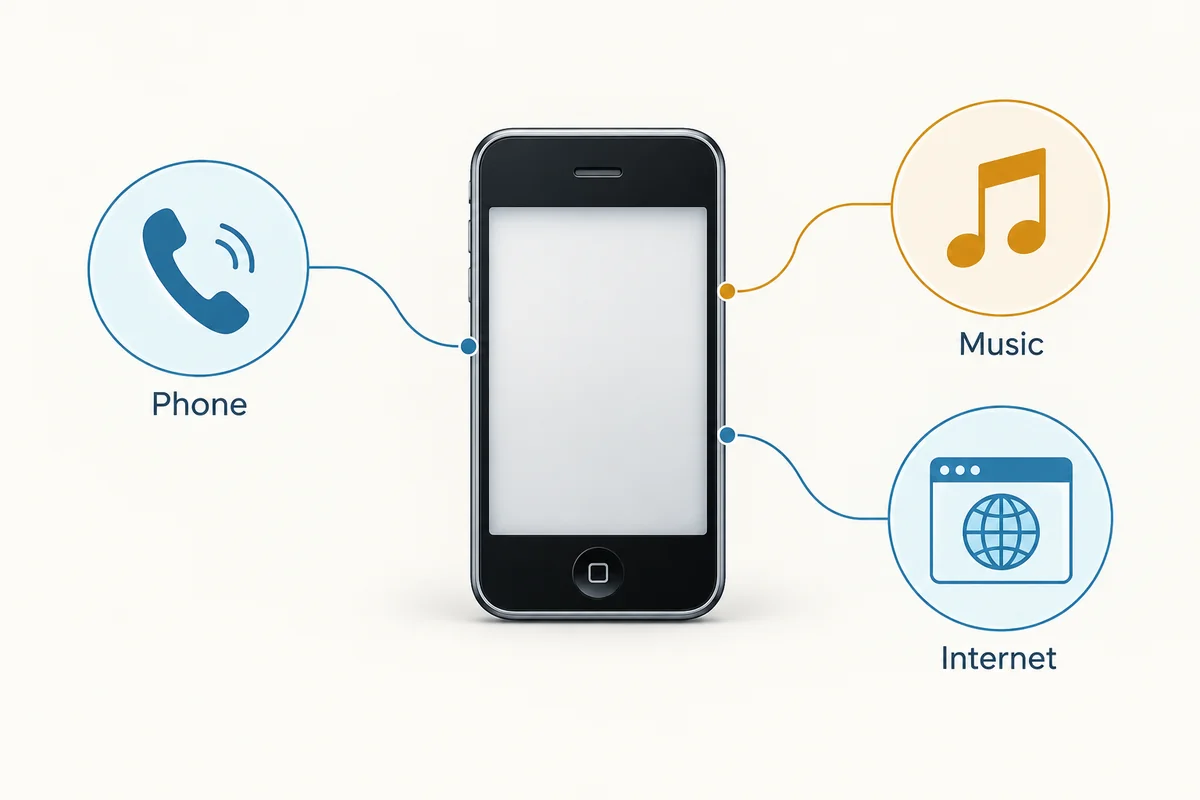
The iPhone’s contribution was a particular integrated product: phone calls, an iPod-style media experience, and internet functions controlled through a large multi-touch display. Apple’s January 2007 announcement describes that combination and its finger-based interface.
Consider typing an address, opening a web page, and then zooming into part of it. Those actions require the screen, touch interpretation, keyboard, browser, networking, and interface behavior to work together. A touch panel alone is not the whole experience. Neither is a design sketch or a persuasive demonstration without the software behind it.
The original development interviews describe the decision to rely on a large screen and virtual keyboard instead of a conventional physical keyboard. That choice created engineering and usability problems the team had to solve. It is a clearer way to understand the achievement than imagining a single inventor suddenly producing a finished phone.
At the same time, Apple did not invent the entire idea of a mobile phone, all touchscreen technology, or every component inside the device. Creating an influential product and originating all of its enabling technologies are different claims. The first can be credited without making the second.
When the first iPhone reached the public
Jobs unveiled the first iPhone at Macworld in San Francisco on January 9, 2007. Apple’s June retail launch announcement confirms that US sales began on June 29 at 6 p.m. local time.
That gap separates a public announcement from a product customers could buy. When a timeline says the iPhone was “invented in 2007,” it usually points to that debut year rather than a single day when all research and development began or ended.
It also helps to keep the original device separate from the later platform. Features people now associate with an iPhone arrived across many generations. The history of today’s iPhone is not exhausted by identifying the people who worked on the 2007 model.
Inventing the iPhone was different from founding Apple
Apple existed long before the iPhone. A question about who founded the company is therefore not the same question as who developed its smartphone. Steve Wozniak’s association with Apple’s early computers does not make him the designer of the original iPhone.
For a short classroom or general-knowledge answer, “Apple, led by Steve Jobs” communicates the central attribution. For an explanation of how the phone was created, include the design, software, and hardware teams. The amount of detail can change without changing that distinction.
Conclusion
Credit Jobs for leading the iPhone’s creation and the Apple teams for making the product work. That answer preserves the significance of his role while explaining the actual process: a coordinated design and engineering effort, built into a product introduced in 2007.

Ethan Miller
Ethan Miller writes about home improvement, interior design, cleaning, and everyday living at Home & Living Daily. He shares practical tips and simple ideas to help readers create more comfortable and functional homes.