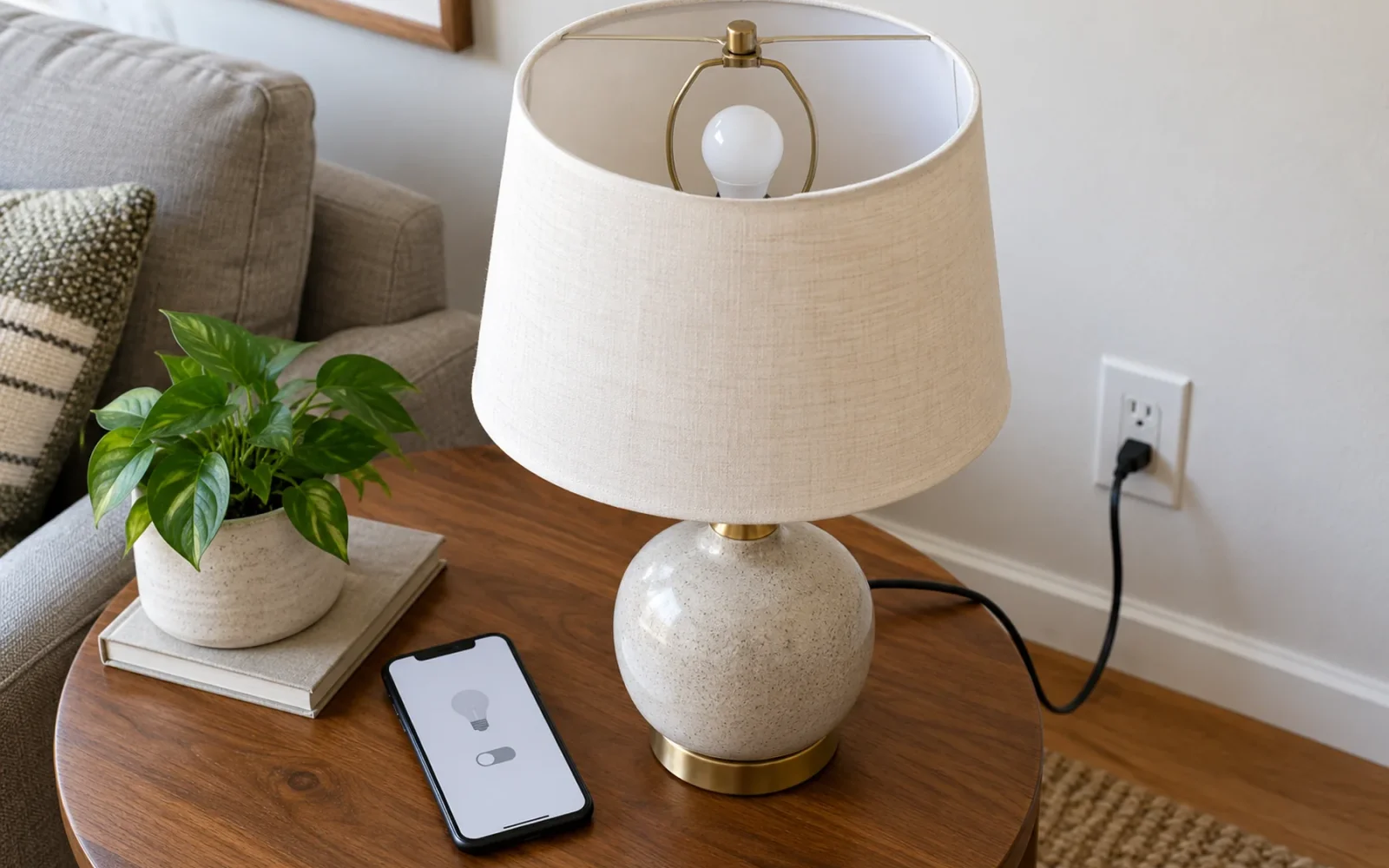
Yes—smart bulbs normally use some electricity when you turn their light off in an app or with a voice command. Their control electronics remain powered so they can receive the next instruction. If you actually disconnect a conventional mains-powered bulb from its electricity supply, it cannot draw standby power from that supply, but it also cannot respond remotely.
The amount depends on the exact bulb. Instead of applying a generic “smart bulb wattage” to every model, look up its standby specification and calculate the cost for your hours of use and electricity rate.
Two Different Meanings of Off
In ordinary conversation, “off” usually means the room is dark. For a connected bulb, that does not necessarily mean the entire device has stopped operating.
When you send an off command, the lighting output stops while the electronics remain available for communication. TP-Link's smart-bulb FAQ explicitly describes this as standby and directs owners to the particular product's specification for its consumption.
A conventional mechanical wall switch can instead interrupt power to the bulb. That removes the bulb's ability to hear an app command, run an instruction it needs power to execute, or participate in its wireless system. Switching it on again restores power; reconnection and startup behavior depend on the product.
| State | What the bulb is doing | How to treat its consumption |
|---|---|---|
| Light on | Producing light with its control electronics operating | Use actual operating power for the chosen settings |
| Light off in the app, supply connected | Waiting in standby for supported commands | Use the model's standby figure |
| Bulb disconnected from its supply | No mains power reaches the bulb | No mains energy is supplied to that bulb |
The last row describes the bulb itself. A separate powered bridge, smart switch, or electronic controller may still consume energy. An electronic dimmer is also not automatically equivalent to a simple mechanical switch that disconnects the load. Identify the actual equipment before assuming the entire lighting system has reached zero consumption.
A Verified Standby Figure Is a Starting Point
For one concrete example, the Philips Hue White and Color Ambiance 60W A19 E26 bulb, product 046677590826, lists standby consumption of 0.2 W and operating power of 7.2 W. These are published specifications for that model, checked on October 19, 2026—not our own measurements or a guarantee for every Hue bulb.
The “60W” in the product name is a conventional-light-output comparison. It is not a claim that the bulb continuously draws 60 watts, and it is not its standby figure. Find the actual power-consumption section rather than using the largest wattage printed in a product title.
Other models and generations can differ. Wireless technology alone does not give you a complete consumption figure, so do not assign one number to all Wi-Fi bulbs and another to every bridge-connected bulb without model-specific evidence.
Calculate the Standby Cost for Your Home
Electricity bills use energy over time. As the U.S. Energy Information Administration explains, watts describe power, while kilowatt-hours describe accumulated electricity use. Convert the standby watts into kilowatt-hours before multiplying by your rate.
The calculation is: standby watts × standby hours ÷ 1,000 = standby kWh. Then multiply those kilowatt-hours by your applicable price per kWh.
Assume a bulb uses 0.2 W in standby for 20 hours each day. Over a 365-day year, the calculation is 0.2 × 20 × 365 ÷ 1,000 = 1.46 kWh. At an assumed variable electricity price of $0.30 per kWh, that is $0.438, or about $0.44 a year.
Those hours and that price are illustrative assumptions, not a national average or a quoted utility tariff. The table scales the same assumption to different bulb counts; it does not describe bulbs with higher standby consumption.
| Bulb count at 0.2 W each | Annual standby energy at 20 hours a day | Annual cost at an assumed $0.30/kWh |
|---|---|---|
| 1 | 1.46 kWh | $0.44 |
| 10 | 14.60 kWh | $4.38 |
| 30 | 43.80 kWh | $13.14 |
Use the rate that applies to the extra energy, including relevant variable delivery charges where applicable. Fixed account charges do not disappear when a bulb uses less electricity. With time-varying prices, divide the standby hours between the appropriate rate periods rather than applying a single off-peak rate to the whole day.
Also count only standby hours as standby. If the bulb lights the room for part of the day, calculate that operating energy separately. Using 24 standby hours and then adding a full day's lighting schedule double-counts part of the day.
Standby Is Only Part of the Lighting Bill
The number of hours you produce light and the power used at your chosen brightness also matter. For a whole-system comparison, include a dedicated bridge or controller if the proposed installation needs one. Do not assign its entire consumption to each bulb separately.
If you already run a multipurpose controller, make the comparison explicit. The energy cost of adding a bulb to an existing installation can differ from the cost of buying and powering a new controller only for that bulb. Both are legitimate questions, but they have different boundaries.
The same applies when comparing smart bulbs with ordinary LEDs. Choose lamps that deliver suitable light for the same task and compare actual operating hours and power. A smart lamp's automatic shutoff might avoid wasted lighting, but leaving it illuminated for decorative effects can add hours. Connectivity does not determine the final result by itself.
Should You Switch Them Off at the Wall?
Cutting power can remove the bulb's standby use, but it also removes the reason many people installed it: being ready for remote control. Decide whether that tradeoff makes sense for the particular light, rather than treating every dark bulb as wasted electricity.
In a Reddit discussion about leaving the wall switch on, the original poster asked about standby consumption and bulb life. Replies included conflicting measurements, corrections to units, and concerns about losing smart controls. That discussion is useful evidence of the questions owners face, not a dependable consumption dataset.
For a regularly used smart light, compare the calculated standby cost with the convenience of keeping schedules, app access, and compatible physical remotes available. For a lamp you rarely need to control remotely, an ordinary LED or a different control arrangement may suit the job better.
If a bulb helps extend a wireless mesh, removing its power may also change that network's available paths. Check the manufacturer's description of the bulb's role before making frequent power cuts part of your routine. For example, Philips Hue describes its bulbs as repeaters in the Hue mesh. That does not mean every smart bulb serves that function or that every power cut will cause a failure.
How to Check Your Own Bulb
Find the exact model number and search the manufacturer's specifications for standby or networked-standby power. Use the figure for the relevant operating state, and check whether a listed value refers to a bulb, a complete fixture, or a separate adapter.
If you want to measure a plug-in lamp, use a suitable energy meter within its specified load and measurement limits. Check the meter's low-load accuracy and display resolution before interpreting a tiny reading. A display rounded to 0.0 W is not, on its own, proof that the connected electronics use no energy.
Keep the measurement boundary clear. A reading for a lamp plugged through another smart plug can include the lamp while excluding or separately accounting for the plug's own consumption, depending on how the meter is arranged. A whole-house meter also includes unrelated equipment, so it is a poor way to isolate one bulb's small standby load.
Do not expose fixed wiring to obtain a reading. The product specification is a reasonable planning basis when a safe, sufficiently accurate measurement is unavailable. Label it as a specification-based estimate rather than a measured result.
Conclusion
A smart bulb that is dark but connected to power usually remains in standby. Work out its cost from the exact model's standby watts, the hours in that state, and your electricity rate. Then decide whether keeping remote control available is useful enough for that light. The important comparison is the complete lighting arrangement and how you use it, rather than the word “off” alone.

Ethan Miller
Ethan Miller writes about home improvement, interior design, cleaning, and everyday living at Home & Living Daily. He shares practical tips and simple ideas to help readers create more comfortable and functional homes.