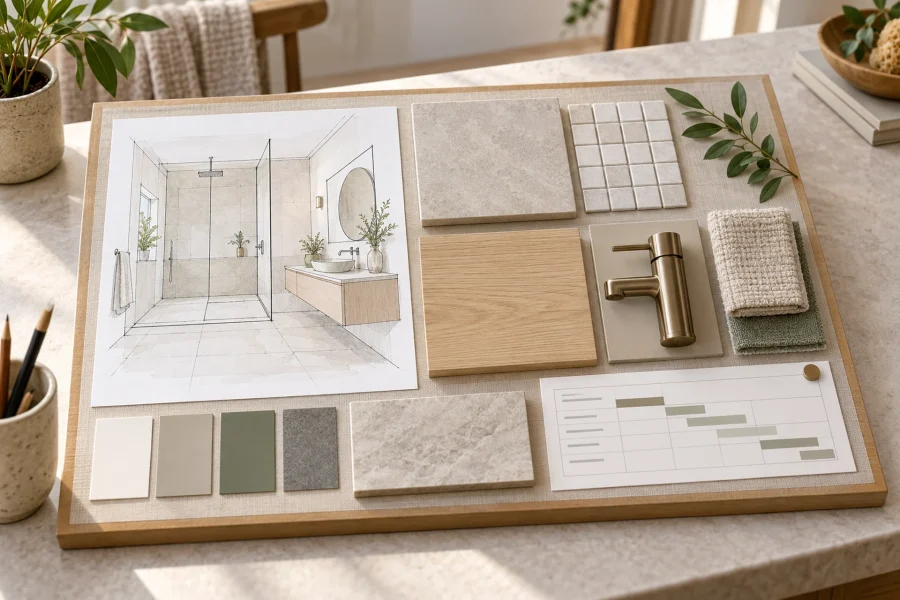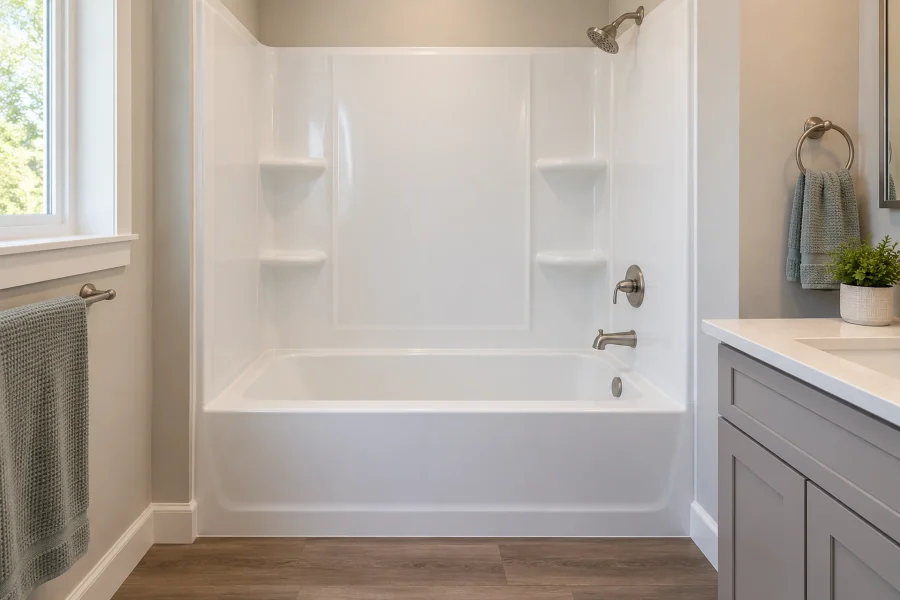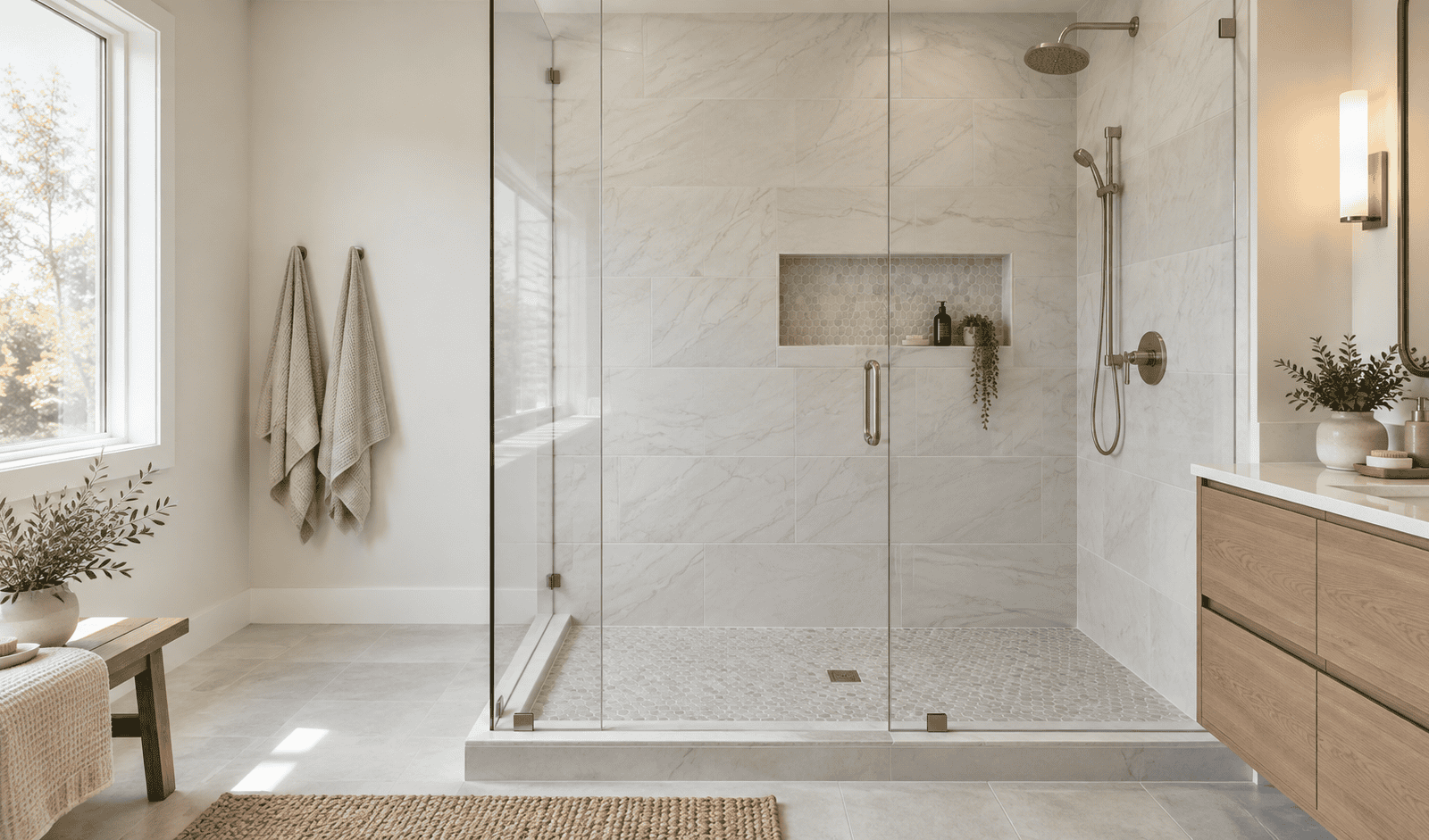
A professional shower retile commonly costs $1,800 to $5,000, with about $2,700 serving as a useful national planning figure. A small, straightforward project — builder-grade ceramic on a compact stall, minimal demolition — can come in closer to $900. Premium materials, a larger footprint, custom features, or water damage discovered once the old tile comes off can push the total toward $10,000 or, on large and highly custom projects, beyond it.
This guide is a national budgeting benchmark built from published cost data, not a quote for your specific bathroom. Every figure below is labeled as materials-only, installed (materials plus labor), or full-project cost, and traced to a named source, so you can see exactly what it covers and recalculate it for your own shower. Actual pricing depends on your local labor market, the exact square footage you tile, and what a contractor finds once demolition starts.
Quick cost summary
| What you’re pricing | Typical range | What’s usually included |
|---|---|---|
| Full professional retile — small, simple | $900 – $1,800 | Minimal demo, ceramic, basic waterproofing |
| Full professional retile — typical | $1,800 – $5,000 (avg. ~$2,700) | Demo, disposal, waterproofing, mid-range tile, labor |
| Full professional retile — premium or large | $6,000 – $10,000+ | Larger area, premium tile, custom features, or repairs |
| Installed cost per sq. ft. (materials + labor) | $4 – $65+, tile-dependent | See the material-by-material table below — varies enormously by tile type |
| Demolition of old tile | $2 – $5 per sq. ft. | Removal only; disposal and substrate condition can add more |
Shower Retiling Cost at a Glance
Not every “retile” is the same job, and lumping them into one average hides more than it reveals. It helps to think in three tiers.
A low-cost cosmetic project — regrouting or swapping a handful of cracked tiles on an otherwise sound wall — usually costs a few hundred dollars and isn’t really a retile at all; it belongs in the repair-versus-replace section below.
A typical professional retile covers demolition of the existing tile, disposal, a waterproofing membrane, mid-range ceramic or porcelain tile, and installation across the shower walls (and often the floor). This is the project most homeowners mean when they search for shower retiling cost, and published national data puts it at $1,800–$5,000, averaging around $2,700.
A high-cost project adds one or more expensive variables: natural stone or glass tile, an intricate pattern like herringbone, a larger walk-in footprint, or substrate and framing repairs discovered once demolition starts. These jobs can run $6,000–$10,000, and large, highly customized projects can exceed that — largely because labor time and material cost per square foot both rise together.
Retiling vs. Tiling a New Shower
“Cost to tile a shower” and “cost to retile a shower” are often used interchangeably online, but they describe different scopes of work, and mixing up their cost data is a common source of sticker shock.
Tiling a new shower usually happens after a shower pan, backer board, and waterproofing are already in place — during new construction or a full bathroom remodel. The contractor is setting tile on a prepared surface, so the price reflects tile and labor only.
Retiling starts with an existing, finished shower. Before any new tile goes up, the crew has to remove the old tile, haul away the debris, inspect and often replace the backer board and waterproofing membrane, and address any water damage hiding behind the old wall. These extra steps — demolition, disposal, surface preparation, and often a new waterproof membrane — are what separate a retile from a straightforward new install, and most published national cost guides (including the ones cited throughout this article) use “tile a shower” and “retile a shower” to mean essentially the same bundled project, so the cost ranges above already reflect a full retile scope rather than tile-only pricing.
Cost to Retile a Shower by Size
Shower square footage is not the same as tiled square footage. A shower floor plan tells you the footprint, but most of the tile in a retile goes on the walls — often floor to ceiling — so the real number to budget against is total tiled surface area, not floor area alone.
A workable formula:
Tiled area = (shower floor area, if tiled) + (wall area = perimeter × height) − (door and fixture openings) + (10–15% waste allowance for cuts)
| Shower size | Approx. tiled area (walls + floor) | Typical scope | Estimated total cost* |
|---|---|---|---|
| 32″ × 32″ stall | 65–80 sq. ft. | Ceramic, minimal demo, simple layout | $900 – $1,800 |
| 36″ × 36″ stall | 80–95 sq. ft. | Ceramic or porcelain, one niche | $1,800 – $2,800 |
| 60″ × 30″ tub-shower surround | 90–110 sq. ft. | Porcelain, walls + floor, standard waterproof rebuild | $2,800 – $4,200 |
| 60″ × 36″ walk-in | 100–130 sq. ft. | Porcelain or stone accent, niche, curb | $3,500 – $6,500 |
| Large custom walk-in | 140–180+ sq. ft. | Premium tile, bench, niche, complex pattern | $6,500 – $12,000+ |
*Illustrative ranges built from the per-square-foot and full-project figures cited throughout this article, not a separate survey. See the worked examples below for the assumptions behind each figure.
Shower Retiling Cost Breakdown
Old Tile Removal and Disposal
Removing existing shower tile typically costs $2 to $5 per square foot, according to Angi’s national cost data. For a standard 70–120 sq. ft. shower, that works out to roughly $150–$600 for demolition alone, before disposal fees or any substrate repair. Costs run higher when tile was set in an older-style mud bed or over metal lath, since the substrate itself often has to come out too, and in bathrooms with limited access (upper floors, tight stairwells) where debris has to be carried out rather than hauled through a ground-floor opening.
Tile Material Costs — Material Only vs. Installed
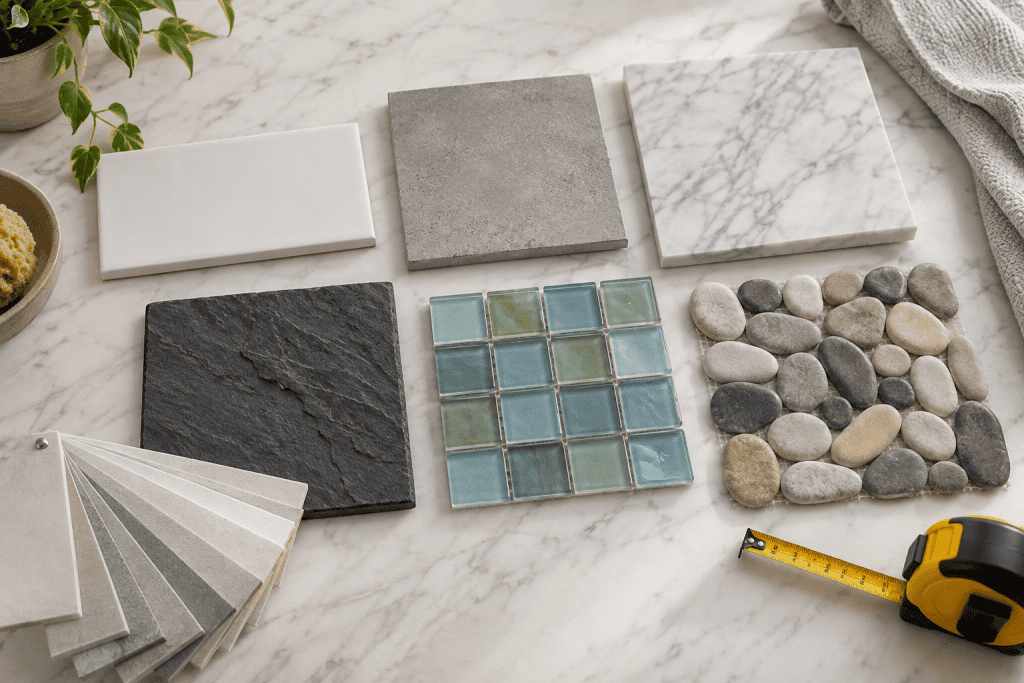
This is the single biggest source of confusion in shower cost guides, because “$25 a square foot” can mean either the tile itself or the finished, installed price — and the two numbers are very different. The table below, based on Fixr’s national shower tiling cost data, keeps them separate:
| Tile type | Material only ($/sq. ft.) | Installed ($/sq. ft.) |
|---|---|---|
| Ceramic | $1.25 – $100 | $4.25 – $110 |
| Porcelain | $3 – $30 | $17 – $46 |
| Slate | $3 – $15 | $13 – $27 |
| Marble | $3 – $50 | $13 – $65 |
| Terracotta | $5 – $15 | $10 – $30 |
| Limestone | $5 – $30 | $13 – $45 |
| Granite | $10 – $50 | $17 – $65 |
| Glass | $10 – $50 | $19 – $65 |
| Pebble tile | $30 – $40 | $42 – $70 |
Ceramic and porcelain span the widest ranges because both include everything from budget big-box tile to handmade or large-format designer lines — the low end of each range is a realistic “standard” choice, not an outlier. Natural stone and glass carry higher installed costs partly because of material price and partly because they take longer, more careful labor to set.
Professional Labor
According to Angi, professional tile installers typically charge $8 to $25 per square foot, or $60 to $120 per hour, and labor commonly makes up 65% to 75% of a shower tiling project’s total cost — more than materials in most cases. Rates vary by region, pattern complexity, and whether the crew is also handling demolition and waterproofing as part of the job.
For labor-market context only: the U.S. Bureau of Labor Statistics’ OEWS survey (May 2025 release) reports a national median wage for tile and stone setters of about $55,690 per year, roughly $26.77 an hour. That’s what a worker earns as an employee — it is not what a contracting business bills a homeowner, since a shop’s hourly rate also has to cover overhead, insurance, materials markup, and profit. Don’t treat the two figures as interchangeable.
Waterproofing and Substrate Repairs
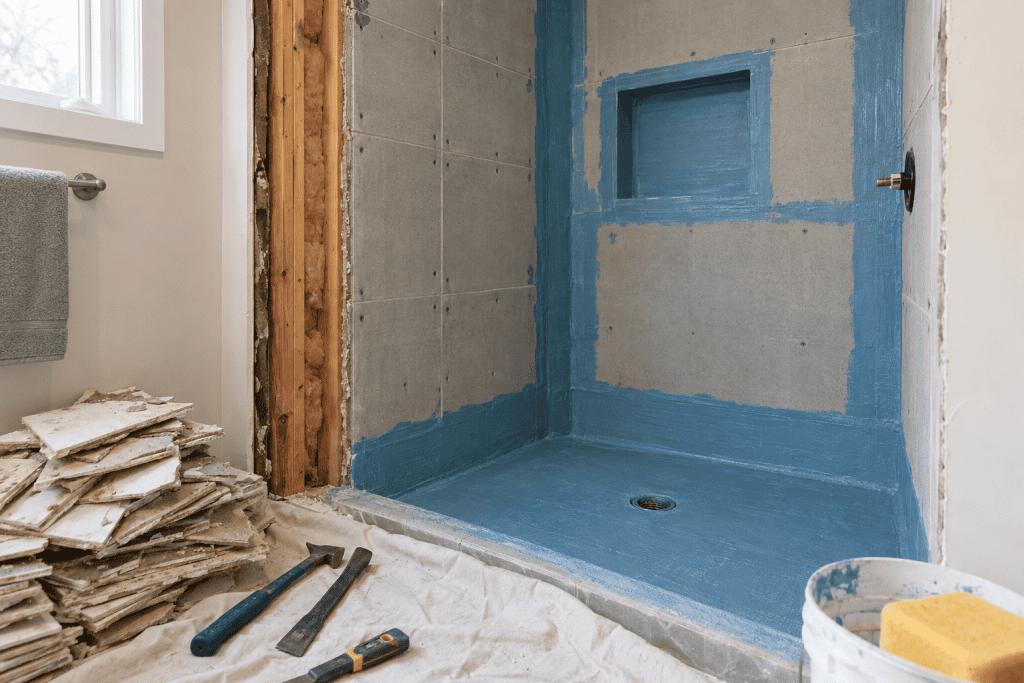
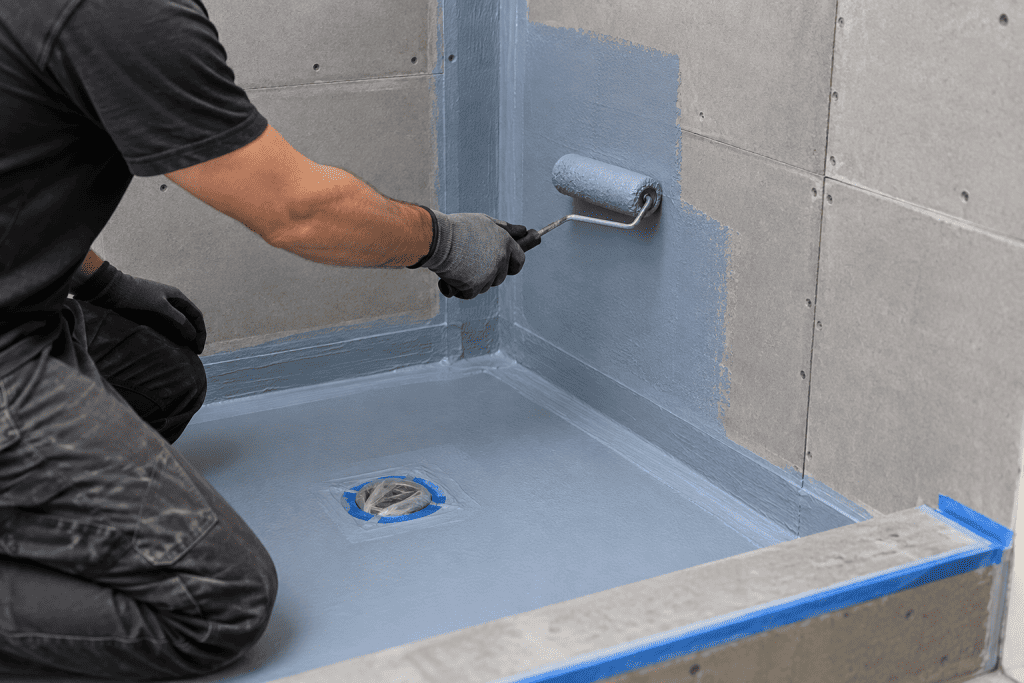
Tile and grout are not, by themselves, a waterproofing system — grout is porous, and without a membrane behind the tile, moisture can migrate into the wall cavity. If demolition reveals water-damaged framing or deteriorated backer board, Angi’s data puts water damage repair at $4 to $10 per square foot of affected area, depending on how far the damage extends. Waterproofing membrane material and labor add to the base tile-installation cost, though we don’t have a single authoritative national figure to cite for that line item in isolation — treat it as included within the installed and full-project ranges above rather than budgeting it separately until a more specific source is confirmed.
Optional Features and Add-Ons
A built-in niche, bench, decorative curb, accent band, or transition threshold each add labor and material cost. Larger upgrades — a heated floor system, a new drain, a rebuilt shower pan, or a frameless glass enclosure — are priced and quoted separately from the core retile, and are not included in the ranges above.
What Factors Affect the Cost
Several variables move the total more than any single line item:
- Tiled square footage — walls plus floor, not just the floor footprint.
- Tile material, size, and weight — installed cost per square foot varies by roughly 25x across the material table above.
- Pattern complexity — herringbone, mosaic, and intricate accent work add labor hours, and labor is the majority of most project budgets.
- Niches, benches, and curbs — every added feature is more cutting and waterproofing detail.
- Demolition difficulty — old mud-set tile, metal lath, or hard-to-access bathrooms cost more to remove than the $2–$5/sq. ft. baseline.
- Substrate and waterproofing condition — hidden water damage, at $4–$10/sq. ft. to repair, is one of the largest sources of change orders.
- Shower pan and drain work — replacing rather than reusing the pan adds significant cost, priced separately.
- Local labor rates and minimum project fees — many contractors have a minimum charge regardless of job size.
- Access and disposal — stairs, elevators, and dumpster or haul-away fees.
- Permits — some jurisdictions require a permit for work involving plumbing or waterproofing changes; requirements vary locally.
Example Shower Retiling Budgets
Illustrative calculations using assumed rates drawn from the sourced ranges above — not a surveyed national average for these specific shower configurations. Every unit price below falls inside the corresponding range cited earlier in this article.
Case 1 — Small stall shower, standard ceramic, minimal demo 32″ × 32″ stall, ~74 sq. ft. tiled area including waste, ceramic tile at the standard-grade end of the installed range, basic demolition
- Demolition (~74 sq. ft. × $2–$5/sq. ft.): $150 – $370
- Ceramic tile, installed (~74 sq. ft. × $8–$15/sq. ft., standard grade within Fixr’s $4.25–$110 range): $590 – $1,110
- Contingency (~10%): $75 – $150
- Estimated total: about $900 – $1,800
This range lines up with Fixr’s own published low-end figure of $900 for a comparable small, builder-grade shower.
Case 2 — Midsize walk-in, porcelain, one niche 36″ × 60″ footprint, ~118 sq. ft. tiled area including waste, porcelain tile, one built-in niche
- Demolition (~118 sq. ft. × $2–$5/sq. ft.): $236 – $590
- Porcelain tile, installed (~118 sq. ft. × $18–$28/sq. ft., mid-range within Fixr’s $17–$46 range): $2,124 – $3,304
- Niche framing and tile: $150 – $400
- Contingency (~10%): $250 – $430
- Estimated total: about $3,000 – $5,000
Case 3 — Large walk-in, premium tile, bench and niche, water damage found at demo Large walk-in, ~150 sq. ft. tiled area including waste, large-format porcelain with a natural-stone or glass accent, built-in bench, water damage discovered behind roughly 40 sq. ft. of wall
- Demolition (~150 sq. ft. × $2–$5/sq. ft.): $300 – $750
- Water damage repair (~40 sq. ft. × $4–$10/sq. ft.): $160 – $400
- Premium tile, installed (~150 sq. ft. × $35–$55/sq. ft., within the granite/glass $17–$65 range): $5,250 – $8,250
- Bench and niche construction: $400 – $800
- Contingency (~10%): $610 – $1,020
- Estimated total: about $8,000 – $12,000
DIY vs. Professional Shower Retiling
| DIY | Professional | |
|---|---|---|
| Upfront cost | Lower — materials and tool rental, no labor charge | Higher — labor is typically 65–75% of the total |
| Time | Often a full weekend or more for a first-timer | Usually several days depending on scope |
| Tools needed | Wet saw, notched trowel, level, membrane roller, etc. | Contractor supplies tools |
| Waterproofing risk | Higher — membrane and pan work are easy to get wrong | Lower, assuming a qualified installer |
| Warranty | None beyond product warranties | Workmanship warranties vary by contractor — ask directly |
| Best for | Small cosmetic jobs, experienced DIYers | Anything involving waterproofing, structure, or plumbing |
This isn’t a step-by-step DIY tutorial, and for good reason: waterproofing mistakes are the most expensive kind of mistake in a shower, because they aren’t visible until water damage has already spread. If your project involves significant water damage, mold, structural repair, drain work, or plumbing changes, it’s worth consulting a qualified professional rather than treating it as a weekend project.
Retile, Regrout, Repair, or Replace?
Not every worn-looking shower needs a full retile. Use the symptoms below as a starting point.
| What you’re seeing | Likely next step | When to get an in-person inspection |
|---|---|---|
| Grout is discolored or stained but tile is solid, with no leaks, odor, or softness | Regrout or deep clean | Usually not needed |
| A few cracked or chipped tiles, rest is sound | Spot repair / tile replacement | If you can’t match the tile |
| Tile is dated but structurally fine | Cosmetic retile | Not usually needed |
| Grout lines are cracking or crumbling repeatedly | Investigate substrate before regrouting | Yes — recurring grout failure often signals movement or moisture |
| Tiles feel loose, hollow, or are shifting | Full retile likely needed | Yes |
| Recurring leaks, staining on the ceiling below, or a musty smell | Possible hidden water damage | Yes — before any cosmetic fix |
| Budget is tight but shower is functional | Regrout, reseal, or targeted repair first | If any of the symptoms above are present |
Leaks, soft or spongy substrate, and mold are not DIY-diagnosis situations — they call for someone who can open the wall and see what’s actually happening behind the tile.
How to Estimate Your Project
A rough preliminary budget follows this structure:
Demolition + substrate repair (if needed) + tile materials, installed + optional features + contingency (10–15%) = estimated project total
A simple worksheet to fill in for your own shower:
- Tiled wall area (perimeter × height, minus openings): ______ sq. ft.
- Tiled floor area (if applicable): ______ sq. ft.
- Total with 10–15% waste allowance: ______ sq. ft.
- Chosen tile’s installed price per sq. ft. (from the material table above): ______
- Demolition estimate ($2–$5/sq. ft. × total area): ______
- Substrate/water damage repair, if applicable ($4–$10/sq. ft. of affected area): ______
- Optional features (niche, bench, curb, drain, pan): ______
- Contingency (10–15% of subtotal): ______
- Estimated total: ______
This structure is also designed so it can be turned into an interactive calculator later — each line is a discrete, independently priced input.
How to Compare Contractor Quotes
Because the categories above can be bundled or left out entirely, two quotes for the “same” shower can differ by thousands of dollars without either one being wrong. Before comparing price, confirm each quote covers the same scope:
- Is demolition and debris disposal included?
- Is a new backer board and waterproofing membrane included, or is the existing substrate being reused?
- What tile is specified, and at what installed price per square foot?
- What grout type is specified, and does it fit a wet environment?
- Are trim, edging, and niche work included or priced separately?
- Is the shower pan being replaced or reused?
- Is drain work included?
- Are permits, if required locally, included in the price or billed separately?
- What’s the estimated timeline, and what happens if hidden damage is found mid-project?
- What warranty covers the labor, and for how long?
- How are change orders handled and priced?
Since labor commonly makes up 65–75% of the total, a quote that looks unusually low relative to others is worth asking about specifically — it’s more likely to reflect less labor (and possibly a smaller scope) than a lower material cost. A lower bid that excludes demolition, waterproofing, or disposal is not actually a lower price — it’s a smaller scope.
How to Save Money Without Creating Water Problems
- Choose standard tile sizes and widely available materials — custom sizing and cutting add labor time, and labor is most of the cost.
- Simplify the layout; a straight-set pattern costs less in labor than herringbone or intricate mosaic work.
- Limit the number of add-on features (niches, benches, accent bands) to what you’ll actually use.
- Confirm tile quantities and your supplier’s return policy before ordering, so you’re not paying twice for shortfalls.
- Minimize mid-project changes — change orders are typically priced at a premium over the original scope.
- Compare quotes only after confirming they cover the same scope, using the checklist above.
What not to cut: waterproofing, substrate repair, and qualified labor for anything structural or plumbing-related. Skipping these to save money upfront is the most common way a retile turns into a much larger repair a few years later.
Frequently Asked Questions
How long does retiling a shower take? Install time itself commonly runs from about one day for a small, straightforward ceramic job to several days for larger or more complex projects, before accounting for waterproofing cure time and scheduling.
Can new tile go over old tile? Sometimes, if the existing tile is flat, sound, and well-bonded, but it’s not recommended for showers — it adds weight, can trap moisture behind two layers, and skips the chance to inspect and renew the waterproofing, which is the part of a shower most likely to be failing.
What’s the difference between regrouting and retiling? Regrouting removes and replaces only the grout lines between existing tiles; it’s a cosmetic and maintenance fix. Retiling removes the tile itself, which is a larger project that also lets you address the substrate and waterproofing underneath.
Can I retile just the floor and leave the walls? Yes, if the walls are sound and you’re only addressing floor wear or damage — this reduces total tiled area and cost. It’s less common than a full retile because the floor and walls typically share the same waterproofing system.
How much of the cost is labor versus materials? Based on Angi’s data, labor commonly represents about 65% to 75% of a shower tiling project’s total cost, with materials making up the rest — labor is usually the larger share, not roughly half.
Do I need extra tile in case pieces break later? Many installers recommend keeping some spare tile from the original batch, since discontinued colors and dye-lot differences can make future matching difficult. Ask your contractor or supplier for their specific recommendation.
Does homeowners insurance cover shower retiling? It depends entirely on the cause of damage and your specific policy — sudden pipe failure may be covered, while gradual leaks or general wear typically are not. Check with your insurer rather than assuming either way.
Do I need a permit to retile a shower? That depends on your local building department and whether the work involves plumbing or waterproofing changes recognized under your jurisdiction’s code. There’s no single national answer — confirm with your local permitting office.
How long does a retiled shower last? A properly installed tile shower can remain serviceable for many years, but its lifespan depends heavily on waterproofing quality, movement control, maintenance, and the condition of the underlying assembly rather than on the tile itself.
Conclusion
A national average price is only a starting point. Most professional shower retiles fall between $1,800 and $5,000, averaging around $2,700, but your real budget depends on how much surface you’re actually tiling, the material you choose, how demolition goes, and whether the waterproofing has to be rebuilt from scratch. Before signing a contract, make sure any quote you’re comparing covers the same scope as the estimates above — and remember that a bid that looks unusually low often means something has been left out, not that you found a better deal.

Ethan Miller
Ethan Miller writes about home improvement, interior design, cleaning, and everyday living at Home & Living Daily. He shares practical tips and simple ideas to help readers create more comfortable and functional homes.