
Outdoor solar lights have several different lifespans: the hours they run after charging, the usable life of the rechargeable battery, and the service life of the complete fitting. There is no dependable single number that covers all three. Check the model’s runtime conditions, battery information, and replacement-part support separately.
An “up to eight hours” runtime claim does not mean the light will run eight hours after a cloudy winter day. An LED-hour rating also does not promise that the battery, seal, sensor, and housing will last equally long.
Ask which clock the claim describes
| Claim or question | What it describes | What it does not establish |
|---|---|---|
| Hours per charge | Nighttime operation under specified charging and mode conditions | Reliable all-night coverage in every season |
| Battery replacement interval | A particular battery’s maintenance or capacity expectation | The same schedule for every chemistry and light |
| LED operating hours | A light-source performance or maintenance claim | The life of all the other components |
| Warranty period | The seller’s stated coverage, conditions, and remedies | A measured average service life or guarantee against every form of deterioration |
Keep the model and operating mode with any figure you record. A motion-triggered light advertising several nights of reserve is not necessarily providing continuous full-output illumination for those nights.
Read nightly runtime with its charging conditions
Runtime depends on stored usable energy and how quickly the light consumes it. Higher output, longer motion activations, decorative effects, and extra connected lights can change demand. A dusk-to-dawn label may describe the control behavior rather than a guarantee that the battery can supply every hour until dawn.
For an idealized arithmetic example, 2 watt-hours of usable energy supplying a constant 0.25-watt load would last eight hours before losses or protective cutoffs. That is not a specification for a particular garden light. It explains why quoting battery capacity without the load gives an incomplete answer.
Sunlight has to replenish that energy. Shade, a dirty panel, short winter days, snow cover, and unsuitable temperature conditions can reduce what the system collects or stores. A clear afternoon is not equivalent to the charging conditions in every product’s runtime statement.
Investigate shorter operation before buying a battery
Check the panel and lens, the selected mode, switch position, and changing shade. Follow the model’s full charging procedure, then observe operation under comparable conditions. A nearby porch light may also affect a dusk sensor and make the lamp appear faulty.
Keep a simple note of the weather, mode, switch-on time, and when the light becomes unusably dim or turns off. Compare like with like. A bright summer evening and an overcast winter day do not form a controlled battery comparison.
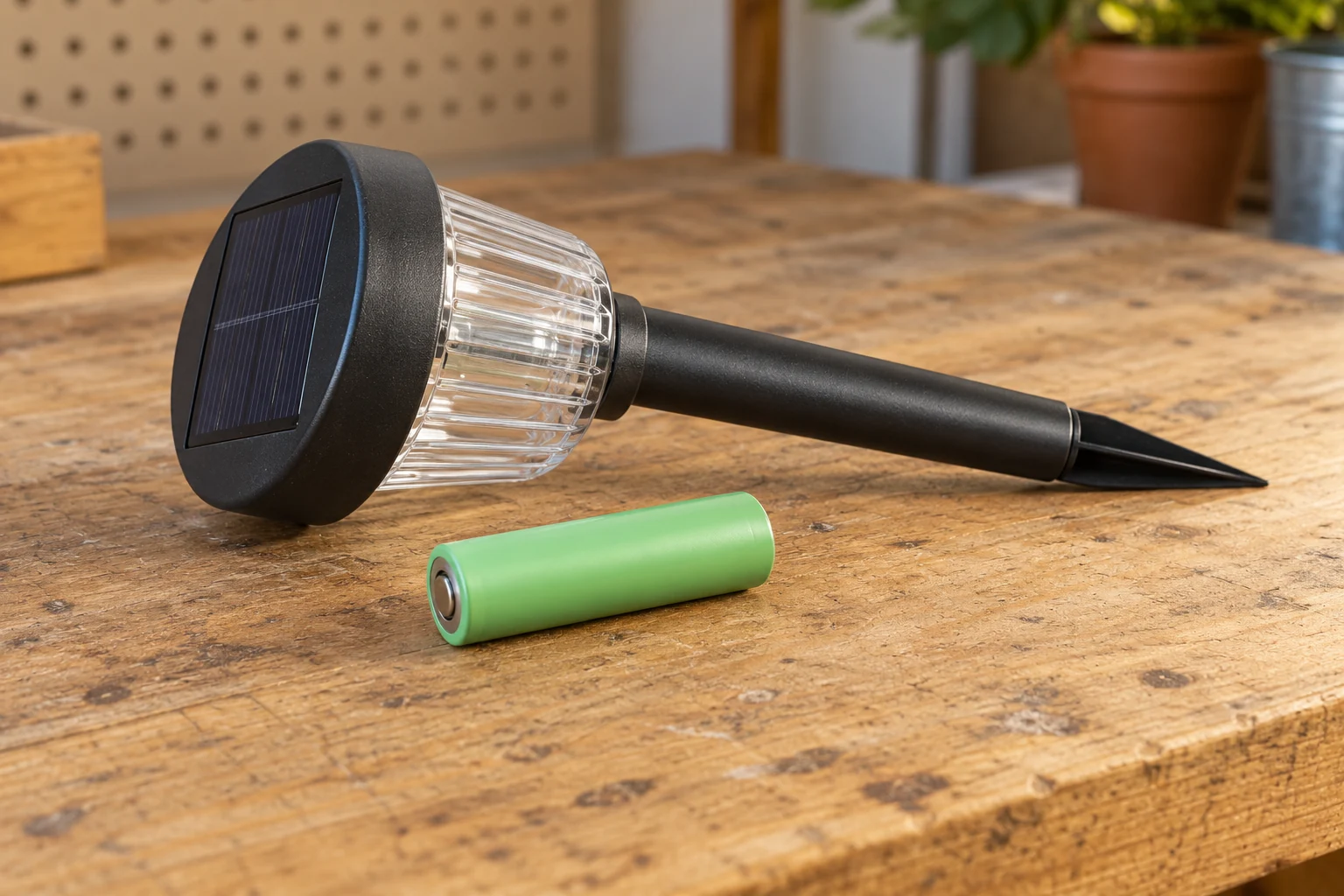
If the light previously performed well and remains poor after suitable charging with the same mode, reduced battery capacity is one possibility. Water ingress, damaged connections, electronics, or the light source can produce other failures. Do not call every short runtime a dead battery.
Separate battery wear from whole-light failure
Use the maker’s maintenance guidance for the actual battery. Different products use different rechargeable chemistries and capacities, and some packs are sealed or not user-replaceable. A stated interval for one model should not be transferred to the whole category.
For a user-serviceable design, match the specified voltage, chemistry, dimensions, connector or terminal arrangement, and capacity requirements. Do not substitute a disposable cell or another rechargeable chemistry because it physically fits. Avoid modifying the charging circuit to pursue longer runtime.
A correct replacement battery may extend the use of an otherwise sound fitting. It will not repair cracked seals, a damaged panel cover, or failed electronics. Stop using a unit with a swollen, leaking, hot, or damaged battery and follow the manufacturer’s handling advice.
Read LED-hour claims cautiously
A lamp can lose useful performance gradually or fail because another component stops working. The government-hosted LED Systems Reliability Consortium lifetime guide explains why light-source performance and whole-luminaire reliability need to be considered separately. It is a systems principle, not a dataset establishing a solar garden light’s lifespan.
Ask whether the quoted hours describe the LED package or complete product, and what operating conditions and failure definition were used. Read the warranty exclusions for batteries, normal finish changes, and environmental exposure rather than treating the warranty length as a lifespan forecast.
Buy for the lighting need and serviceability
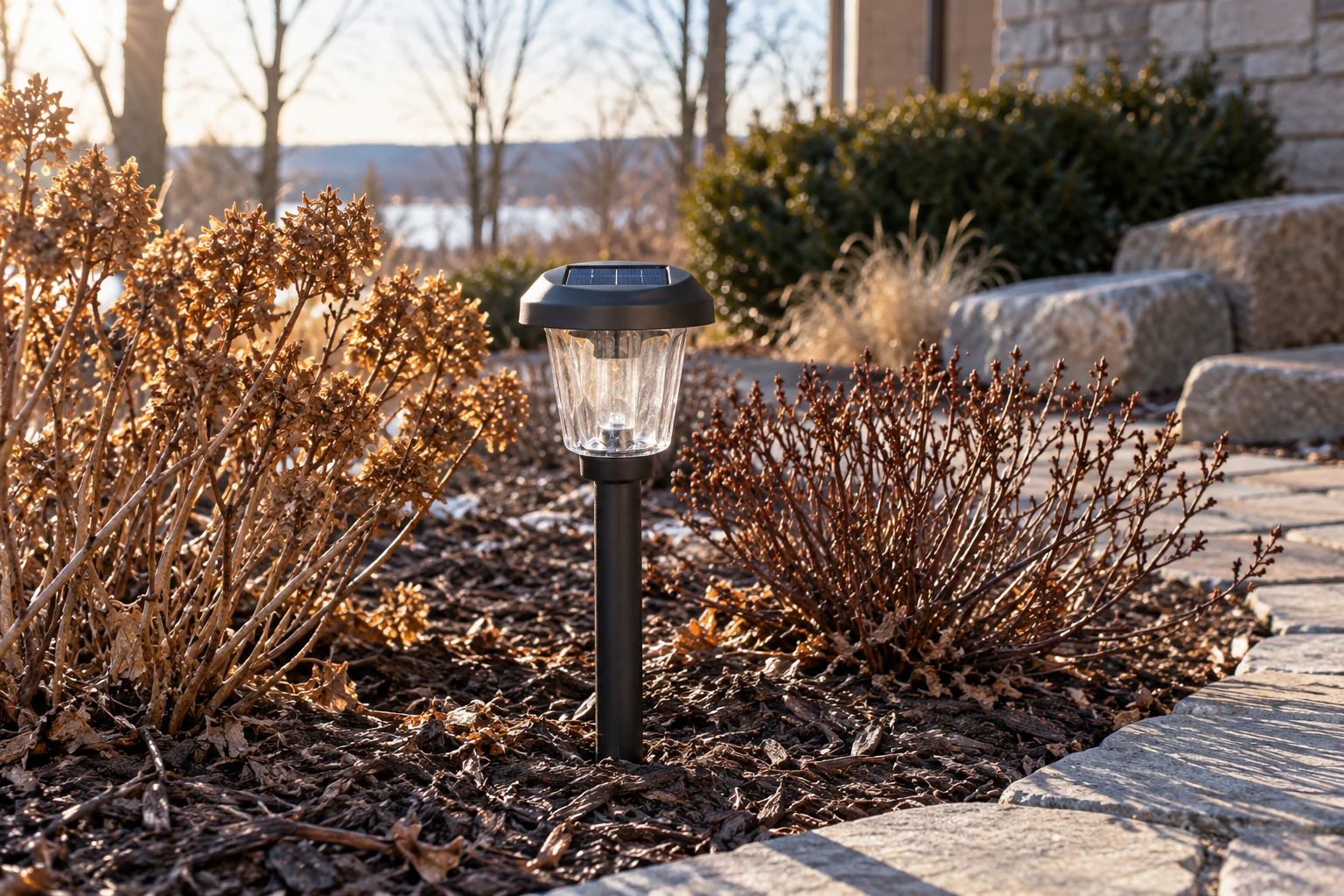
For decorative accents, variable nightly runtime may be acceptable. For an entrance or route that needs dependable illumination at a particular time, assess the full winter performance and an appropriate backup or different power arrangement.
Look for clear mode-specific runtime information, replaceable parts where useful, a realistic battery procedure, suitable exposure ratings, and accessible support. Store and maintain the light as its instructions require.
When a rechargeable battery reaches the end of use, follow EPA battery-management guidance and local collection arrangements. Rechargeable batteries belong in appropriate collection streams rather than household rubbish or municipal recycling bins. Plan the eventual maintenance as part of the purchase, not only after the first lamp goes dark.

Ethan Miller
Ethan Miller writes about home improvement, interior design, cleaning, and everyday living at Home & Living Daily. He shares practical tips and simple ideas to help readers create more comfortable and functional homes.