Palm trees range from towering coastal landmarks to compact, clumping shrubs, and their needs vary just as much. For a quick first look, check the fronds: feather-shaped leaves point to a pinnate palm, while hand-shaped fans belong to palmate or costapalmate palms. Then match the species to your climate, available space, and soil drainage before you plant.

How to recognize palm tree types
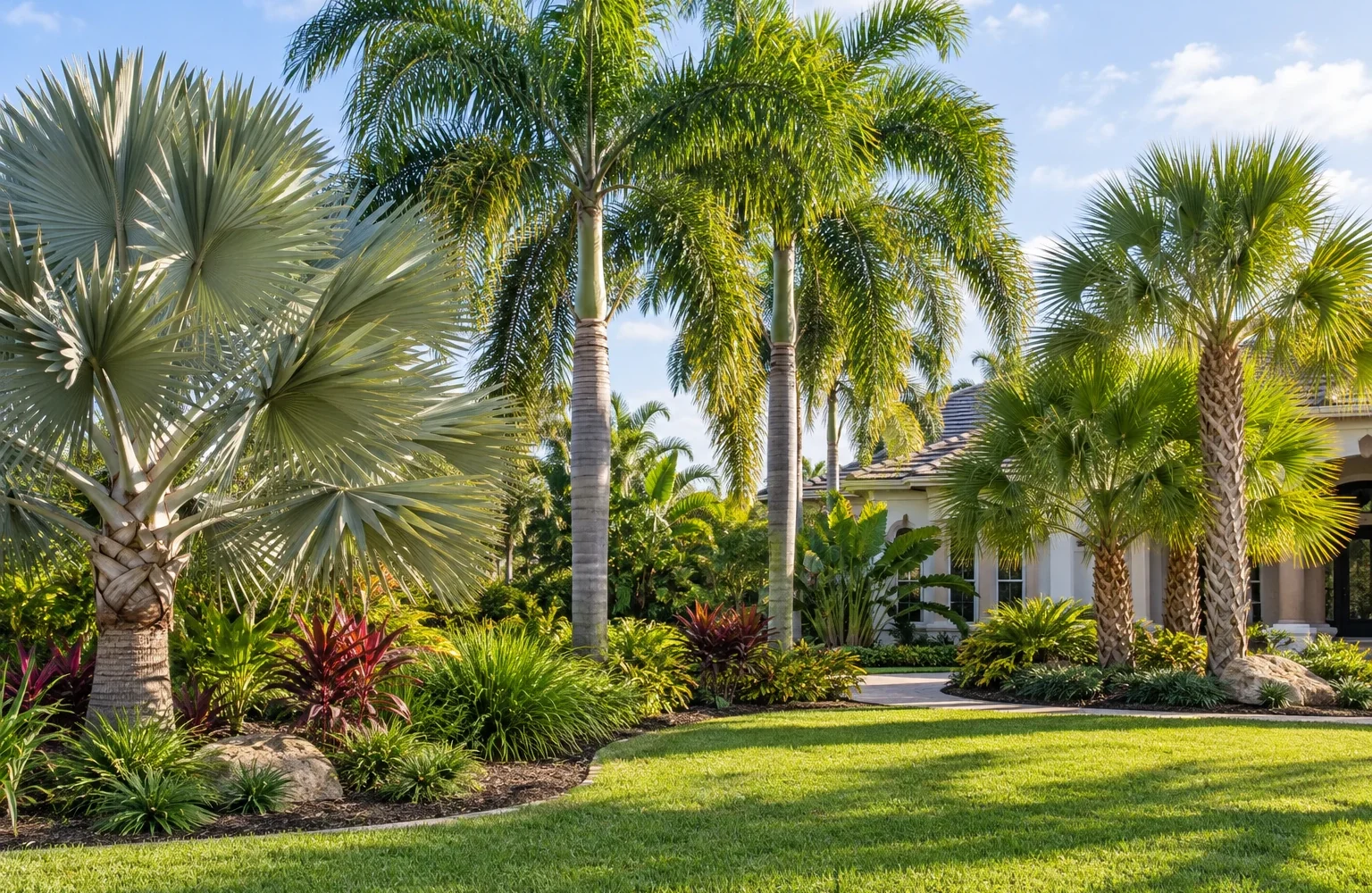
Most palms have one of three leaf forms. Pinnate, or feather, fronds carry leaflets along a central stem; coconut, queen, and date palms are familiar examples. Palmate fronds spread from one point like fingers from a hand. Windmill and Mexican fan palms are examples. Costapalmate fronds look fan-shaped but have a noticeable extension of the leaf stalk into the blade; sabal palms fit this group. These shapes are a useful starting point, but trunk, growth habit, fruit, and region help confirm an identification. UF/IFAS explains the three palm leaf structures.
Also note whether the palm grows from one trunk or forms a clump, whether the trunk is smooth or fiber-covered, and how large the mature crown becomes. Common names can vary by region, so use the scientific name when checking a nursery label.
12 common types of palm trees
1. Cabbage palm (Sabal palmetto)
This southeastern U.S. native has a sturdy single trunk and rounded, costapalmate fronds. It is widely used in coastal and warm-climate landscapes and is more cold tolerant than many tropical-looking palms. Give it room for a broad crown and choose a site suited to its eventual height; a young plant can look deceptively small.
2. Windmill palm (Trachycarpus fortunei)
A strong candidate for cooler regions, the windmill palm has a relatively slender trunk covered in brown fibers and a crown of fan leaves. It is valued for cold tolerance, though exposure, drainage, and the plant’s health affect winter performance. Protect it from harsh winds where practical and avoid waterlogged soil.

3. Needle palm (Rhapidophyllum hystrix)
This low-growing, clumping palm is prized in colder parts of the Southeast. Its fan-shaped leaves rise from a dense base, and sharp needle-like spines sit among the leaf bases. Place it away from narrow paths where people might brush against the spines.
4. Dwarf palmetto (Sabal minor)
Unlike a classic tall palm, dwarf palmetto usually stays low, with much of its trunk at or below ground. Its fan leaves suit naturalized beds and smaller landscapes. It can handle more cold than many palms, but still needs conditions appropriate to the local climate and soil.
5. Saw palmetto (Serenoa repens)
Saw palmetto forms a spreading, often multi-stemmed clump rather than a tall single-trunk tree. Its fan leaves may be green or blue-green, and it works best where there is room for its horizontal spread. The leaf stalks have saw-toothed edges, so avoid tight spaces and high-traffic borders.
6. Pindo palm (Butia odorata)
Also called jelly palm, this slow-growing palm has arching, blue-green feather fronds and a stout trunk. It is a popular choice for a tropical look in milder regions with occasional cold. Its fruit can attract wildlife and create cleanup, so consider placement over patios and walkways.

7. Queen palm (Syagrus romanzoffiana)
Queen palms are known for a smooth, slender trunk and long, graceful feather fronds. They grow quickly in warm areas and can become large, so allow generous overhead clearance. They are less suitable where freezes are common and may struggle in alkaline soils; check local extension guidance before planting.
8. Mexican fan palm (Washingtonia robusta)
This tall, narrow palm has a slender trunk topped by large fan leaves. It is a familiar street and skyline tree in warm, dry parts of the West and Southwest. Its height can make maintenance difficult and unsuitable for many residential lots, so consider mature scale before choosing it.
9. California fan palm (Washingtonia filifera)
California fan palm has a thicker trunk and broad fan crown than its Mexican relative. It is adapted to arid settings and does not perform as well in humid climates. A large crown and eventual height call for an open planting site.
10. Date palm (Phoenix dactylifera)
Date palms have feather-shaped fronds, a stout trunk, and edible dates when the right female cultivar is pollinated. They are grown as fruit trees and ornamentals in hot, dry regions. Fruit production and harvest require planning, and the sharp leaf bases mean it should not crowd walkways.
11. Pygmy date palm (Phoenix roebelenii)
This smaller date palm is often sold as a landscape accent or container plant in warm regions. Its arching feather fronds look delicate, but the leaf bases can be sharp. Although it is sometimes grown indoors, it needs suitable bright light and is not interchangeable with palms adapted to low-light rooms.
12. Coconut palm (Cocos nucifera)
The coconut palm is a tall, tropical feather palm associated with warm coastal regions. It needs sustained warmth and is highly vulnerable to cold, which limits outdoor use across most of the continental United States. Choose it only where local conditions support long-term growth.

Which palm should you choose?
- For cooler winters: Start by researching windmill palm, needle palm, dwarf palmetto, and regionally suitable sabal palms. Local microclimates and plant condition matter, so hardiness ranges are guides rather than guarantees.
- For a warm coastal landscape: Sabal, queen, and other regionally proven palms may fit, depending on salt exposure, drainage, and space.
- For a dry western yard: California fan and date palms may be better adapted than humidity-loving selections; check water needs and local restrictions.
- For limited space: Consider dwarf palmetto, saw palmetto, or a smaller pindo palm, but account for mature spread and leaf-spine hazards.
- For a container: Pygmy date and some windmill palms can be grown in large pots, but container size, drainage, light, and winter protection become part of the care plan.
Before buying, check the USDA hardiness zone for your location, then confirm recommendations with a nearby Cooperative Extension office. Zone labels describe average annual extreme minimum temperatures; they do not account for every freeze duration, wind exposure, drainage issue, or young-plant vulnerability. UF/IFAS notes that cold response depends on the palm’s age, health, and local conditions. Mississippi State Extension’s Midsouth palm guide also compares mature sizes and regional suitability.

Are sago palms and ponytail palms true palms?
No. Sago palm (Cycas revoluta) is a cycad, and ponytail palm (Beaucarnea recurvata) belongs to a different plant family. Their common names can make them easy to confuse with true palms. Sago palm is toxic if ingested by people or pets, so keep it away from children and animals.
What to remember
There is no single best palm for every yard. Identify the frond type, check the mature dimensions, and choose a species suited to your winter temperatures, summer conditions, and drainage. A locally adapted, appropriately sized palm will usually be easier to maintain than a tropical species chosen for appearance alone.
Sources
- UF/IFAS: Palm Leaf Structure
- UF/IFAS: Cold-Hardy Palms
- Mississippi State University Extension: Palms & Cycads for the Midsouth Landscape
- North Carolina Extension Gardener Plant Toolbox: Windmill Palm

Ethan Miller
Ethan Miller writes about home improvement, interior design, cleaning, and everyday living at Home & Living Daily. He shares practical tips and simple ideas to help readers create more comfortable and functional homes.