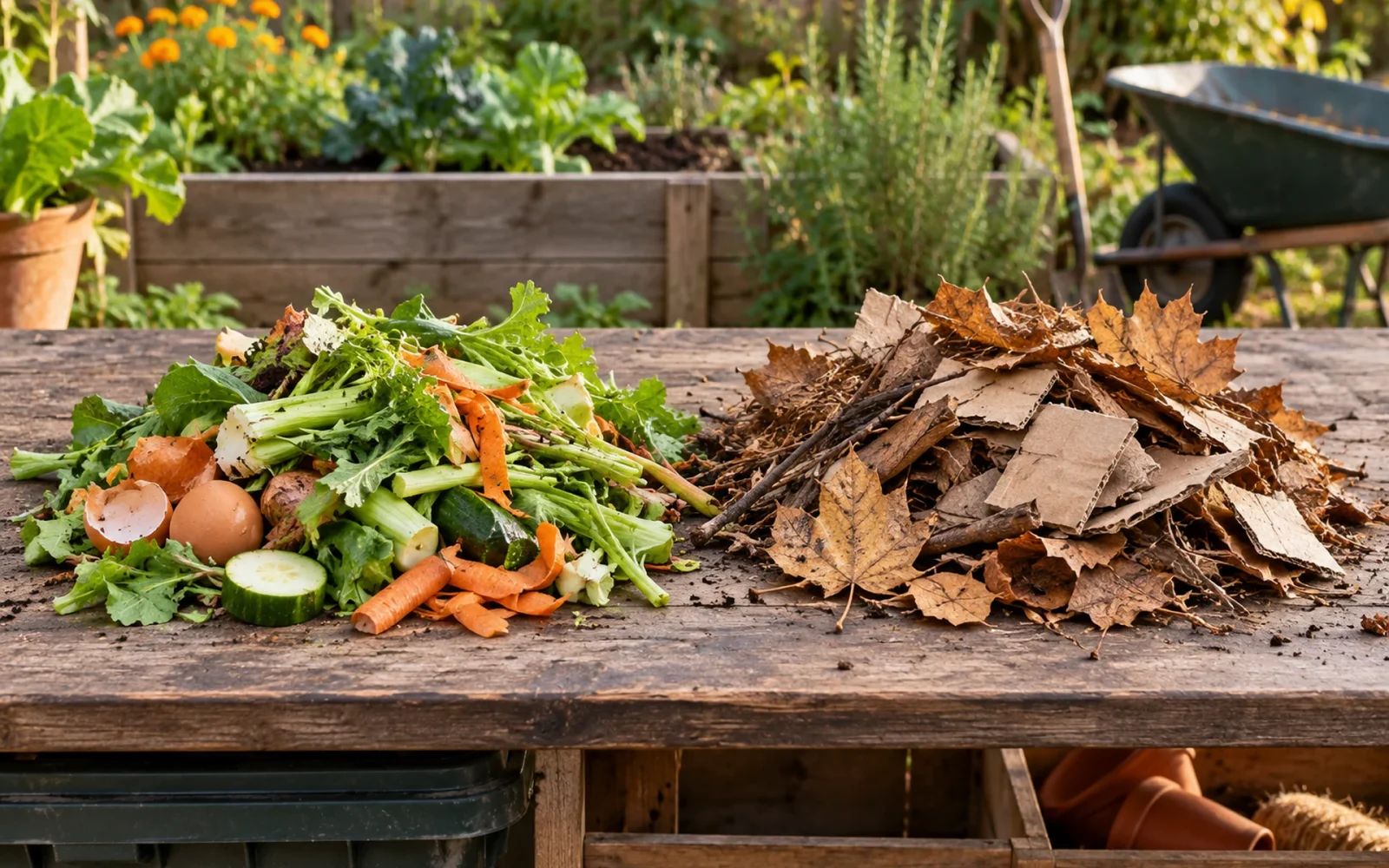
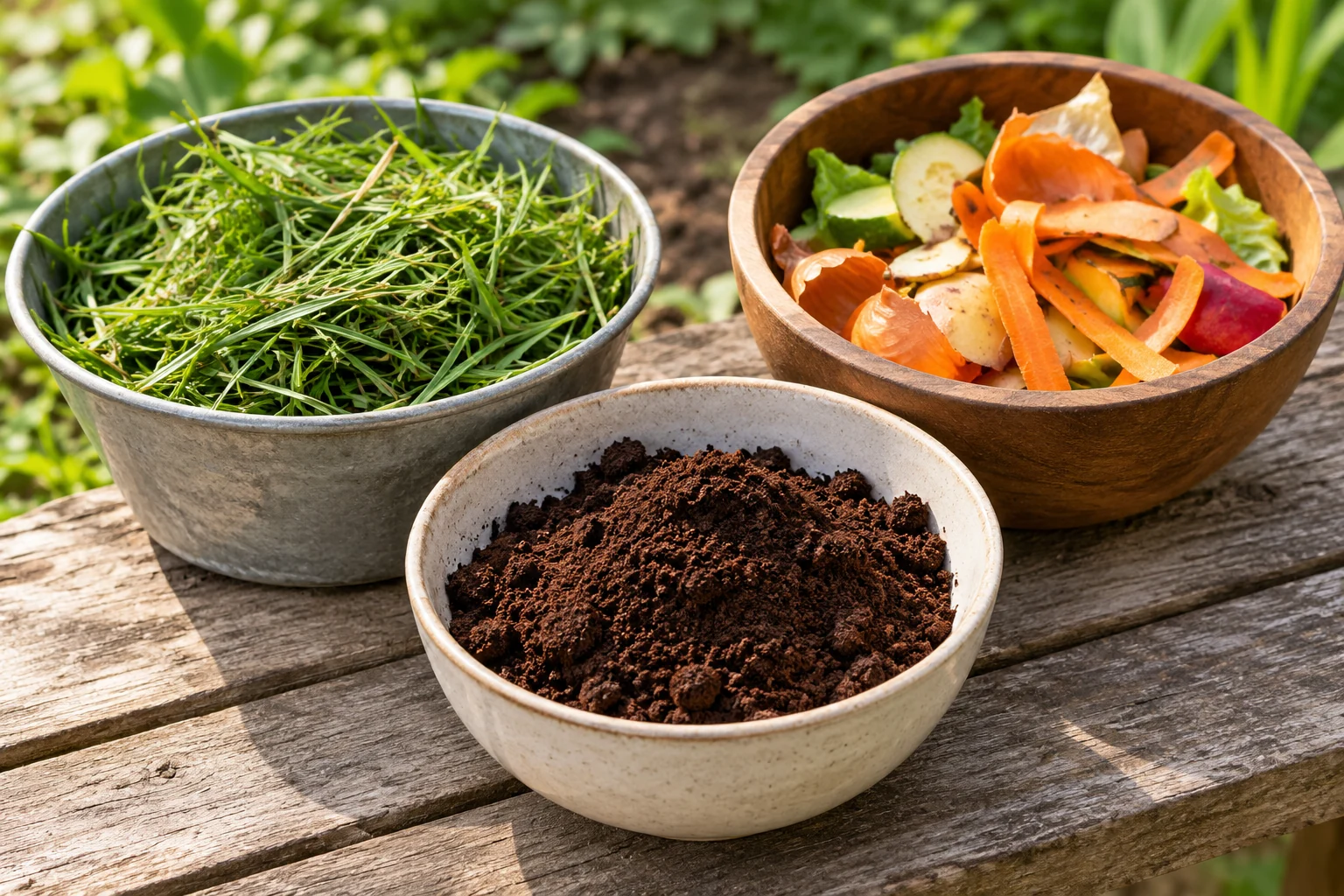
Compost “greens” are relatively nitrogen-rich ingredients such as vegetable scraps, fresh grass clippings, and coffee grounds. “Browns” are relatively carbon-rich ingredients such as dry leaves, plain cardboard, and straw. The names describe their role, not simply their color: brown coffee grounds count as a green input.
Use both groups, then adjust the mixture by its moisture, structure, and activity. A bucket ratio can help you start, but it cannot account for every combination of ingredients.
The two groups do more than supply nutrients
Greens often arrive with considerable moisture and readily available material for decomposition. Browns supply carbon and, depending on their form, can absorb moisture and help the pile remain porous.
The Cornell Waste Management Institute’s balancing guide describes these complementary roles: greens supply nitrogen and moisture, while browns contribute carbon and structure. That helps explain why a container filled only with wet food scraps behaves differently from a mixed pile.
Texture matters within each group. A sheet of wet cardboard, finely packed sawdust, and a loose handful of leaves are all brown inputs but do not create identical air spaces. “Add more browns” still requires choosing a useful form and mixing it appropriately.
A short guide to common inputs
| Input | Usual role | What to remember |
|---|---|---|
| Vegetable and fruit trimmings | Green | Wet, soft material; remove stickers and avoid an exposed food pile |
| Fresh untreated grass clippings | Green | Can mat together when added in a thick layer |
| Coffee grounds | Green | The brown color does not make them a carbon-rich brown input |
| Plain paper coffee filter | Brown | Different role from the grounds inside it |
| Dry fallen leaves | Brown | Size, dampness, and how tightly they pack change the mix |
| Torn plain cardboard | Brown | Remove unsuitable tape, coatings, and labels |
| Untreated woody material | Brown | Useful structure, but larger pieces may decompose slowly |
This is a balancing guide, not permission to compost every material in those categories. Treatment history, contamination, packaging, and the capabilities of your system still matter.
Why 30:1 does not mean thirty buckets of leaves
Cornell’s compost-chemistry explanation describes an initial carbon-to-nitrogen target around 30:1 by weight. That is carbon relative to nitrogen in the material, not a recipe of thirty parts brown ingredients to one part greens.
Both groups contain carbon and nitrogen, just in different proportions. They also contain different amounts of water and available carbon. A volume of loose leaves does not weigh the same as a volume of wet peelings or tightly packed paper.
That is why fixed bucket recipes vary between guides. They are rough management aids based on particular materials, not chemical analyses. For a household pile, observation is often more useful than pretending you can calculate an exact ratio from an unidentified bag of leaves.
Start with an identifiable mixture
Use a modest amount of suitable greens and enough loose, prepared browns to distribute the scraps and retain an airy structure. Cover food rather than leaving it visible around the perimeter.
As an illustrative trial for leaves and vegetable scraps, you might measure three loosely filled containers of leaves alongside one container of trimmings. Mix and inspect the result. That is a starting experiment with those materials, not proof that the chemical ratio is correct or a rule for sawdust, cardboard, and manure.
Use the same container and a consistent loose fill if you want to compare batches. Note what you added and how the pile behaves. Changing the packing method can alter the recipe as much as changing the written number.
Adjust to the condition you find
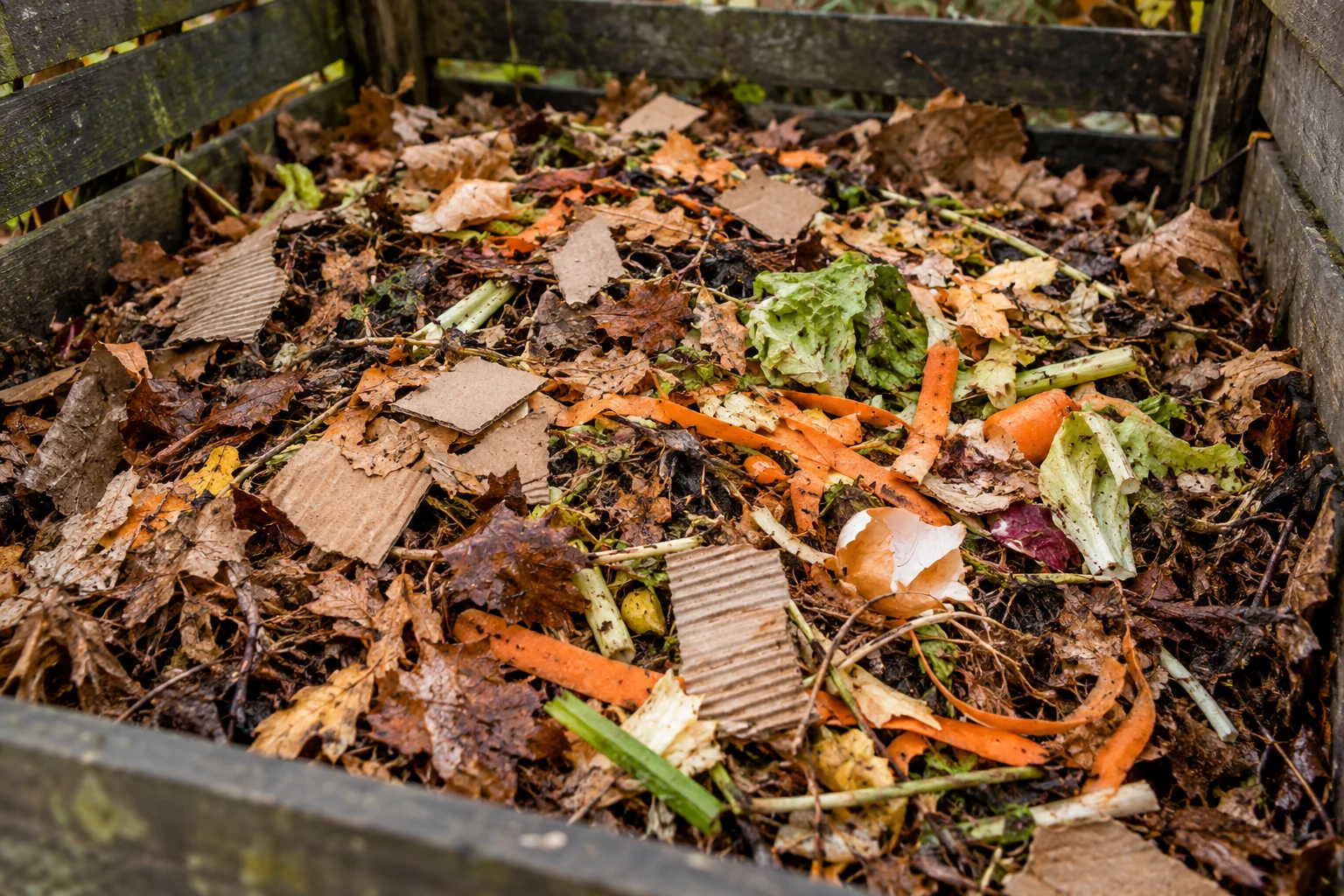
Wet and dense: stop adding another load of wet scraps. Break apart compacted sections and distribute suitable drier browns. Check rain entry and drainage as well as the ingredient balance.
Ammonia-like odor after a large green addition: reassess the nitrogen-heavy mix and incorporate appropriate carbon-rich material. A dry cap on top may not correct the center.
Dry and unchanged: check moisture before adding more food. If the mixture is adequately damp but dominated by slow woody material, some suitable greens and more time may be needed.
Cool without other problems: consider weather, pile size, and the method. A lack of heat does not automatically mean you need a nitrogen additive, especially in a small or winter pile.
Make one considered correction, then observe the response. Adding water, fertilizer, several new scraps, and a starter at the same time makes it harder to learn what the system needed.
Keep browns available between seasons
Store clean dry leaves or prepared plain cardboard where you can reach them with the next kitchen scraps. Protect them from becoming a soaked, compressed reserve.
That simple supply habit often matters more than achieving a perfect recipe on paper. A balanced routine is one you can repeat with known materials, then adjust when the weather or incoming scraps change.

Ethan Miller
Ethan Miller writes about home improvement, interior design, cleaning, and everyday living at Home & Living Daily. He shares practical tips and simple ideas to help readers create more comfortable and functional homes.