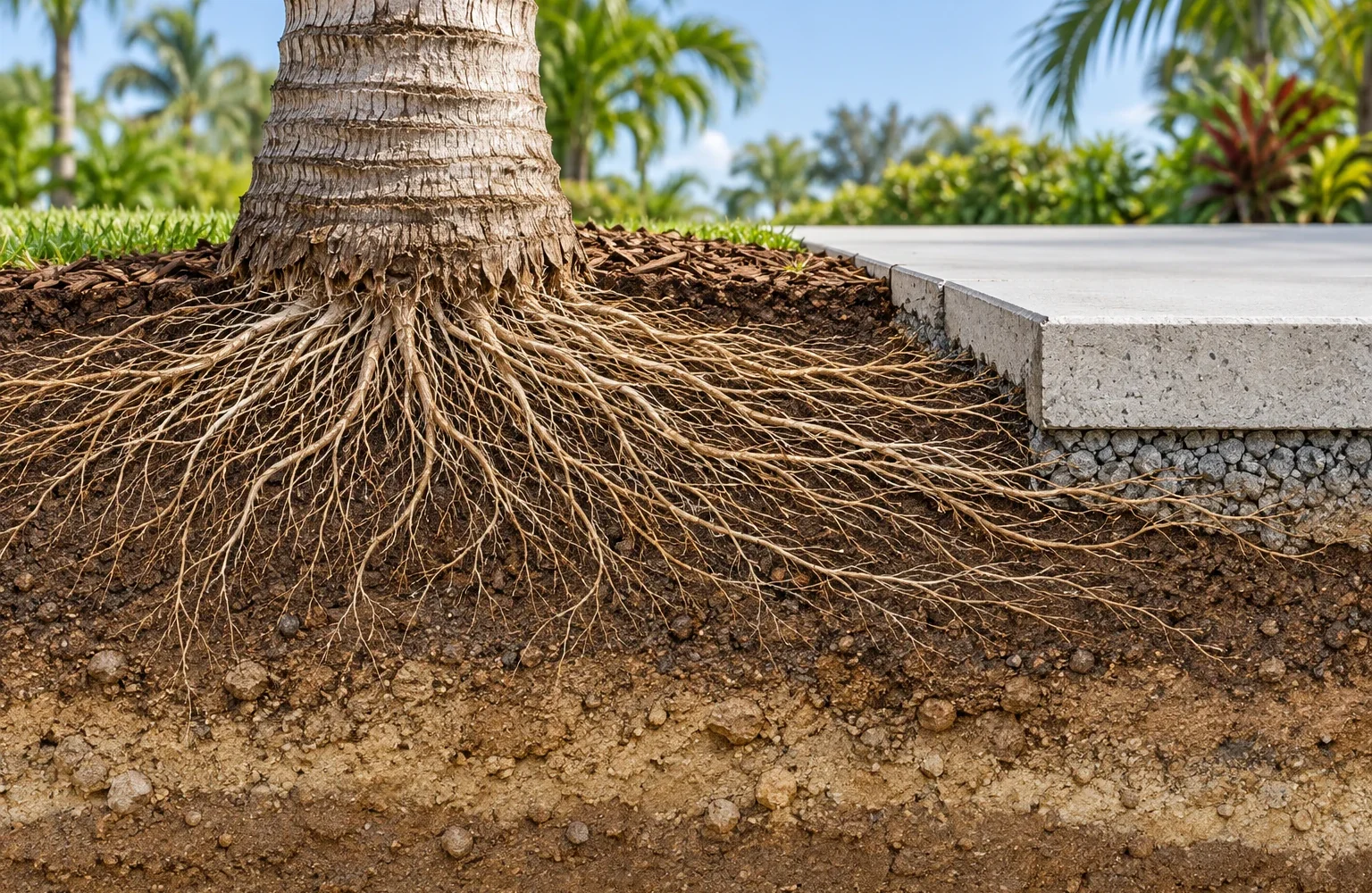
Usually, palm tree roots are a lower risk to a sound foundation than the thick, expanding roots of many hardwood trees. Palms grow a dense network of thin, fibrous roots from the trunk base. Those roots do not typically enlarge like woody roots that wedge against concrete. Still, a palm planted too close to weak paving, a retaining wall, shallow irrigation, or a damaged pipe can create real problems.
The useful distinction is between major structural damage and surface or maintenance conflicts. A healthy palm rarely cracks a well-built foundation by force alone. Its shallow root mass can, however, contribute to lifted pavers, crowded planting beds, or root growth into an already leaking line.
How palm roots grow
Unlike a typical oak or maple, a palm does not rely on one large taproot. It produces many adventitious roots from a root-initiation zone near the trunk base. Most of the active root mass is relatively shallow, though roots can travel farther through loose, irrigated soil. The exact depth and spread depend on species, soil, water, and the space available.
That biology explains why palms are often easier on sound foundations than large woody trees, while still being capable of crowding hardscape edges. For a variety overview, see our separate guide to different types of palm trees when that page is publicly available.
What can palm roots damage?
| Site feature | Typical risk | What to check |
|---|---|---|
| Sound foundation | Low in most cases | Existing cracks, movement, drainage problems, and very tight planting distances |
| Sidewalks, patios, and pavers | Moderate nuisance risk | Slab thickness, edge restraint, shallow roots, and lifting or trip points |
| Water or sewer pipes | Usually indirect | Leaks, cracked joints, older lines, and roots entering an existing opening |
| Shallow irrigation | Possible interference | Emitter lines, valve boxes, and roots pressing against fittings |
Concrete and foundations
Thin palm roots generally do not create the same expanding wedging pressure as woody structural roots. A sound foundation is therefore usually a lower-risk target. The more common concern is a slab or paver edge that is thin, poorly compacted, already cracked, or boxed tightly against a dense root zone.
If a walkway rises next to a palm, do not assume the tree caused every crack. Compare the direction of movement, inspect drainage and soil washout, and look for roots actually contacting the underside. A qualified arborist or contractor can separate root pressure from settlement or construction failure.
Pipes and drains
Roots seek moisture, but they usually exploit a pipe that already has a leak, open joint, or crack rather than crushing an intact line. If you see recurring wet soil, slow drainage, or roots around a cleanout, have the line camera-inspected before deciding whether the palm is the cause.
Patios, pavers, and irrigation
Shallow roots can press against flexible irrigation tubing, crowd a narrow bed, or lift individual pavers. These are repairable landscape conflicts, but cutting major roots on a standing palm can reduce stability and health. Treat root pruning as a professional decision.
How far should you plant a palm from hardscape?
Use the mature height and root-zone size of the selected species, not the size of the nursery plant. As a practical starting point, leave several feet for small palms and a wider setback—often 10 feet or more—for large, spreading species. Check local extension guidance and the palm’s mature dimensions before planting near a slab, wall, or utility corridor.
Also map irrigation and utility routes first. Consistent watering near the intended root zone is better than repeatedly wetting a foundation edge, and it reduces the chance that roots will follow a narrow moisture trail under paving.
Can a root barrier help?
A properly installed barrier can redirect shallow roots away from a walkway or patio edge. It needs continuous coverage, adequate depth, and an installation that does not trap the trunk or create a new drainage problem. A barrier is a planning tool, not a guarantee; it cannot repair a cracked pipe or compensate for planting a large palm in a tiny bed.
Warning signs that deserve an inspection
- New lifting, rocking, or trip edges in a walkway or patio beside the palm.
- Repeated wet spots, sewer odors, slow drains, or unexplained irrigation leaks.
- Roots exposed after erosion or roots pressing against a retaining wall.
- A palm that suddenly leans, loses vigor, or has a damaged trunk base.
Photograph changes over time, note irrigation and rainfall, and avoid cutting large roots yourself. Call an arborist for tree stability questions and a licensed plumber or contractor for suspected line or foundation defects.
Bottom line
Palm roots usually do not behave like aggressive hardwood roots that steadily thicken and break sound foundations. Their more realistic risks are shallow hardscape lifting, interference with irrigation, and entry into pipes that are already compromised. Give the mature palm room, keep utilities in the planting plan, and investigate the actual failure before removing a healthy tree.

Ethan Miller
Ethan Miller writes about home improvement, interior design, cleaning, and everyday living at Home & Living Daily. He shares practical tips and simple ideas to help readers create more comfortable and functional homes.