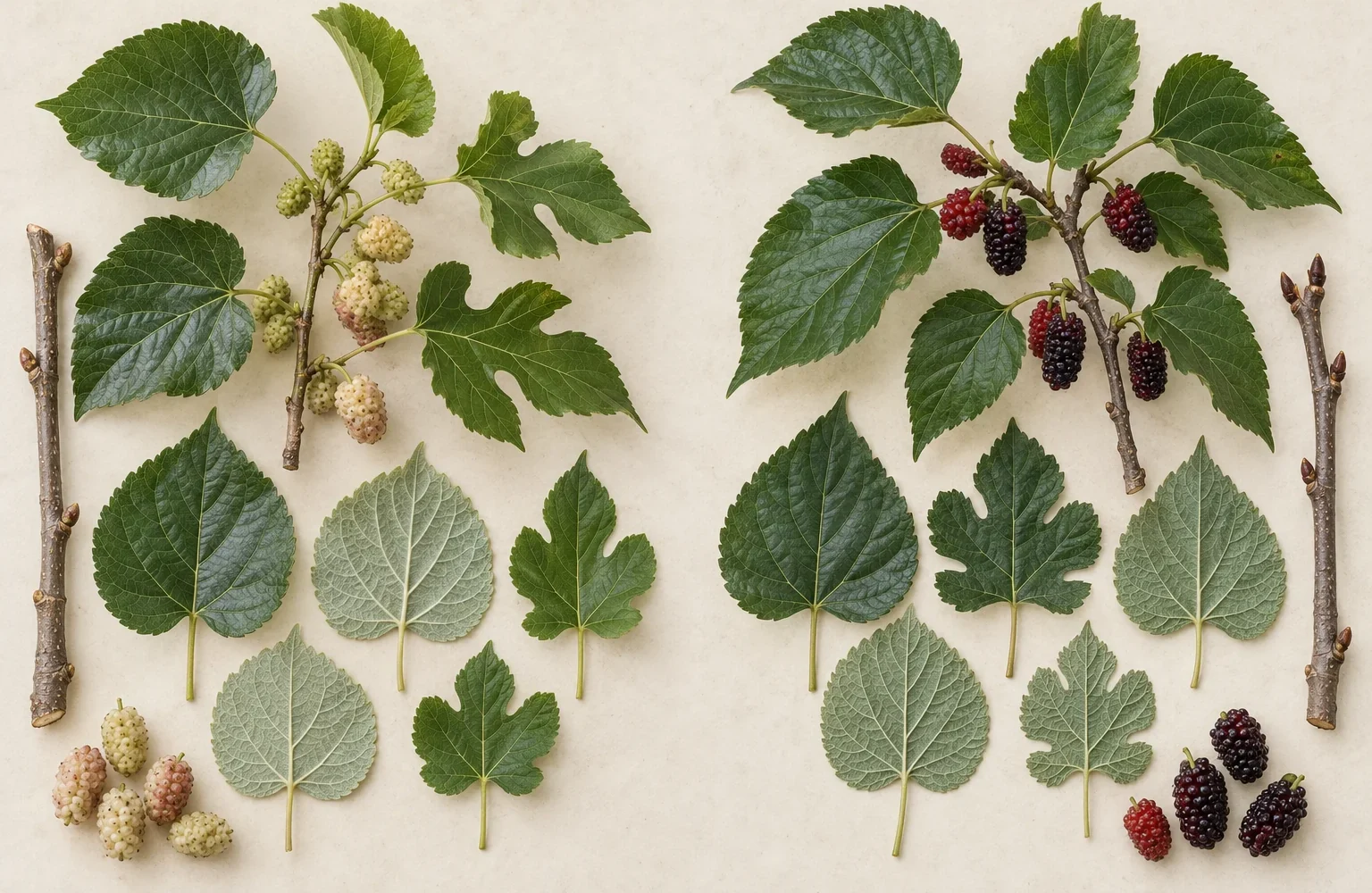
If you are comparing a red mulberry and a white mulberry, start with the leaves and bark rather than fruit color alone. Red mulberry (Morus rubra) usually has larger, rougher leaves with a fuzzy underside and scaly gray-brown bark. White mulberry (Morus alba) usually has smaller, shinier leaves, smoother undersides, and warmer tan bark with a braided look. The two species hybridize, so a field identification is sometimes only a best fit.
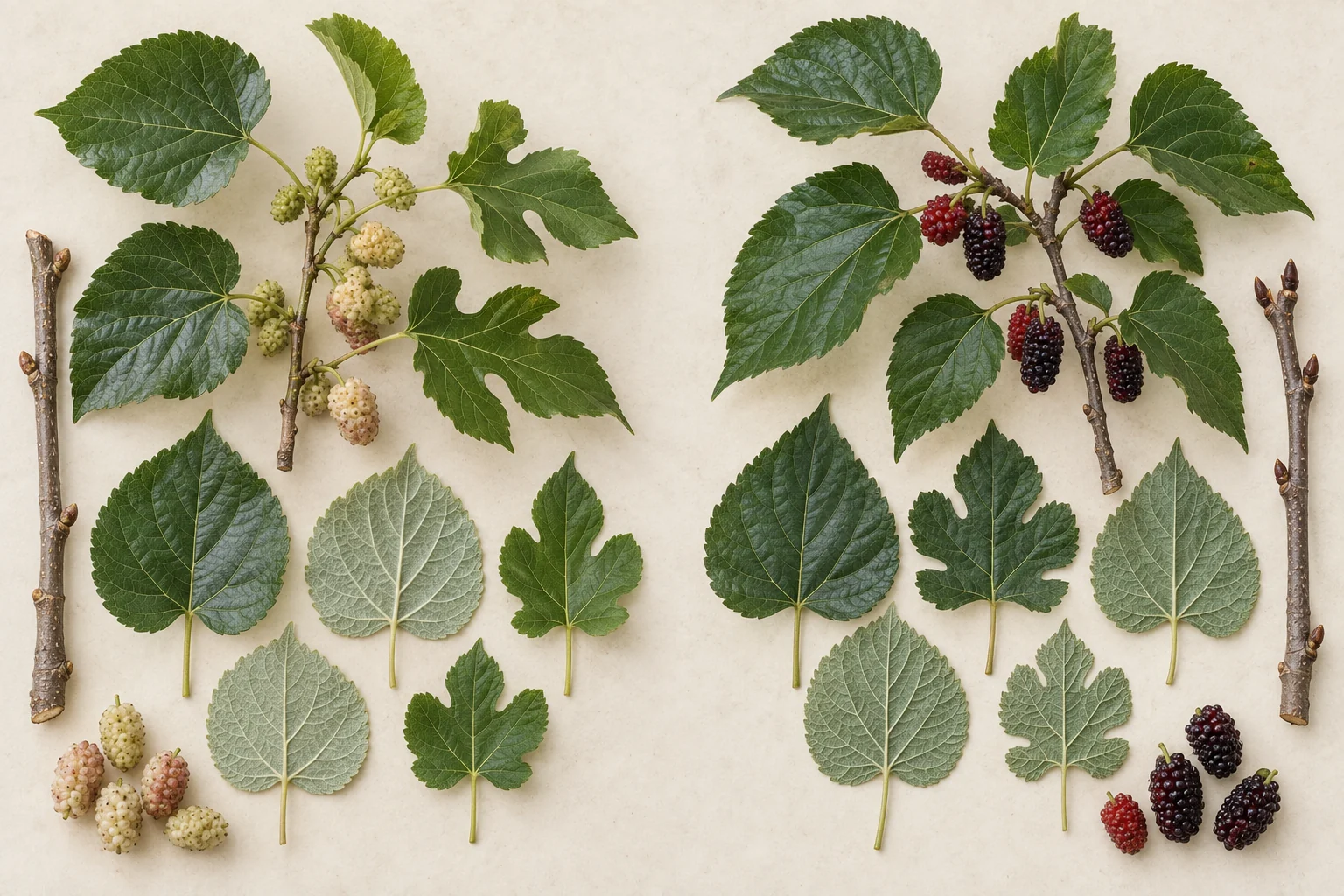
Red Mulberry vs. White Mulberry at a Glance
| Feature | Red mulberry (Morus rubra) | White mulberry (Morus alba) |
|---|---|---|
| Native range | Native to much of eastern and central North America | Introduced from Asia; naturalized widely in the United States |
| Leaf surface | Usually dull and sandpapery on top; underside often hairy | Usually smoother and shinier on top; underside mostly smooth |
| Leaf size | Often larger, commonly 4–10 inches long | Often smaller, commonly 3–4 inches long |
| Leaf shape | Unlobed or lobed, with a long pointed tip | Highly variable; lobed leaves are common on vigorous shoots |
| Bark | Gray-brown with flatter, scaly ridges | Tan to brown with rounded, braided-looking ridges |
| Ripe fruit | Usually dark red to purplish-black and relatively large | May be white, pink, red, purple, or nearly black |
| Typical habitat | Moist, mature woods and bottomlands | Disturbed ground, edges, roadsides, and landscapes |
How to Identify the Leaves
Look at several leaves from different parts of the canopy. Red mulberry leaves are commonly larger, thicker, and rough to the touch. Their underside may feel softly hairy, especially along the veins. White mulberry leaves are often bright green and glossy, with a smoother underside. Both trees can produce lobed and unlobed leaves, so a single leaf is weak evidence.

Compare the Bark and Growth Habit
Mature red mulberry bark tends to form flatter, scaly ridges over gray-brown bark. White mulberry bark is often warmer tan or brown, with ridges that look braided or interlaced. White mulberry trees also commonly have crooked or multiple trunks, while red mulberry is more likely to develop a straighter single trunk in a wooded setting. Young trees can be less distinctive, so use bark as supporting evidence.
Why Fruit Color Can Mislead You
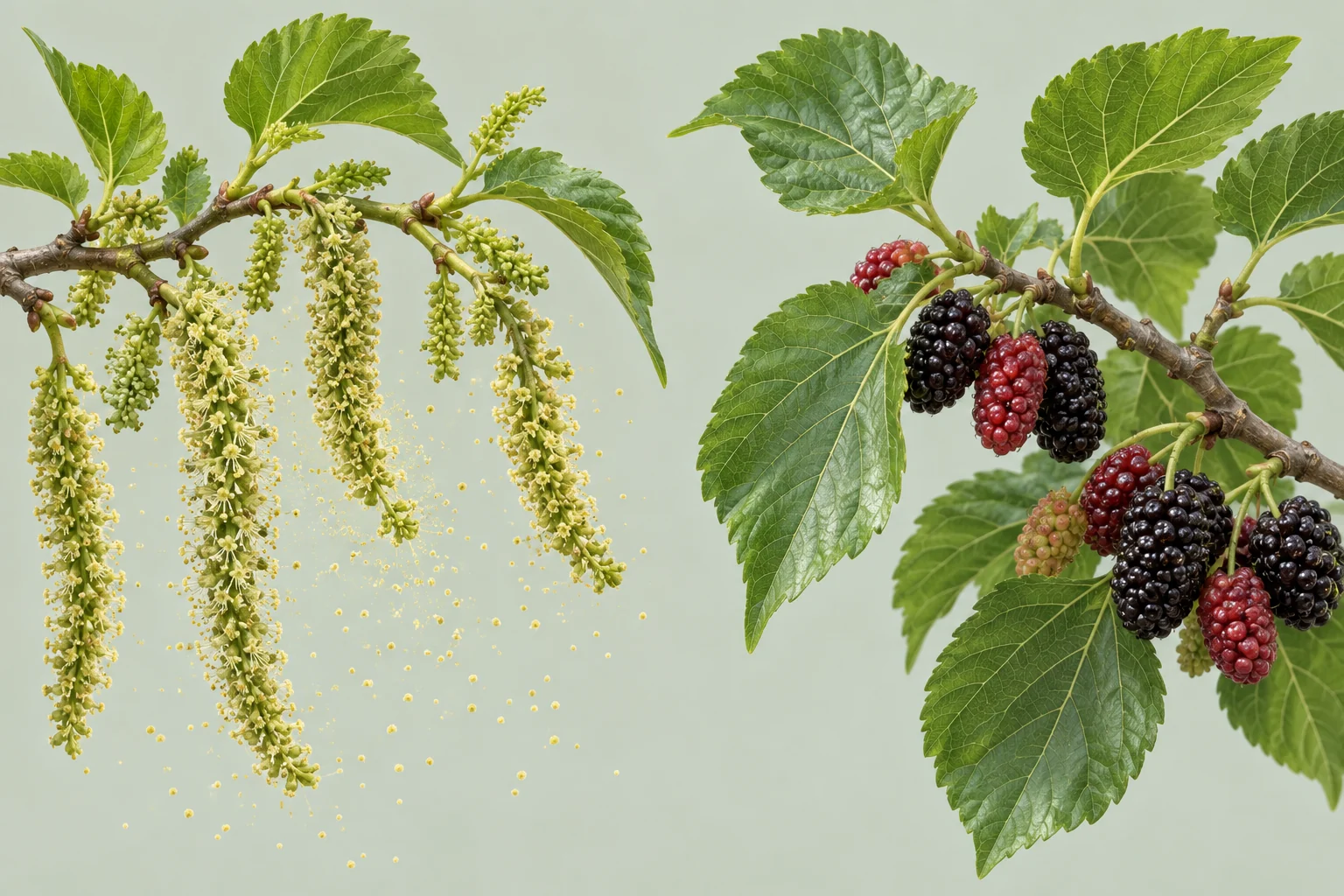
The common names do not reliably predict ripe fruit color. Red mulberry fruit is commonly dark red or purplish-black when ripe. White mulberry fruit can be white, pink, red, purple, or almost black. White mulberry fruit is often produced in more numerous clusters, while red mulberry fruit is frequently larger and more spaced along the twig. Taste is also variable and should not be used as the only identification test.
Native Status, Hybrids, and Planting Decisions
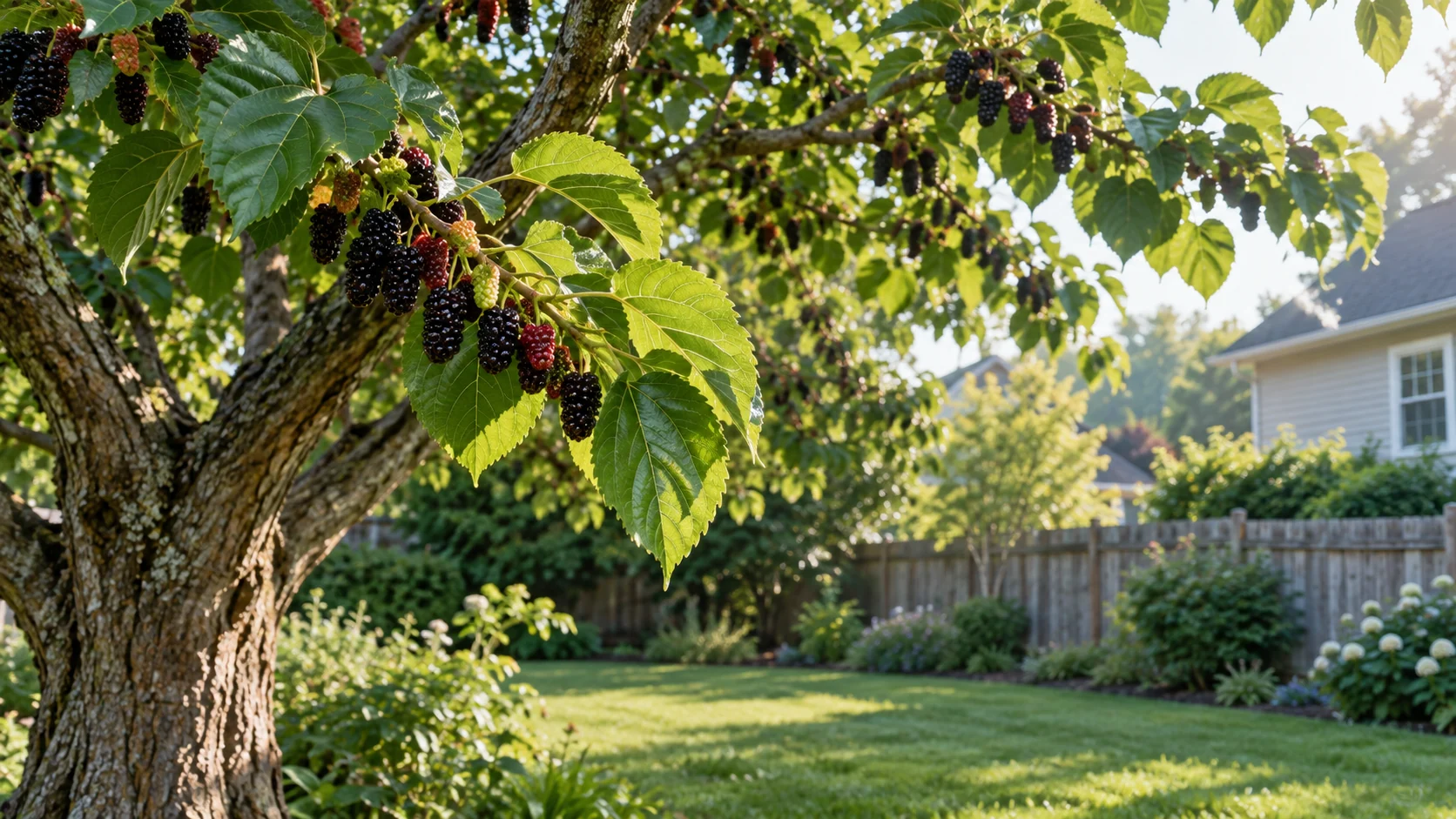
Red mulberry is a native North American tree with value for wildlife and a sweet, juicy fruit. White mulberry was introduced from Asia and is widely naturalized; it can compete with red mulberry and hybridize with it. In areas where the species overlap, intermediate trees are common. A local Extension office or botanist can help when the identification affects removal, conservation, or a planting decision.
For legal and local planting questions, see our guide to why mulberry trees are restricted in some places. Rules differ by state and city, and a comparison guide cannot determine the law at a particular address.
A Practical Field Checklist
- Photograph several mature leaves from the upper and lower surfaces.
- Feel the upper leaf surface and check the underside for hairs.
- Note whether the leaves are mostly large and pointed or smaller and glossy.
- Inspect mature bark for scaly ridges versus braided ridges.
- Record fruit size, clustering, and ripe color, but treat fruit as supporting evidence.
- Consider habitat and trunk form.
- If the features conflict, label the tree “possible hybrid” and seek local confirmation.
Bottom Line
Red mulberry is usually the better match when a tree has large, rough, hairy leaves, scaly gray bark, and larger dark fruit in a wooded habitat. White mulberry is more likely when leaves are glossy and smooth, bark is braided and tan, and fruit color varies widely on a fast-growing tree in a disturbed or landscaped setting. Because hybrids blur those patterns, combine several clues before deciding what you have.
Sources: Purdue Extension identification guide; Clemson Home & Garden Information Center; USDA Forest Service white mulberry review; Botanical comparison guide.

Ethan Miller
Ethan Miller writes about home improvement, interior design, cleaning, and everyday living at Home & Living Daily. He shares practical tips and simple ideas to help readers create more comfortable and functional homes.