Mulberry trees are not illegal throughout the United States. No federal law bans them nationwide, and the rules that do exist differ by location, species, and activity. Some Southwestern cities restrict mulberries under pollen-control ordinances. Separately, several states regulate white mulberry (Morus alba) as an invasive plant because it spreads readily and hybridizes with native red mulberry (Morus rubra). A rule against planting or selling a tree does not automatically require a homeowner to remove an established tree. To determine what applies at a particular address, check the exact state and local rules for planting, sale, transport, propagation, possession, and removal
Are Mulberry Trees Illegal in the United States
There is no nationwide prohibition on owning or growing every type of mulberry tree. Most relevant restrictions operate at the state, county, or city level, and their scope varies.
A city ordinance may prohibit planting any member of the genus Morus. A state invasive-plant rule may target only white mulberry. Another rule may regulate sales or transportation without requiring removal of trees already growing on private land. Public landscaping standards, nursery sales rules, homeowner association requirements, and tree-removal permits can also apply independently.
For that reason, statements such as “mulberry trees are illegal in Texas” or “mulberries are banned in Arizona” are too broad. A restriction in El Paso does not establish a statewide Texas ban, and a planting rule in one Arizona city does not determine what is legal in every other Arizona community.
The regulated action matters as much as the species:
| Informal claim | What the rule may actually mean |
| Mulberries are illegal | A city prohibits new planting |
| Mulberries are banned | Planting, sale, importation, or another named activity is restricted |
| White mulberry is illegal | A state regulates Morus alba as an invasive plant |
| You must remove the tree | Removal is required only if a separate rule or enforcement order says so |
Why Some Places Restrict Mulberry Trees
Allergenic pollen
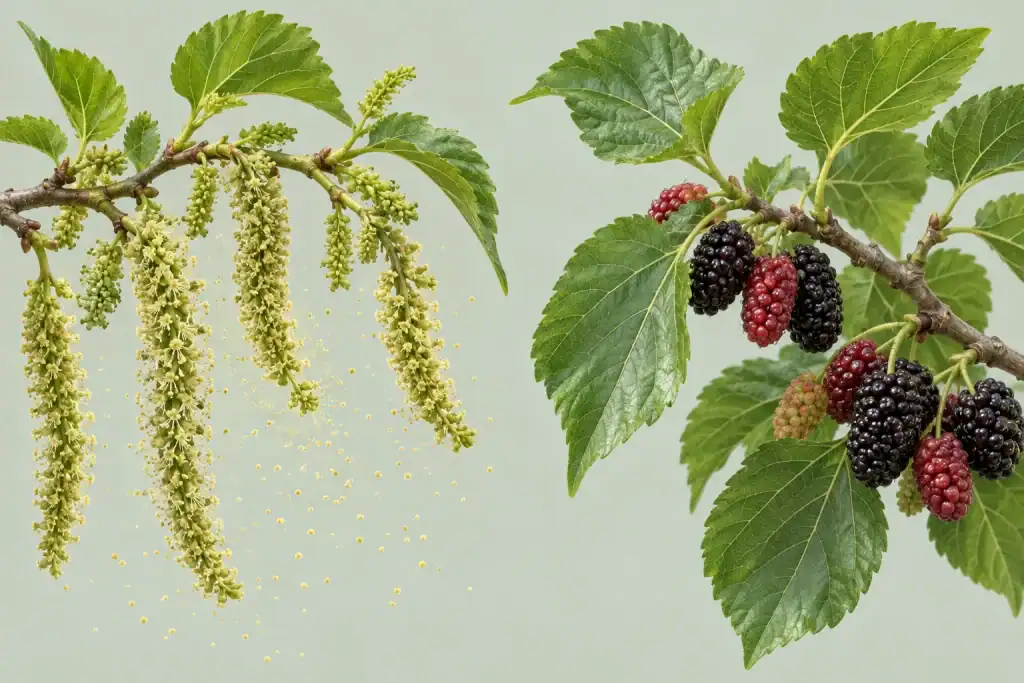
Mulberries may be regulated for pollen in dry, windy communities. Male flowers produce pollen, while female flowers generally produce fruit. “Fruitless” mulberry cultivars are commonly male, so a tree that does not make berries can still release pollen.
Albuquerque identifies mulberry as its highest measured tree-pollen producer in a table based on 14 years of local data. The city’s pollen-control ordinance prohibits the growing, sale, importation, and planting of all members of the genus Morus. This is a local public-health rule rather than a nationwide judgment about every mulberry tree. City of Albuquerque Restricted Trees for Pollen Control
The fruit itself does not create airborne pollen. Pollen comes from the male reproductive structures, and allergy risk can differ by species, cultivar, sex, exposure, and individual sensitivity.
Invasive white mulberry
White mulberry is native to Asia and was introduced to North America in connection with attempts to establish a silk industry. It now grows widely outside cultivation. Birds and other animals eat the fruit and disperse the seeds, allowing seedlings to establish along woodland edges, fence lines, roadsides, and other disturbed sites.
Not every state classifies white mulberry in the same way. Indiana prohibits a defined list of activities involving the species. Ohio restricts sale, propagation, distribution, importation, and intentional dissemination. Wisconsin classifies most white mulberry plants as Restricted but currently exempts male cultivars. These differences show why words such as invasive, prohibited, restricted, and noxious should not be treated as interchangeable.
Hybridization with native red mulberry
White mulberry can hybridize with red mulberry, a species native to much of eastern and central North America. University Extension sources describe concern that hybridization and competition may reduce genetically pure red mulberry populations. This ecological issue is one reason land managers discourage the spread of white mulberry. University of Maryland Extension
A restriction aimed at white mulberry does not automatically apply to red mulberry. However, visual identification can be difficult where the two species and their hybrids occur together. A homeowner making a planting or removal decision may need help from a local Extension office or qualified arborist.
Fruit and maintenance concerns
Fruiting mulberries can stain pavement, patios, and vehicles beneath the canopy. Birds spread the seeds, and volunteer seedlings may appear in unwanted locations. A large, fast-growing tree can also conflict with pavement, utilities, or nearby structures when it is planted in an unsuitable space.
These are legitimate landscape considerations, but they are not necessarily the stated legal basis for a particular ordinance. A city’s pollen rule should be described as a pollen rule unless the official source identifies additional reasons.
Which Mulberry Trees Are Restricted
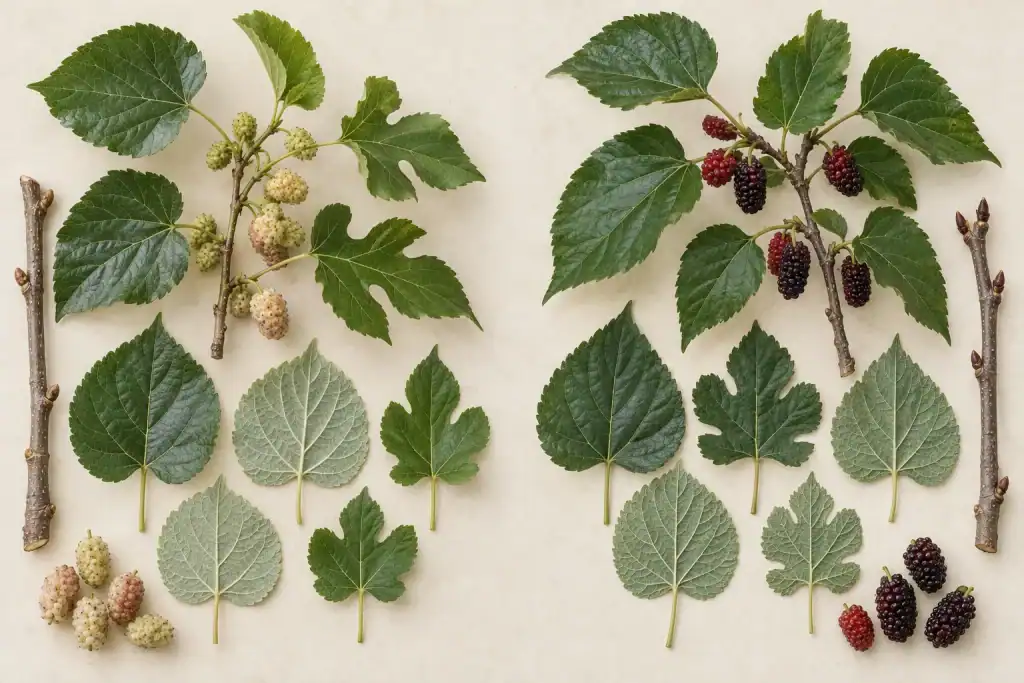
The common name “mulberry” covers several species with different ecological and legal status.
| Type | Scientific name | United States context | Main issue |
| White mulberry | Morus alba | Non-native and regulated in some states | Invasiveness and hybridization |
| Red mulberry | Morus rubra | Native to much of eastern and central North America | Conservation and misidentification |
| Black mulberry | Morus nigra | Non-native but less often central to U.S. restrictions | Local rules still apply |
The name white mulberry does not reliably describe fruit color. Its ripe fruit may be white, pink, red, or dark purple. Leaves also vary in shape, even on the same tree.
Mulberries are often described as dioecious, meaning male and female flowers occur on separate trees, but some individuals can bear both types of flowers. This biological variation is another reason not to infer legal status solely from whether a tree currently bears fruit.
Some ordinances avoid identification problems by regulating the entire Morus genus. Albuquerque does this. State invasive-plant rules, by contrast, may name only Morus alba and may include specific exceptions.
Verified Examples of Mulberry Restrictions
The following examples illustrate several different regulatory approaches. They are not a complete list of every state, county, city, development, or homeowner association rule.
| Location | Covered tree | Restricted activity | What the cited rule says about existing trees |
| Albuquerque New Mexico | All members of genus Morus | Growing, sale, importation, and planting are prohibited | The reviewed provision does not provide a simple homeowner exemption; confirm a specific existing tree with the city |
| El Paso Texas | Any mulberry tree | Planting and sale within the city are prohibited | The cited section does not create a general removal requirement |
| Apache Junction Arizona | Morus mulberry trees | Listed as prohibited noxious pollen producers under the land development code | The cited provision does not establish the status of every pre-existing private tree |
| Indiana | White mulberry Morus alba | Sale, gift, barter, exchange, distribution, transport, and introduction are illegal | The cited statewide rule does not state a general private-property removal duty |
| Ohio | White mulberry Morus alba | Sale, offer for sale, propagation, distribution, importation, and intentional dissemination are prohibited, subject to stated exceptions | The cited rule does not require every existing tree to be removed |
| Wisconsin | White mulberry Morus alba, with male cultivars currently exempt | Restricted plants generally may not be transported, transferred, or introduced without a permit | The current Restricted classification does not impose a general control duty on landowners |
Albuquerque New Mexico
Albuquerque’s ordinance is broader than a ban on male trees. Section 9-12-5 identifies all members of the genus Morus among the regulated trees for which growing, sale, importation, or planting is prohibited. The city also publishes a plain-language pollen-control page explaining that mulberries may not be planted within city limits. Albuquerque Pollen Control Ordinance
Because the ordinance uses the word growing, homeowners with an existing tree should not rely on a general internet statement that every old tree is automatically grandfathered. The city should be asked how the ordinance applies to the particular tree and property.
El Paso Texas
El Paso Code of Ordinances Section 9.10.010 states that, beginning September 1, 1992, it is unlawful to plant any mulberry tree or sell mulberry trees within the city. The section does not add propagation or transportation to that main prohibition. El Paso Code of Ordinances
This is a city rule, not a Texas-wide ban. The cited planting-and-sale section also does not, by itself, say that every established tree must be removed.
Apache Junction Arizona
Apache Junction lists Morus mulberry trees as prohibited plants and describes them as noxious pollen producers. Apache Junction Land Development Code
The cited provision supports the conclusion that the city prohibits these trees in the landscaping context covered by the code. It does not support a blanket statement that all existing trees are exempt. A property owner should confirm how the provision applies to an established tree or a proposed replacement.
Indiana
Indiana’s Terrestrial Plant Rule, 312 IAC 18-3-25, includes white mulberry. The Indiana Department of Natural Resources explains that it is illegal to sell, gift, barter, exchange, distribute, transport, or introduce listed plants in the state. Indiana Department of Natural Resources
This is broader than a commercial-sales restriction, but the cited rule does not say that every landowner must remove every existing white mulberry.
Ohio
Ohio Administrative Code Rule 901:5-30-01 lists Morus alba as an invasive plant. Except for the rule’s stated exceptions, a person may not sell, offer it for sale, propagate, distribute, import, or intentionally cause its dissemination in Ohio. The rule allows disposal, control, and approved research or educational use under specified conditions. Ohio Administrative Code
The Ohio rule does not justify describing all mulberries as illegal, and it does not establish a universal duty to remove every tree already present on private land.
Wisconsin
Wisconsin DNR currently classifies white mulberry as Restricted and expressly exempts male cultivars. For restricted plants, transport, transfer, or introduction generally requires a permit, while the classification does not create a general duty for landowners to control established plants. Wisconsin DNR White Mulberry
Wisconsin has also been conducting a rulemaking process to update NR 40. Anyone relying on this classification should check the current DNR rule page before buying, moving, or planting a tree. Wisconsin DNR NR 40
Can You Keep an Existing Mulberry Tree
A ban on new planting or nursery sales does not automatically create a duty to remove an established tree. At the same time, it is unsafe to assume that every older tree is grandfathered.
The answer depends on the words used in the applicable rule. An ordinance may regulate planting only, or it may also regulate growing, possession, maintenance, control, or removal. A separate nuisance code, tree-protection ordinance, permit requirement, property-line dispute, or homeowner association rule may also apply.
Before removing a mature tree, check both sides of the issue:
1. Does an invasive-plant or pollen ordinance regulate the tree?
2. Does a separate local rule require a permit or restrict removal?
3. Is the tree on private property, shared property, a right of way, or an HOA-controlled area?
4. Has the species been identified reliably?
5. Has the local authority issued any written guidance or enforcement notice?
This article provides general educational information. It cannot determine the legal requirements for a specific property.
How to Check the Rules Where You Live
Use the following process before buying, planting, moving, or removing a mulberry tree.
1. Identify the tree as closely as possible. Record the likely species, whether it bears fruit, and where it is growing.
2. Search both the city and county code for “mulberry” and “Morus.”
3. Check the state agriculture or natural-resources agency’s invasive, prohibited, restricted, or noxious plant list.
4. Identify the exact regulated action. Look for words such as plant, sell, import, transport, introduce, propagate, possess, grow, control, and remove.
5. Check whether the rule contains exceptions for existing plants, cultivars, research, disposal, or permitted activity.
6. Ask the relevant planning department, code-enforcement office, state agency, county Extension office, or qualified arborist to clarify ambiguous wording.
7. Save the current rule or written response before acting.
Useful searches include:
- “[city] municipal code mulberry”
- “[city] Morus planting ordinance”
- “[state] invasive plant list Morus alba”
- “[county] Extension mulberry tree”
What to Plant Instead
No single replacement tree is suitable throughout the United States. Climate, soil, available water, mature size, overhead and underground utilities, fruit drop, pollen, and local rules all matter.
A local University Extension office or native-plant organization can recommend trees appropriate for the region. When possible, choose a locally native species with a mature size suited to the planting space. Confirm that the replacement is not restricted and that its roots and canopy will have adequate room.
Frequently Asked Questions
Are mulberry trees illegal in the United States
No. There is no federal ban on all mulberry trees. Restrictions come from particular state or local rules and may cover only one species or one activity. A city may prohibit planting any mulberry, while a state may regulate only white mulberry sales, transport, propagation, or introduction.
Are mulberry trees illegal in Texas
Not statewide. El Paso prohibits planting or selling mulberry trees within the city, but that municipal ordinance does not establish a Texas-wide prohibition. Check the city and county code that applies to the property.
Are mulberry trees illegal in Arizona
There is no blanket statewide ban on every mulberry established by the sources cited here. Apache Junction prohibits mulberries in the landscaping context addressed by its code, and other Arizona jurisdictions may have their own pollen-control rules. Verify both city and county requirements.
Is white mulberry illegal
It depends on the state and activity. Indiana, Ohio, and Wisconsin regulate white mulberry, but their rules are not identical. Indiana prohibits several forms of transfer and introduction. Ohio prohibits sale, propagation, distribution, importation, and intentional dissemination. Wisconsin currently classifies the species as Restricted while exempting male cultivars.
Are red mulberry trees illegal
Red mulberry is native to much of eastern and central North America and is not the target of the state white-mulberry rules discussed above. A local ordinance that covers the entire Morus genus may still restrict red mulberry planting.
Can I keep a mulberry tree already growing in my yard
Possibly. A rule against new planting or sale does not automatically require removal, but some rules use broader terms. Check the ordinance, any invasive-plant requirements, and separate tree-removal or nuisance provisions before assuming the tree is grandfathered.
Are mulberries safe to eat
Ripe fruit from correctly identified white, red, and black mulberry trees is generally considered edible. Avoid unripe fruit and the milky sap, which Extension and U.S. Forest Service sources associate with stomach upset and other adverse effects. Do not eat fruit from a tree that has not been identified confidently or may have been exposed to contaminants. U.S. Forest Service
Sources
- City of Albuquerque Restricted Trees for Pollen Control
- Albuquerque Pollen Control Ordinance
- El Paso Code of Ordinances Chapter 9.10
- Apache Junction Land Development Code
- Indiana Department of Natural Resources Terrestrial Invasive Plants
- Ohio Administrative Code Chapter 901 5 30
- Wisconsin DNR White Mulberry
- Wisconsin DNR NR 40
- University of Maryland Extension White Mulberry
- U.S. Forest Service White Mulberry Species Review

Ethan Miller
Ethan Miller writes about home improvement, interior design, cleaning, and everyday living at Home & Living Daily. He shares practical tips and simple ideas to help readers create more comfortable and functional homes.