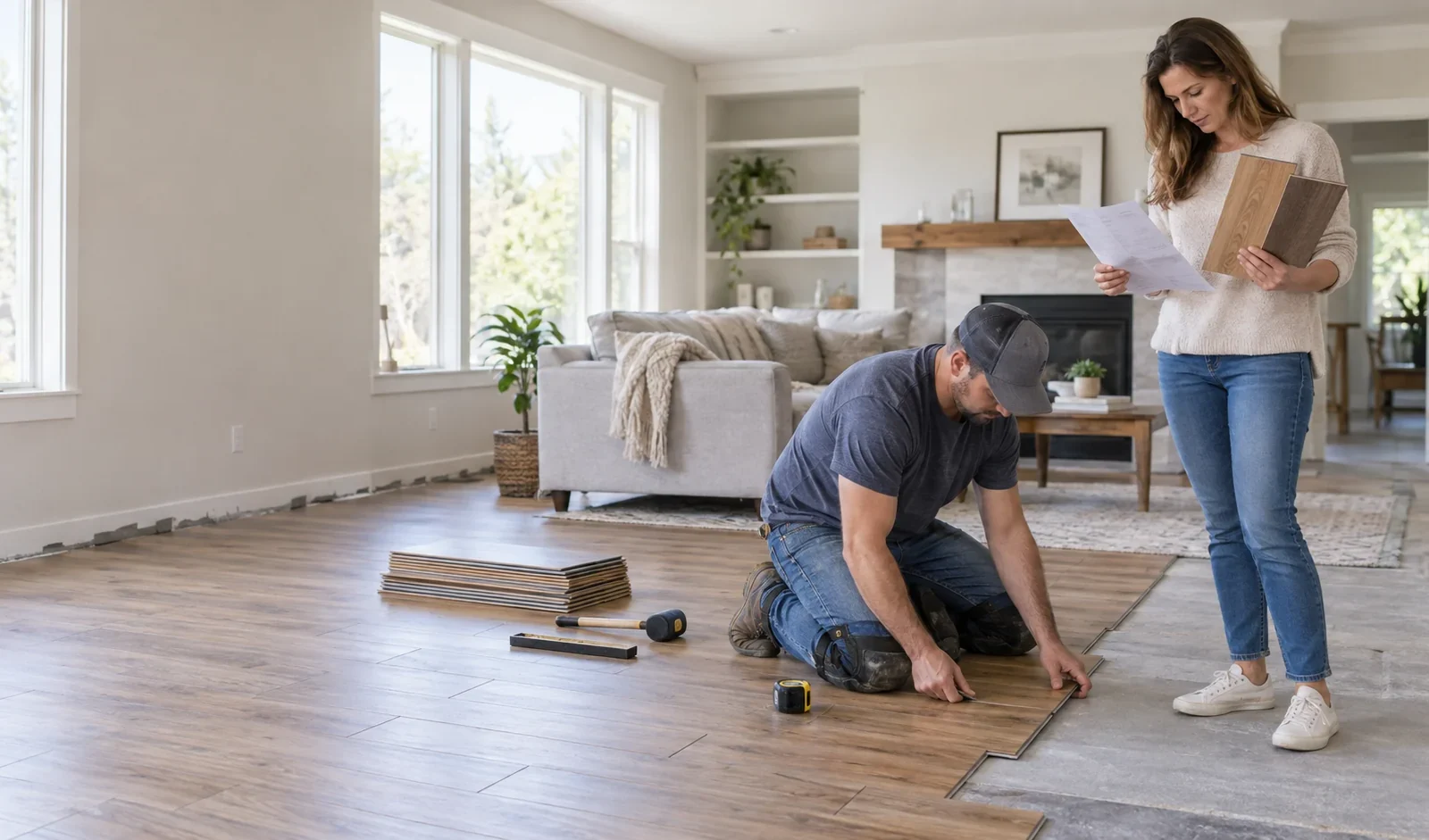
Most U.S. homeowners can expect to pay roughly $4 to $9 per square foot for professionally installed luxury vinyl plank (LVP), covering the planks and basic floating installation over a flat, sound subfloor. A straightforward 500-square-foot project may cost about $2,000 to $4,500. Projects that require hardwood or tile removal, extensive subfloor work, new trim, or stair installation can exceed $8,000. Material grade, installation method, and floor preparation create most of the difference between a low quote and a high one.
Pricing sources reviewed September 29, 2026. Published ranges were cross-checked across national cost guides, installer pages, retail material listings, and federal wage data. The ranges below are budgeting guides, not contractor quotes.
How Much Does LVP Installation Cost?
Published 2026 guides cluster around similar numbers, though they define “installed” differently. Basic-to-mid-range installed ranges such as $4 to $8, $3 to $9, and $4.50 to $12 per square foot appear across cost guides, with wider ranges (up to $13 to $16) when removal, prep, and premium products are bundled in. Because definitions differ, this guide separates four numbers instead of averaging them:
| Cost type | Typical range (per sq ft) | What it includes |
| Material only | $1.50 to $7.00 | Planks (budget to premium); excludes waste, labor, trim |
| Labor only | $1.50 to $5.00 | Basic floating installation on a prepared floor |
| Basic installed | $4.00 to $9.00 | Planks + labor + basic supplies, flat subfloor, no removal |
| Installed cost with common add-ons | $6.00 to $14.00+ | Basic installed + removal, prep, trim, furniture moving |
Not every project requires all of these add-ons. Old flooring removal, significant subfloor repair, stairs, and complex patterns are usually not included in a basic installed price, so ask for them as separate line items. Sources (accessed September 29, 2026): Carpet Exchange, RealCost, Estimators.us, NEDES Estimating, Right Step Flooring, TRU Installation.
LVP Installation Cost per Square Foot
You will see $4, $8, and $14 per square foot all quoted as “the” LVP price because they answer different questions: $4 is often a budget plank with basic labor, $8 a mid-range plank with typical labor, and $14 a premium plank with removal and prep bundled in. A retail shelf price is never an installed price.
| Tier | Material (per sq ft) | Typical basic installed | Best for |
| Budget | $1.50 to $2.50 | $3.50 to $5.00 | Low-traffic rooms, rentals, short-term updates |
| Mid-range | $2.50 to $4.50 | $5.00 to $8.00 | Most family homes |
| Premium | $4.50 to $7.00+ | $7.00 to $12.00 | High-traffic areas, pets, design-driven projects |
Material tiers follow D&G Flooring’s 2026 price ranges and McMillan Floors. Installed columns add typical labor of $1.75 to $4.00 and 10% waste (accessed September 29, 2026).
Material Cost per Square Foot
Four features drive plank pricing:
- Wear layer. The clear protective top coat is measured in mil (one thousandth of an inch). It is not the same as millimeters. A 20 mil wear layer is about half a millimeter thick, while total plank thickness is usually quoted in mm.
- Core. SPC (stone-polymer composite) cores are denser, harder, and generally more dimensionally stable, while WPC (wood-polymer composite) cores are thicker, softer, and quieter underfoot. Published sources disagree on which costs more, and wear layer, brand, design, and attached backing often matter more than core type alone.
- Attached underlayment. Planks with a pad already attached can cost more per box but may save a separate underlayment purchase.
- Texture and design. Embossed-in-register textures, wider planks, and more varied prints raise the price.
Labor Cost per Square Foot
Most published sources place basic professional labor between about $1.50 and $4.00 per square foot, with some contractor price sheets reaching $5.00 in high-cost metros or complex rooms. Rates depend on regional wages, minimum project charges on small jobs, and room complexity: closets, many doorways, diagonal cuts, and transitions all add time.
For wage context, U.S. Bureau of Labor Statistics data reports a mean hourly wage of about $29.69 for floor layers (SOC 47-2042) in May 2025 (BLS OEWS May 2025 national table). That is what employers pay workers, not what homeowners pay contractors. A contractor’s quote also covers overhead, insurance, vehicles, tools, and profit.
What Is Included in an Installed Price
Never compare a single per-square-foot number without checking this list:
- Measurement and estimate visit
- Delivery
- Waste allowance (commonly 5% to 15%)
- Installation labor
- Adhesive (glue-down only) and underlayment or vapor barrier, if needed
- Transitions, baseboard or quarter round
- Furniture and appliance moving
- Old flooring removal and disposal
- Sales tax
LVP Cost by Quality and Construction
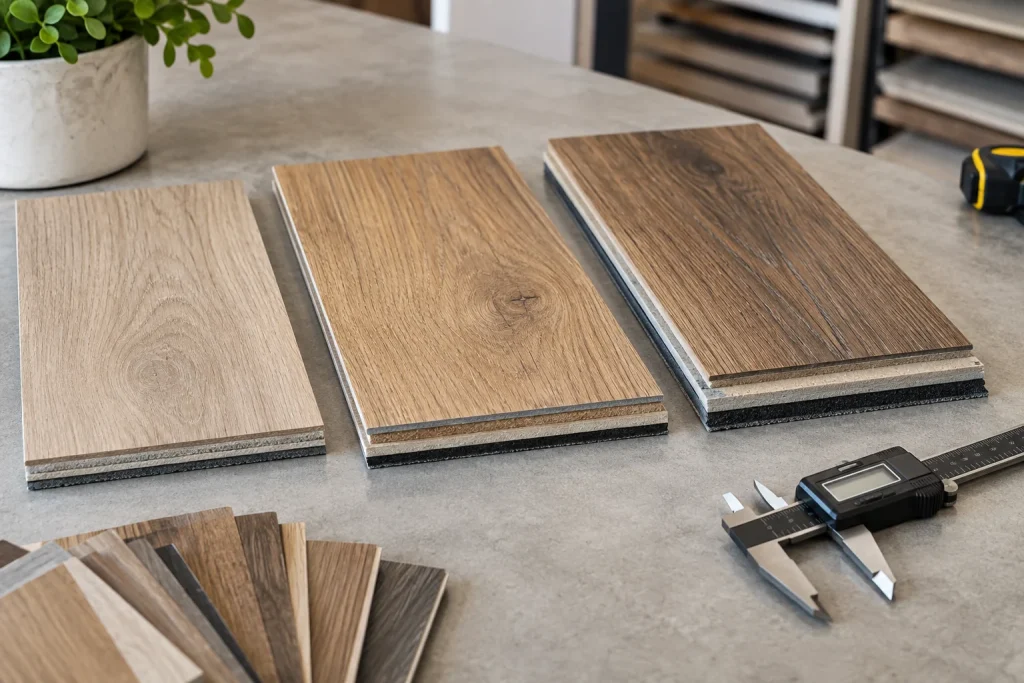
| Feature | Budget | Mid-range | Premium / commercial |
| Material price | $1.50 to $2.50 | $2.50 to $4.50 | $4.50 to $7.00+ |
| Wear layer | Roughly 6 to 12 mil | Roughly 12 to 20 mil | 20 mil and up |
| Core | Often flexible PVC or entry WPC | SPC or WPC | Rigid SPC |
| Suited to | Bedrooms, rentals | Kitchens, living areas, most homes | Busy homes, pets, commercial-style use |
Source: D&G Flooring, RealCost (accessed September 29, 2026). Warranty length is not the same as expected lifespan, so treat it as one input, not a promise.
Budget LVP
A fit for low-traffic rooms or short-term updates. Watch for thin wear layers, weaker locking systems, and greater sensitivity to an uneven subfloor.
Mid-range SPC or WPC LVP
The reference tier for most household budgets. The trade-offs are between feel underfoot (WPC is softer), dent resistance and stability (SPC is denser), and wear layer thickness.
Premium and Commercial LVP
A higher price should map to something verifiable: a thicker wear layer, published certifications, a more stable core, better design quality, or stronger warranty terms. “Luxury” on the label alone is not a specification.
Installation Cost by Method
| Method | Labor impact | Notes |
| Floating click-lock | Lowest | DIY-friendly; needs flat subfloor and proper expansion gaps |
| Glue-down | Roughly $0.50 to $1.00 more per sq ft in labor | Adhesive, rolling, cure time; harder to remove later |
| Peel-and-stick vinyl plank | Low | A different, thinner product category, not equivalent to rigid-core LVP |
Glue-down labor premium from NEDES Estimating (accessed September 29, 2026).
Cheaper material does not automatically mean a cheaper finished floor: glue-down labor and prep can outweigh a lower plank price. Choose by space: floating suits most residential rooms, glue-down suits large continuous areas or heavy rolling loads, and peel-and-stick suits temporary or very low-demand spaces.
LVP Installation Cost by Project Size
All examples use one set of assumptions: 10% waste on materials, labor charged on net area, and no removal, subfloor work, stairs, trim, or tax. Low = $2.00 material + $1.75 labor; Mid = $3.50 + $3.00; High = $5.50 + $4.00 per sq ft.
| Net area | Low | Mid | High |
| 100 sq ft | $395 | $685 | $1,005 |
| 200 sq ft | $790 | $1,370 | $2,010 |
| 500 sq ft | $1,975 | $3,425 | $5,025 |
| 1,000 sq ft | $3,950 | $6,850 | $10,050 |
| 1,500 sq ft | $5,925 | $10,275 | $15,075 |
| 2,000 sq ft | $7,900 | $13,700 | $20,100 |
Calculated from the assumptions above; unit prices are drawn from the material and labor ranges in this guide. Very small jobs often hit a contractor’s minimum charge, so the 100 and 200 sq ft low figures may not be achievable in practice.
Worked Example for a 500 Square Foot Project
Formula: material cost = net area × (1 + waste) × material price; labor = net area × labor rate; add removal, prep, and extras separately.
Net area 500 sq ft; 10% waste gives 550 sq ft to order.
| Line item | Low | Mid | High |
| Material (550 sq ft) | $1,100 ($2.00) | $1,925 ($3.50) | $3,025 ($5.50) |
| Labor (500 sq ft) | $875 ($1.75) | $1,500 ($3.00) | $2,000 ($4.00) |
| Old floor removal | $0 | $500 (carpet, $1.00) | $1,500 (hardwood, $3.00) |
| Subfloor prep | $0 | $300 (patching allowance) | $500 (leveling 250 sq ft at $2.00) |
| Underlayment / vapor barrier | $0 (attached) | $0 (attached) | $250 ($0.50) |
| Trim and transitions | $150 | $400 | $800 |
| Furniture moving | $0 | $150 | $250 |
| Total (before tax) | $2,125 | $4,775 | $8,325 |
| All-in per sq ft | $4.25 | $9.55 | $16.65 |
These are scenarios, not forecasts. Tile removal, major subfloor repair, or stairs would push the high case higher.
Additional and Hidden LVP Installation Costs
| Item | Typical cost | When it applies |
| Carpet removal | $0.50 to $1.50/sq ft | Replacing carpet |
| Laminate / floating floor removal | $1 to $3/sq ft | Replacing click-together floors |
| Sheet or glued vinyl removal | $1 to $4/sq ft | Adhesive scraping adds time |
| Hardwood removal | $2 to $4/sq ft | Glued-down costs more than nailed |
| Tile removal | $2 to $7/sq ft | Thinset and heavy debris |
| Self-leveling / leveling | $1 to $3/sq ft | Uneven slab or subfloor |
| Plywood underlayment | $1 to $2/sq ft | Damaged or uneven wood subfloor |
| Underlayment (if not attached) | about $0.25 to $0.75/sq ft | Depends on product |
| Concrete moisture testing | $100 to $300 | Slabs and below-grade rooms |
| Baseboard | $1 to $3/linear ft | Replacing or adding |
| Transitions | T-molding $10 to $25; reducers $8 to $20 each | Doorways and floor changes |
| Furniture moving | $50 to $150/room | If not included |
| Stair work | See the stairs section below | Priced per finished step |
Sources (accessed September 29, 2026): removal from ProjectCalcs, Dropcurb, Dropcurb hardwood, Angi laminate, Angi tile and Homewyse; leveling, moisture testing and furniture from NEDES Estimating; plywood, trim, transitions and furniture from D&G Flooring; underlayment from Really Cheap Floors. Costs vary widely by market.
Old Flooring Removal and Disposal
Carpet and floating floors sit at the low end. Tile, glued hardwood, and adhesive-heavy vinyl cost more because of slower work and heavier debris. In homes built before 1980, ask about testing before removing old resilient flooring or adhesive. Many contractors bill removal separately from installation, so confirm whether it is in the quote.
Subfloor Preparation and Moisture Work
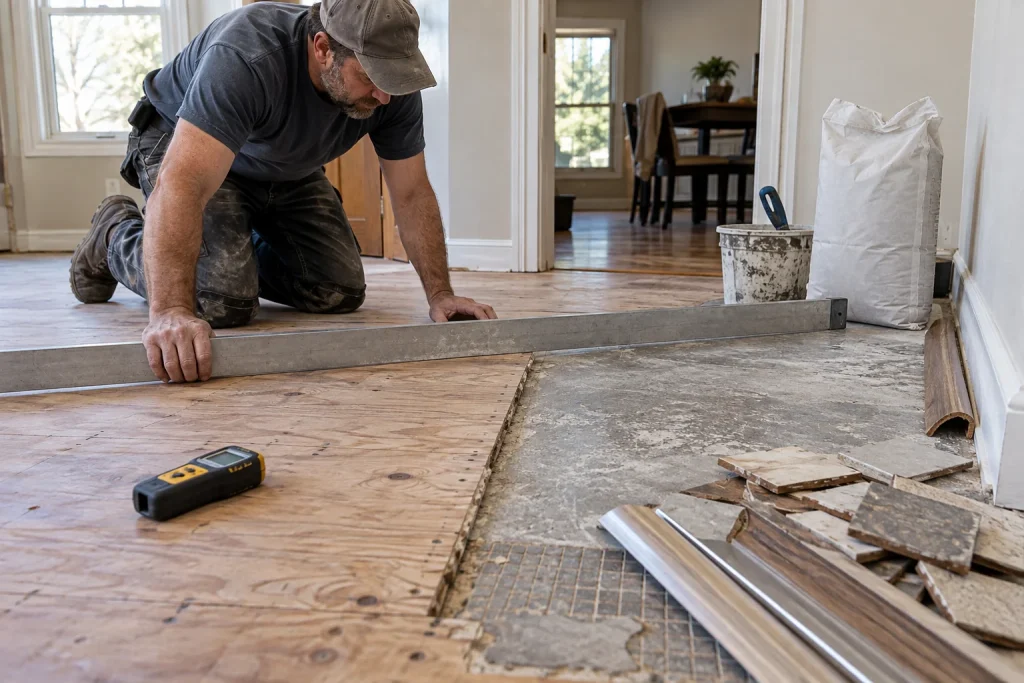
This is the most common source of budget surprises and the easiest item for a low bid to leave vague. Installation instructions for rigid-core click products we reviewed specify a subfloor flat to 3/16 inch over 10 feet, with one also requiring 1/32 inch over 1 foot (rigid-core click instructions; click-lock SPC instructions). Exact tolerances vary by product and pattern, so check the installation guide for the flooring you are buying. Concrete slabs, basements, and bathrooms may also need moisture testing.
Underlayment and Vapor Barrier
An attached pad does not automatically remove the need for a vapor barrier over concrete. For example, one click-lock SPC manufacturer’s instructions recommend a taped 6-mil plastic sheet over concrete before installing (installation instructions). Requirements depend on the product and site conditions, and the manufacturer’s instructions also govern the warranty.
Trim, Transitions, Doors, and Furniture
Budget for baseboard or quarter round, reducers or T-molding at doorways, door jamb undercutting so planks can slide underneath, and moving furniture and appliances.
Stairs and Custom Layouts
Stairs are priced per finished step (tread, riser, and stair nose), not by floor square footage, and they are labor-intensive. Published labor-only figures vary widely, from roughly $30 to $75 per step in one guide to $40 to $100 in another. Complete packages cost substantially more: published estimates put a 12 to 16 step staircase at roughly $800 to $3,500 installed, depending on prep, nosing, and finish. Compare quotes by the complete cost per finished step, and confirm what is included.
Diagonal and herringbone layouts add cutting time and can raise waste by roughly 10% to 15%. Small closets and many doorways add labor too.
Stair sources (accessed September 29, 2026): Really Cheap Floors, D&G Flooring stair nose guide, D&G Flooring stair tread guide, LatestCost.
DIY vs Professional LVP Installation
DIY is not free labor. Add tools (utility knife, spacers, tapping block, saw), extra waste from mistakes, your time, and the risk of rework or voided warranty terms.
| Factor | DIY | Professional |
| Labor | $0 cash, but your time | Roughly $1.50 to $5.00/sq ft |
| Tools | Buy or rent | Included |
| Waste | Often higher | Usually lower |
| Warranty | Risk if instructions missed | Workmanship warranty possible |
DIY suits small, square rooms with a flat subfloor and click-lock planks. Hire a professional for stairs, glue-down, uneven floors, moisture concerns, or large areas.
How to Evaluate an LVP Installation Quote
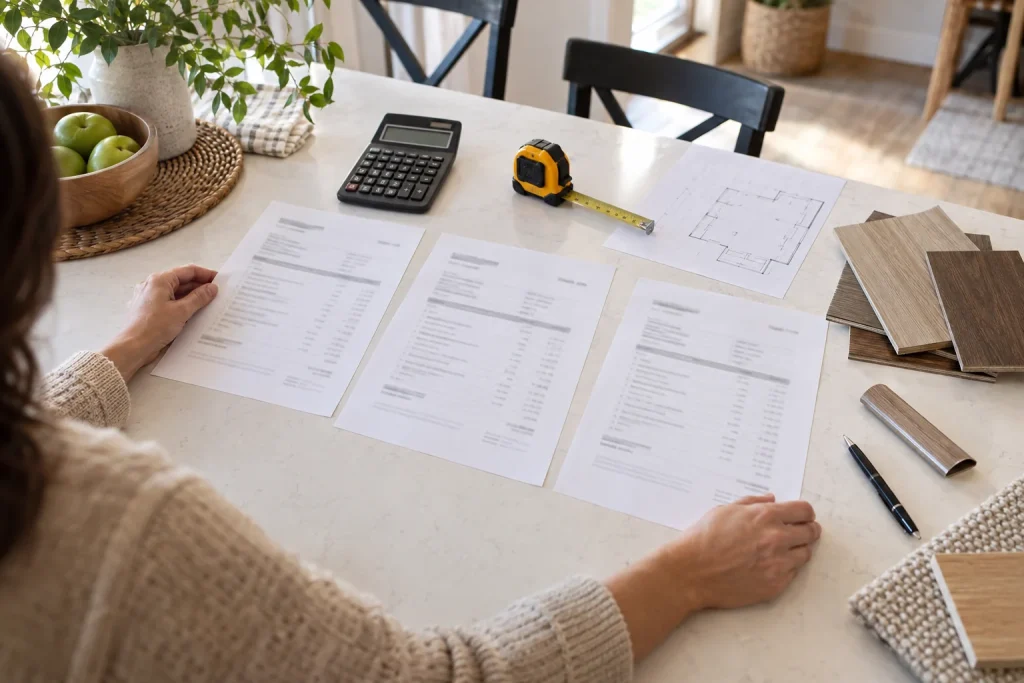
Get at least three itemized quotes with the same scope, and compare line by line, not just total price.
What a Complete Quote Should Include
- Square footage measured, with net area and order area shown separately
- Exact product name and model, box count, and waste percentage
- Installation method
- Subfloor scope and who pays if problems are discovered
- Removal and disposal
- Trim, transitions, stairs
- Delivery, tax, schedule
- Workmanship warranty and payment terms
Red Flags in a Low Bid
- No site measurement
- No product model listed
- Vague “subfloor allowance”
- Removal or disposal not addressed
- Unusually large cash deposit
LVP Cost Compared With Other Flooring
| Flooring | Installed cost vs. LVP | Water tolerance | Repair | Feel |
| Carpet | Usually lower | Poor | Patch or replace | Softest, warmest |
| Laminate | Often similar or lower | Sensitive to standing water at seams | Replace planks | Hard, can sound hollow |
| LVP | Baseline | Water-resistant surface; seams and subfloor still matter | Replace planks | Slightly soft, quiet |
| Engineered hardwood | Usually higher | Limited | Limited refinishing | Real wood |
| Solid hardwood | Usually higher, widest range | Limited | Can be refinished | Real wood |
| Porcelain tile | Wide range, often higher installed | Excellent | Cracked tile and grout repair | Hard, cold |
Published installed ranges for other flooring disagree widely because sites define “installed” differently. Guides we reviewed put laminate at about $3 to $14 per square foot, engineered hardwood at about $6 to $20, and solid hardwood at roughly $6 to $25, so treat any single figure with caution and compare like-for-like quotes.
Sources (accessed September 29, 2026): HomeGuide, CostPrism, NerdWallet, Cost to Renovate.
LVP is not always the best choice: hardwood can be refinished, tile can outlast most floors, and carpet is comfortable in bedrooms. Compare on moisture, repairability, feel, and lifespan, not price alone.
How to Save Money Without Cutting the Wrong Costs
- Measure accurately and order sensible waste (5% to 10% for simple rooms, more for diagonal layouts).
- Schedule connected rooms together to spread mobilization costs.
- Ask for the subfloor line item to be split out, not hidden in a lump sum.
- Handle low-risk prep yourself: clear the room, remove baseboards carefully, pull carpet.
- Buy materials from a source with a clear return policy on unopened boxes.
Do not skip moisture testing, leveling, or the expansion gaps your product requires. Those shortcuts cause failures that cost more than they save.
LVP Installation Cost Worksheet
Use this worksheet to build your own budget range. Fill in your measurements and the unit prices from your quotes, and compare the result with the ranges above.
| Line | Formula | Your number |
| Net area (sq ft) | Length × width of each room, added together | |
| Order area (sq ft) | Net area × (1 + waste), using 5%, 10%, or 15% | |
| Material cost | Order area × price per sq ft | |
| Installation labor | Net area × labor rate (add $0.50 to $1.00 for glue-down) | |
| Old floor removal | Net area × removal rate for your floor type | |
| Subfloor prep | Affected area × leveling or repair rate | |
| Underlayment / vapor barrier | Net area × rate, if not attached | |
| Trim and transitions | Linear feet of baseboard + number of transitions | |
| Stairs | Number of steps × complete cost per finished step | |
| Furniture moving | Rooms × rate, if charged | |
| Total before tax | Add all lines | |
| All-in cost per sq ft | Total ÷ net area |
Run the worksheet three times (low, middle, and high unit prices) to get a range rather than a single number. It is a planning tool, not a contractor quote.
Frequently Asked Questions
How much does it cost to install 1,000 square feet of LVP?
Using the assumptions above, basic installed cost runs about $3,950 to $10,050 for 1,000 net square feet, with $6,850 as a mid case. Removal, subfloor work, trim, and stairs add to that.
How much does LVP installation labor cost per square foot?
Most sources place basic labor at about $1.50 to $4.00 per square foot, sometimes up to $5.00 in high-cost areas or complex rooms. Glue-down, stairs, and small rooms usually cost more.
Is it cheaper to install LVP yourself?
Usually in cash, yes, since you save labor, but tools, extra waste, time, and possible rework reduce the savings. Simple click-lock rooms suit DIY; stairs, glue-down, and problem subfloors usually do not.
Does LVP need underlayment?
Not always. Many planks have an attached pad, and some manufacturers prohibit adding another. Concrete or crawlspace installations may still need a vapor barrier. Follow the manufacturer’s instructions.
How much does it cost to install LVP on stairs?
Labor-only stair pricing varies widely, and complete tread, riser, nosing, and finishing packages cost substantially more. Published estimates for a 12 to 16 step staircase run roughly $800 to $3,500 installed. Compare quotes by the complete cost per finished step.
How much waste should I add when ordering LVP?
About 5% to 10% for simple layouts and up to 15% for diagonal, herringbone, or many-cut rooms. Check your product’s guidance and buy from the same lot.
Is LVP cheaper than laminate or hardwood?
LVP typically costs more than basic carpet and often overlaps with laminate, while usually costing less than engineered or solid hardwood. Product tier and installation conditions matter more than the category label.
Methodology and Sources
Pricing sources reviewed September 29, 2026. Scope: U.S. national ranges, residential, floating click-lock as the base case. Included: planks, basic labor, and the add-ons listed. Excluded: sales tax, permits, asbestos or lead abatement, structural repairs.
We compared published national cost guides, installer and contractor price pages, retailer material ranges, removal-cost pages, manufacturer installation instructions, and U.S. Bureau of Labor Statistics wage data. Where sources disagree (for example, basic installed ranges from $3 to $9 up to $4.50 to $12), we kept the difference and explained the definitions instead of averaging. Forum posts were not used as national price evidence. Most price sources are secondary; we did not collect ZIP-code-specific retail prices or itemized contractor quotes, so treat every range as a starting point and get local written quotes.

Ethan Miller
Ethan Miller writes about home improvement, interior design, cleaning, and everyday living at Home & Living Daily. He shares practical tips and simple ideas to help readers create more comfortable and functional homes.